President Trump isn’t going to like this.
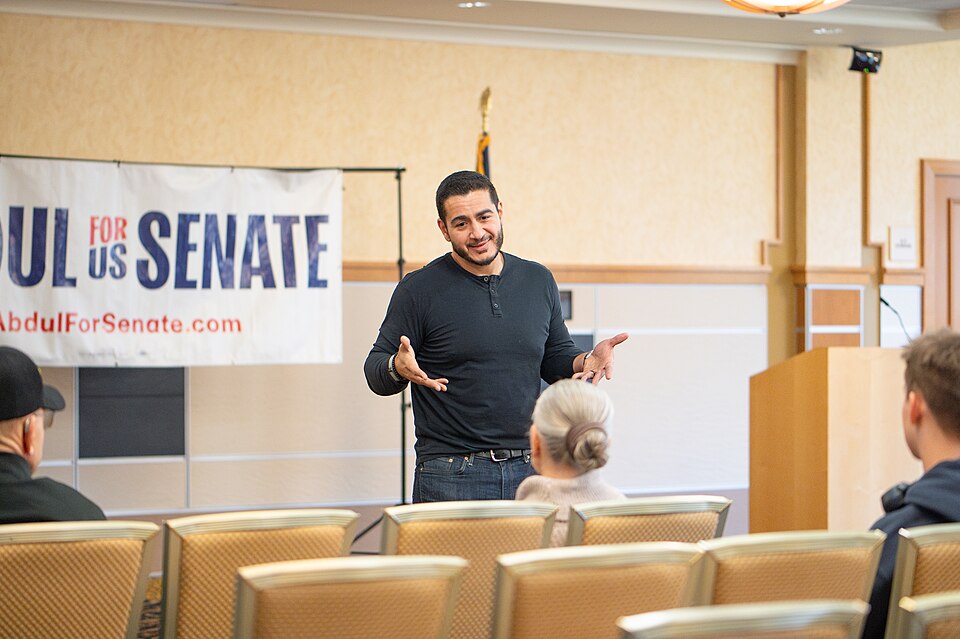
Michigan U.S. Senate candidate Abdul El-Sayed is facing fresh criticism after his campaign posted an altered image involving first lady Melania Trump and White House aide Natalie Harp, adding another controversy to an increasingly heated political battle.
The social media attack came only days after El-Sayed sparked a separate backlash over remarks involving second lady Usha Vance.
Now, critics are questioning why the Michigan candidate’s campaign continues to bring the wives of prominent Republican leaders into its political attacks.
El-Sayed Campaign Takes Aim at Melania Trump
The latest controversy unfolded as President Donald Trump and Canada remained locked in a tense political and trade dispute.
After Trump ordered Lake Ontario renamed “Lake America,” El-Sayed’s campaign jumped into the debate on X.
“If we’re just renaming everything now… When are we making this official?” the campaign wrote.
The post included a doctored version of Melania Trump’s official White House webpage.
Melania Trump’s name had been crossed out and replaced with that of Natalie Harp, a longtime Trump supporter who now works as an aide to the president.
The apparent insinuation immediately generated criticism from conservatives, who accused the campaign of turning a political disagreement into a personal attack involving the president’s wife and a female White House employee.
Conservatives Fire Back
Republican communications strategist Matt Whitlock was among those who quickly responded.
“This is just such a weak, phoned-in effort,” Whitlock wrote on X, adding that his four-year-old could come up with better insults.
Whitlock then questioned the campaign’s repeated focus on the spouses of Republican leaders.
“Weird how much time this campaign spends talking about other people’s wives,” he wrote.
Journalist James David Dickson also criticized the strategy, writing that El-Sayed’s political team appeared to be creating additional problems for its own candidate.
Conservative advocacy organization Michigan Forward called the post “gross.”
Political commentator Melik Abdul went further, accusing the political left of displaying “sexism and misogyny.”
The criticism adds another distraction for El-Sayed as Michigan’s Senate campaign attracts national attention.
Who Is Natalie Harp?
Harp has maintained a close professional relationship with Trump for years and has become a familiar presence within his political operation.
Her story first gained widespread attention after she publicly credited a policy backed by Trump with helping her during a serious battle with bone cancer.
Trump signed the federal Right to Try Act into law in 2018. The legislation was intended to make it easier for certain patients facing life-threatening illnesses to seek access to experimental treatments that had not yet received full Food and Drug Administration approval.
Harp became an outspoken Trump supporter and later joined his political team. She subsequently became an aide in the second Trump administration.
Her prominent role has recently attracted increased media attention, along with online speculation about her relationship with the president.
The altered image circulated by El-Sayed’s campaign appeared to play directly into that speculation by replacing Melania Trump’s name with Harp’s.
Controversy Follows Usha Vance Remark
The latest episode is particularly notable because it follows another controversy involving El-Sayed and second lady Usha Vance.
Vice President JD Vance had discussed how his late grandfather — whom he called “Pawpaw” — might have reacted to El-Sayed becoming a serious contender for the U.S. Senate.
El-Sayed responded by bringing Vance’s wife into the conversation.
“So do we think JD is taking Usha with him back in time to meet Papaw, or no…,” El-Sayed wrote on X.
Usha Vance is the daughter of Indian immigrants.
The remark prompted accusations from El-Sayed’s political opponents and other critics, who argued that the reference was inappropriate and appeared to invoke her ethnic background.
The dispute quickly became another flashpoint in Michigan’s increasingly contentious Senate race.
El-Sayed’s Social Media Strategy Under Scrutiny
The two incidents have now raised broader questions about El-Sayed’s campaign strategy.
Political campaigns routinely use humor, sarcasm and provocative social media posts to generate attention. But those tactics can also backfire when the discussion shifts away from policy and toward the candidate’s rhetoric.
That is the danger facing El-Sayed.
Instead of focusing exclusively on taxes, inflation, immigration, public safety, government spending and other issues important to Michigan voters, his campaign is now dealing with questions surrounding its remarks about Melania Trump, Natalie Harp and Usha Vance.
For Republicans, the controversy provides an opportunity to turn the focus onto El-Sayed’s judgment and temperament.
For El-Sayed, it creates another potential distraction at a time when every campaign message matters.
White House Delivers Sharp Response
The White House has also entered the fight.
White House spokesperson Davis Ingle blasted El-Sayed while criticizing his policy record and previous public comments.
Ingle told Fox News Digital that Abdulrahman Mohamed El-Sayed supports steep tax increases and cutting police funding, while also pointing to recent reports highlighting his past criticism of American football as promoting “toxic masculinity” and his negative remarks about Thanksgiving.
“Everything this radical says is moronic,” he added.
Those descriptions represent the White House’s characterization of El-Sayed and his positions.
The response demonstrates how closely the Trump administration is watching the Michigan contest and how quickly the Senate campaign has developed into a national political battle.
Michigan Senate Race Takes Center Stage
Michigan is likely to remain one of the country’s most closely watched political battlegrounds.
Control of the U.S. Senate can determine whether a president is able to advance major legislative priorities, confirm federal judges and secure approval for important administration nominees.
That makes the outcome consequential well beyond Michigan.
It also means candidates face intense scrutiny over statements that might once have remained confined to a local campaign.
Social media has transformed that environment even further. One post can dominate political coverage within hours, particularly when it involves nationally recognized figures such as Trump, Melania Trump or Vice President Vance.
El-Sayed is now experiencing that reality firsthand.
Latest Controversy Could Become a Campaign Issue
It remains unclear whether the controversy will have any lasting effect on Michigan voters.
El-Sayed’s supporters may view the posts as political humor directed at powerful Republicans, while his critics see them as unnecessarily personal attacks that distract from serious policy debates.
That disagreement will ultimately be settled by voters.
But the political risk is clear.
Campaigns generally want voters talking about their strongest issues. When attention instead turns toward controversies involving candidates’ social media posts, political opponents gain an opportunity to control the conversation.
With the battle for the Senate intensifying, Republicans are unlikely to let the controversy disappear quietly.
And after separate disputes involving Usha Vance, Natalie Harp and now an image altering Melania Trump’s White House page, El-Sayed may face growing pressure to explain whether this kind of political attack is helping — or hurting — his campaign.