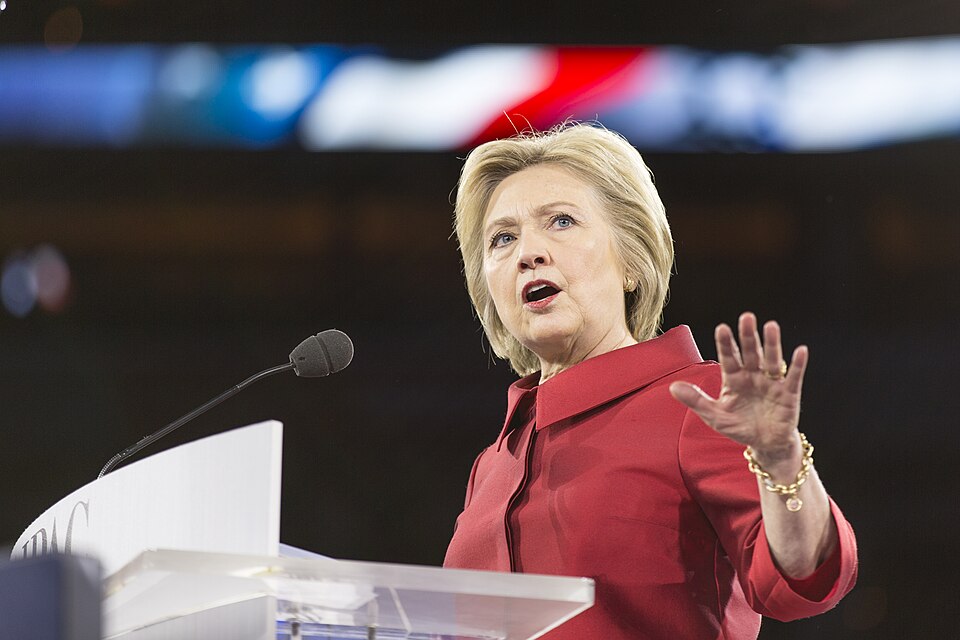
Hillary is back to stir up more drama.
Former Secretary of State Hillary Clinton has inserted herself into President Donald Trump’s growing trade dispute with Canada, claiming that some Republicans may be privately rooting for Canadian Prime Minister Mark Carney as tensions between the two longtime allies intensify.
Clinton made the provocative assertion Monday night during an appearance in New York, where she questioned whether Republican lawmakers truly support a prolonged trade battle with Canada.
Her comments come as Trump presses ahead with his “America First” trade agenda and Canada prepares retaliatory tariffs of its own.
The escalating dispute could have major consequences for American manufacturing, agriculture, automobiles and consumer prices — particularly in states with strong economic ties to Canada.
Hillary Clinton Says Republicans May Privately Side With Canada
Clinton argued that Republican senators are unlikely to be enthusiastic about a trade war involving one of America’s largest trading partners.
“I can’t imagine that even in the Republican cloakroom in the Senate, there’s much enthusiasm for going into a trade war with Canada,” Clinton said.
She specifically highlighted Ohio and Michigan, two politically important states with significant manufacturing sectors and extensive commercial ties to Canada.
According to Clinton, approximately 40% of Ohio’s exports and 60% of Michigan’s exports go to Canada.
She then made an even stronger claim about Republicans and Prime Minister Carney.
Clinton argued that Republicans in those states — and across the country — are likely unhappy with Trump’s approach and may privately support Carney for pushing back against the president and defending Canada’s interests.
Clinton did not identify any Republican lawmakers who had privately expressed support for Carney, meaning her assertion about Republicans “secretly cheering” the Canadian leader was political speculation rather than a documented statement from GOP senators.
Still, her remarks bring renewed attention to the potential political consequences of Trump’s aggressive approach toward Canada.
Canada Announces Retaliatory Tariffs Against United States
The dispute intensified Tuesday when Canada announced retaliatory tariffs against American goods.
Carney said Canada would respond “dollar for dollar” after the Trump administration imposed 50% tariffs on more than $20 billion worth of Canadian goods.
Those American tariffs went into effect over the weekend.
Canada’s retaliatory measures are scheduled to begin Sept. 8, setting the stage for another round in the economic confrontation between Washington and Ottawa.
The situation could become even more significant in the months ahead.
Trump has threatened additional 50% tariffs targeting Canadian cars, trucks, automobile parts and steel beginning early next year.
Those industries are deeply connected to American manufacturing, particularly across Michigan and other Midwestern states where factories and suppliers frequently operate through cross-border supply chains.
What Trump’s Canada Tariffs Could Mean for Americans
For millions of Americans, the biggest question is not the political rhetoric coming from Washington or Ottawa. It is what the dispute could mean for jobs, prices and the broader U.S. economy.
Tariffs are taxes imposed on imported goods. Trump has long argued that they can be used to defend American industries, encourage domestic production and pressure foreign governments into negotiating better trade agreements.
Supporters of Trump’s trade strategy say previous administrations allowed foreign competitors to gain advantages while American factories closed and manufacturing jobs moved overseas.
They see tariffs as an important negotiating tool for rebuilding domestic production and putting American workers first.
Critics argue that tariffs can also increase costs for U.S. businesses that rely on foreign materials and components. Companies may ultimately pass some of those additional expenses along to consumers.
That debate is particularly important when dealing with Canada because the economies of the two countries are closely connected.
Automobiles, steel, energy, agriculture and other products routinely move across the northern border as part of an enormous trading relationship.
Trump Doubles Down on His “America First” Trade Strategy
Trump has shown little indication that political criticism will persuade him to abandon his tougher approach.
His administration has made tariffs a central part of its broader economic strategy, arguing that the United States must use its enormous consumer market as leverage when negotiating with other countries.
For Trump supporters, the confrontation represents another example of the president challenging economic arrangements that Washington accepted for decades.
The administration’s argument is straightforward: Access to American consumers is enormously valuable, and foreign governments should expect tougher negotiations when the United States believes existing trade arrangements are unfair.
Canada, however, is making clear that it intends to fight back.
Carney said his government may use more targeted retaliation to protect Canadian workers and businesses as additional American tariffs approach.
That raises the possibility of a prolonged back-and-forth in which each government places new economic pressure on the other.
U.S.-Canada Relations Face Growing Pressure
The tariff confrontation is only one source of tension between Trump and Canada during his second term.
Trump has repeatedly discussed Canada in unusually aggressive terms and has even floated the idea of the country becoming America’s 51st state.
Those remarks, combined with the trade dispute, have contributed to a much more contentious relationship between Washington and Ottawa than Americans have traditionally seen.
Canada has historically been among America’s closest allies and most important economic partners.
But Trump has consistently argued that friendly relationships should not prevent the United States from demanding trade arrangements that he believes better serve American interests.
The result is a fundamental disagreement over how Washington should handle one of its closest neighbors.
White House Hits Back at Hillary Clinton
The Trump White House quickly responded to Clinton — and officials went straight back to the 2016 presidential election.
White House spokesperson Kush Desai dismissed Clinton’s criticism by invoking her historic defeat against Trump.
“If Hillary Clinton knew anything about Ohio or Michigan – or Wisconsin and Pennsylvania, for that matter – she wouldn’t have so humiliatingly lost to President Trump in 2016,” Desai said.
The response was particularly pointed because those states played an important role in Trump’s rise to the presidency.
Trump’s appeal to working-class voters across the industrial Midwest helped him break through the Democrats’ traditional “blue wall” in 2016 and defeat Clinton in an election that shocked much of the political establishment.
Nearly a decade later, Clinton is invoking some of those same voters and states while criticizing Trump’s trade strategy.
Why Michigan and Ohio Matter in the Canada Trade Fight
Michigan could become especially important if the dispute expands to automobiles and auto parts.
The American and Canadian auto industries are highly interconnected, with vehicles and components potentially crossing the border during different stages of production.
Ohio also maintains extensive commercial ties with Canada.
That means lawmakers representing these states have to balance competing priorities.
Many Republican voters support Trump’s push to restore American manufacturing and negotiate tougher trade agreements. At the same time, businesses operating across the border may worry about higher costs or disruptions caused by escalating tariffs.
Those competing interests could make the Midwest one of the most important regions to watch as the dispute unfolds.
Clinton’s Claim Puts Republicans in the Spotlight
Clinton’s suggestion that Republicans are privately cheering for Carney is likely to attract attention, but there is an important distinction between political rhetoric and demonstrated opposition.
She did not provide evidence that Republican senators are secretly supporting Canada’s position.
That does not mean Republicans have no concerns about tariffs. Individual lawmakers can support Trump’s broader economic agenda while disagreeing with specific trade measures or worrying about their effects on businesses back home.
The real test will come as the economic consequences become clearer.
If tariffs produce concessions from Canada while strengthening American manufacturing, Trump will have powerful evidence for his negotiating strategy.
If the dispute instead produces significant price increases or economic disruptions, opponents will almost certainly use those consequences against the administration.
The Trump-Canada Battle Is Far From Over
The next major date is Sept. 8, when Canada’s retaliatory tariffs are scheduled to take effect.
After that, attention will turn toward Trump’s threatened tariffs on Canadian automobiles, trucks, auto parts and steel.
For Americans, this is about considerably more than another political argument between Trump and Clinton.
The outcome could influence manufacturing jobs, automobile prices, agricultural markets, cross-border businesses and the cost of everyday goods.
Trump is betting that America’s economic power will force Canada to negotiate on terms more favorable to the United States.
Carney is signaling that Canada intends to resist that pressure.
And Clinton has now stepped directly into the fight, turning an already heated international trade dispute into another chapter in the political rivalry that has followed Trump and his opponents for years.
As Washington and Ottawa prepare for their next moves, American workers, businesses and consumers will be watching closely to see who ultimately blinks first.