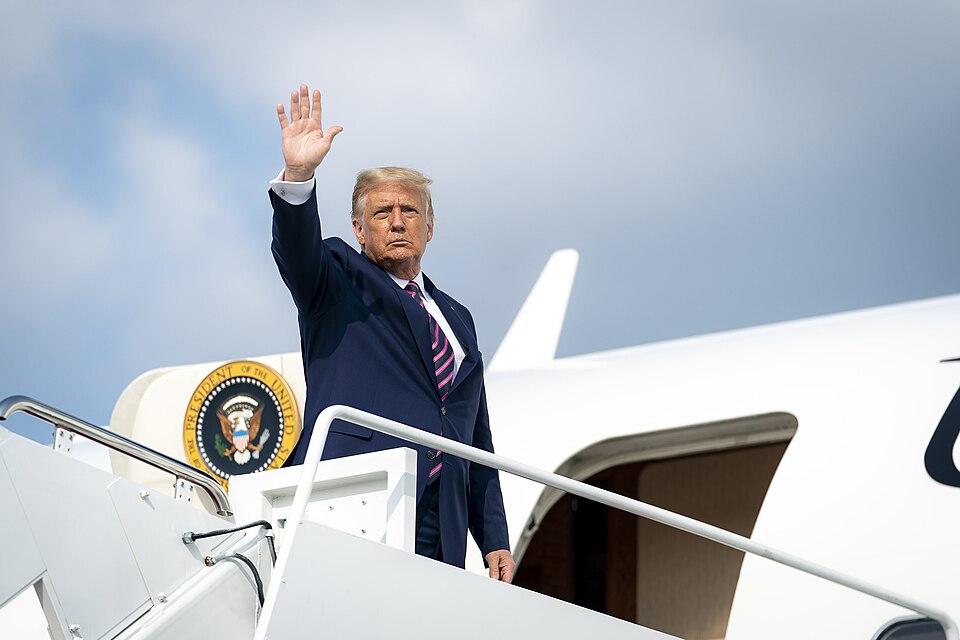
President Donald Trump’s campaign rally in Syracuse, New York, took a dramatic turn Friday evening after a woman disrupted his speech and was escorted out by law enforcement officers.
The October 9 incident quickly attracted attention after the woman directed an offensive hand gesture toward the president while being removed from the venue.
Trump supporters responded with loud patriotic chants, while the president briefly acknowledged the disturbance before continuing his remarks.
The confrontation came as Trump was campaigning for Republican candidates ahead of the November midterm elections, with political tensions running high across the country.
Woman Disrupts Trump During New York Rally
The unexpected interruption occurred while Trump was discussing his first presidential inauguration on January 20, 2017.
As the president addressed supporters, boos suddenly erupted from a section of the audience.
Trump paused, looked toward the disturbance, and acknowledged the commotion.
Cameras then showed a woman being escorted toward the exit by law enforcement officers.
Before leaving, she turned toward the president and raised both middle fingers in his direction.
The gesture immediately drew attention from the audience, with Trump supporters breaking into chants of “USA! USA! USA!”
Rather than allowing the confrontation to dominate his appearance, Trump moved forward with his speech.
However, the president did address the broader issue of protesters interrupting his political events.
Trump Responds to Rally Protesters
Following the disturbance, Trump accused his political opponents of financially supporting individuals who disrupt his appearances.
The president has made similar claims about protesters at previous campaign events.
However, no evidence was provided establishing that the woman removed from the Syracuse rally had been paid to attend.
The situation did not end with the first interruption.
Later in his speech, another individual caused a disturbance, prompting Trump to question whether the person was a supporter or political opponent.
The president ultimately dismissed the interruption and continued speaking.
Both incidents demonstrated how political disagreements can quickly become heated during major public gatherings.
Trump Campaigns for Republican Candidate in New York
The Syracuse appearance was part of Trump’s effort to support Republicans competing in the upcoming midterm elections.
The president traveled to upstate New York to campaign for Bruce Blakeman, the Republican candidate challenging Democratic Governor Kathy Hochul.
New York has traditionally been a difficult state for Republican candidates seeking statewide office, making the gubernatorial contest an important opportunity for the party.
Trump’s involvement also reflects the larger effort by Republicans to generate interest and participation ahead of November.
Although the rally was intended to highlight political priorities and encourage voter participation, the confrontation briefly shifted attention away from the campaign message.
Additional Protests Surround Trump’s Appearance
The disturbance inside the Syracuse venue was not the only protest connected to the president’s visit.
Demonstrators gathered outside the Oncenter Convention Center to express opposition to Trump and his administration.
Footage shared by a student journalist with Syracuse University’s The Daily Orange showed crowds participating in anti-Trump chants.
The protests followed another contentious rally in San Antonio, Texas, earlier in the week.
During that appearance, Trump faced multiple interruptions from hecklers.
One confrontation became physical when a man wearing a Make America Great Again hat pulled a protester to the ground by the hair.
The incident raised concerns about maintaining security and preventing political disagreements from escalating into physical confrontations.
Together, the events illustrate the challenges surrounding highly attended political gatherings during an increasingly contentious election season.
Rally Incident Raises Questions About Respect and Free Speech
The Syracuse confrontation has renewed questions about appropriate behavior at political events.
The First Amendment protects peaceful political expression, including criticism of elected officials. At the same time, event organizers and security personnel may enforce lawful rules intended to maintain order and protect attendees.
Those principles can become difficult to balance when protesters interrupt speeches or confront supporters.
Some Americans consider disruptive demonstrations an important way to challenge political leaders.
Others believe such actions interfere with an audience’s ability to hear a candidate or elected official speak.
Regardless of political affiliation, preventing violence and protecting public safety remain important responsibilities.
The incident also highlights a broader concern about the increasingly confrontational nature of American political debate.
Midterm Elections Approach as Political Divisions Continue
With the November elections approaching, Trump is expected to remain an important figure in Republican campaigning.
His public appearances provide opportunities to promote GOP candidates, address national concerns, and encourage voter participation.
Democrats are also mobilizing their supporters and emphasizing disagreements with the administration’s policies.
Issues including the economy, government spending, immigration, public safety, and national security continue to shape the political conversation.
While confrontations at rallies may attract significant media attention, voters will ultimately determine the country’s political direction at the ballot box.
The incident in Syracuse serves as another example of how strongly Americans feel about their political beliefs.
It also raises a question that extends beyond any one president or political party: Can Americans express their disagreements without allowing those disagreements to disrupt public events?
As election day approaches, political tensions are likely to remain a major part of the national conversation.