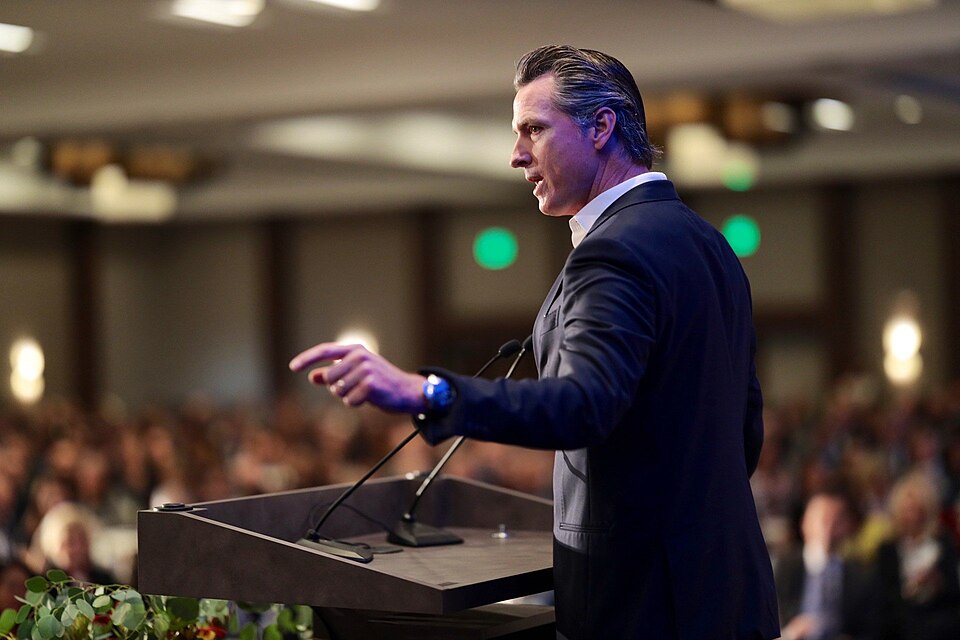
Here’s what Newsom is doing now.
California Gov. Gavin Newsom is taking his political operation to another crucial battleground state, throwing his support behind Michigan Democrats following the surprise Senate primary victory of progressive candidate Abdul El-Sayed.
The California Democrat is scheduled to visit Michigan this weekend as the party turns its attention toward November’s midterm elections. But Newsom’s growing presence in swing states is attracting attention for another reason: persistent speculation that he could seek the Democratic presidential nomination in 2028.
Newsom has increasingly built relationships with Democrats across the country while campaigning, fundraising and promoting policies associated with the party’s progressive wing.
His decision to quickly endorse El-Sayed is now putting that strategy under a brighter spotlight.
El-Sayed has backed Medicare for All and abolishing Immigration and Customs Enforcement, while his positions regarding Israel have generated significant controversy.
Republicans believe those positions could make Michigan one of the clearest tests yet of whether the Democratic Party’s progressive wing can win over voters in a competitive statewide election.
Newsom Quickly Endorses El-Sayed
Newsom congratulated El-Sayed shortly after the former public health official narrowly defeated Rep. Haley Stevens in Michigan’s Democratic Senate primary.
Newsom also accused President Donald Trump and Republicans of attempting to “rig the rules and silence voters” before calling for Democratic unity heading into November.
“On to November! Let’s take our country back,” the California governor added.
According to Newsom’s political operation, the governor contacted El-Sayed following the primary and endorsed him after the race was called.
Newsom’s Michigan trip reportedly had been scheduled before the primary results were known, and it remains unclear whether Newsom and El-Sayed will make a joint campaign appearance.
Nevertheless, the governor’s endorsement places him squarely behind one of the most closely watched progressive nominees of the 2026 election cycle.
Newsom Expands His National Political Profile
Newsom’s Michigan visit is the latest stop in an increasingly ambitious national political schedule.
The governor has repeatedly declined to announce whether he plans to run for president in 2028, saying his current priority is helping Democrats win elections and regain control of Congress.
His travel schedule, however, continues to generate speculation.
Newsom recently traveled to Nevada, one of the nation’s most important presidential battlegrounds, to campaign for Democratic candidates.
Earlier this year, he also traveled around the country while promoting his memoir, making appearances in New York, South Carolina, Tennessee, Texas and Nevada.
Newsom has traveled internationally as well, visiting Switzerland, Germany and the United Kingdom, where he met with foreign leaders and promoted California’s climate policies.
Critics contend that the extensive travel resembles the early stages of a national presidential campaign.
Newsom and his allies maintain that he is focused on strengthening the Democratic Party ahead of the midterms.
Newsom’s Progressive Shift Draws Attention
The Michigan trip also comes as Newsom appears increasingly willing to embrace economic policies popular among progressive Democrats.
In June, Newsom backed the concept of a national billionaire tax.
Now he is supporting a Michigan Senate candidate who has championed several major progressive priorities.
That combination could become important if Newsom eventually enters the 2028 Democratic presidential primary.
Democratic voters would likely encounter a crowded field of candidates competing for support from the party’s progressive base.
Republicans, meanwhile, are likely to argue that Newsom’s recent moves show the California governor aligning himself with a Democratic agenda they consider too liberal for many independent and working-class voters.
The political battle could provide an early preview of arguments Americans will hear in both the 2026 midterms and the 2028 presidential campaign.
Michigan Senate Primary Stuns Democrats
El-Sayed’s victory was particularly notable because of how close and expensive the Democratic primary became.
He defeated Stevens by approximately one percentage point, receiving 48.5% of the vote compared with her 47.5%.
El-Sayed rejected corporate PAC contributions while his opponent benefited from substantial outside spending.
More than $30 million reportedly came from the American Israel Public Affairs Committee’s United Democracy Project super PAC in support of Stevens.
Television spending supporting Stevens and opposing El-Sayed dramatically exceeded the resources available to El-Sayed’s campaign.
It still was not enough to defeat him.
The candidates traded increasingly sharp attacks during the final weeks of the campaign, particularly over campaign financing and U.S. policy toward Israel.
El-Sayed accused Stevens of relying on what he called a multimillion-dollar “corporate crutch,” while Stevens criticized El-Sayed’s record and positions involving the Middle East.
When the votes were counted, El-Sayed emerged with the Democratic nomination.
Republicans See An Opening In Michigan
Republicans quickly seized on the result.
El-Sayed supports Medicare for All and has called for abolishing ICE, positions that Republicans are expected to make central issues in the general election.
His views regarding Israel have also attracted scrutiny.
Republicans are attempting to connect El-Sayed to a broader group of progressive Democrats and democratic socialists gaining influence within the party.
House Speaker Mike Johnson has used the term “Mini Mamdanis” to describe progressive candidates he argues represent the Democratic Party’s movement to the left.
Texas Republican Sen. John Cornyn similarly suggested that Michigan’s primary outcome could improve Republican prospects in November.
Those attacks provide an indication of the campaign Republicans are preparing to run.
Rather than treating the Michigan Senate election as an isolated contest, GOP leaders are likely to present it as part of a national debate over immigration enforcement, taxes, government spending, health care and the Democratic Party’s ideological direction.
Newsom’s endorsement could become part of that argument.
El-Sayed’s Position On ICE Could Become Major Issue
Immigration is likely to be one of the biggest areas of disagreement in the Michigan Senate campaign.
El-Sayed has supported abolishing ICE, placing him in direct opposition to President Trump and Republicans who have made stronger immigration enforcement a central part of their agenda.
The issue could prove especially significant with independent and moderate voters.
Republicans are expected to argue that eliminating ICE would weaken the federal government’s ability to enforce immigration law.
El-Sayed and progressive Democrats, meanwhile, have argued for fundamentally restructuring the country’s immigration enforcement system.
The disagreement gives Michigan voters a clear policy choice heading into November.
Medicare For All Returns To Political Spotlight
Health care could become another major dividing line.
El-Sayed supports Medicare for All, a proposal that would dramatically expand the federal government’s role in health insurance.
Supporters argue that a universal system could guarantee health coverage to Americans regardless of employment or income.
Opponents have raised concerns about the potential cost, higher taxes and the effect such a system could have on private insurance and existing health coverage.
For older voters in particular, the debate over Medicare and health care could become especially important as both parties attempt to explain what their proposals would mean for families, retirees and taxpayers.
The Michigan campaign gives Republicans another opportunity to challenge Democrats on the cost and scope of progressive health care proposals.
Campaign Contributions Come Under Scrutiny
El-Sayed has also faced renewed attention over campaign contributions from individuals with ties to the Council on American-Islamic Relations, commonly known as CAIR.
Fox News Digital reported that El-Sayed’s campaign received more than $115,000 from current and former officials and leaders affiliated with the organization.
CAIR has been the subject of significant political controversy.
The United Arab Emirates designated CAIR a terrorist organization in 2014, while officials in Florida and Texas have more recently taken actions labeling or designating the organization as a terrorist group.
CAIR disputes those characterizations.
Among the contributors identified in the report was CAIR Executive Director Nihad Awad, who previously faced widespread criticism over remarks concerning Hamas’ October 7, 2023 attack against Israel.
El-Sayed’s father-in-law, Jukaku Tayeb, who has served on CAIR-Michigan’s board, was also identified among the donors.
There has been no allegation that El-Sayed’s campaign violated campaign-finance law by accepting the reported contributions.
Even so, Republicans are likely to continue raising the issue during the general election campaign.
Newsom To Campaign With Michigan Democrats
Newsom’s weekend schedule extends beyond the Senate contest.
The California governor is expected to campaign alongside Michigan Secretary of State Jocelyn Benson, who is running for governor.
He will also support Democratic legislative candidates seeking control of the Michigan House.
Newsom reportedly plans to meet with Black community leaders and younger Democratic activists during the trip.
His political organization says it has raised more than $1.7 million for Democratic candidates and state parties this year, including approximately $160,000 for the Michigan Democratic Party.
That fundraising operation could help Newsom establish relationships with Democratic officials, donors and activists across important electoral states.
Those relationships would also be valuable should he eventually decide to seek the presidency.
Newsom’s Travels Fuel 2028 Speculation
Newsom insists that his focus remains on the 2026 elections, but speculation surrounding a potential presidential campaign is unlikely to disappear.
Governors considering presidential runs have historically used national fundraising, campaign appearances and support for candidates in early primary and battleground states to expand their political networks.
Newsom is now doing many of those things.
He has traveled extensively outside California, raised money for Democratic candidates, campaigned in swing states and increasingly weighed in on national political debates.
His critics say the pattern looks more like a presidential campaign than the normal schedule of a sitting governor.
Newsom has not committed to a 2028 campaign.
But each new trip gives voters another reason to wonder.
Newsom’s California Record Could Follow Him
Any future Newsom presidential campaign would almost certainly bring increased scrutiny of his record as California governor.
Republicans have repeatedly criticized California Democrats over taxes, housing costs, homelessness, crime, energy policy and government regulation.
Newsom and his supporters counter that California remains an economic powerhouse and argue that Democratic policies have helped the state maintain its leadership in technology, innovation and clean energy.
That debate could eventually move onto the national stage.
If Newsom seeks the White House, Republicans are likely to argue that his record provides Americans with a preview of what his policies could mean nationwide.
Newsom would have an opportunity to make the opposite case: that California demonstrates his ability to govern one of America’s largest and most economically important states.
For voters, that would turn California itself into a major issue in the 2028 campaign.
Michigan Becomes A Test For Democratic Party
Before 2028 arrives, however, Democrats have a much more immediate challenge.
El-Sayed will face Republican Mike Rogers in November in what is expected to become one of the country’s most closely watched Senate elections.
Democrats view the seat as critical to their hopes of gaining control of the Senate.
Republicans see El-Sayed’s nomination as an opportunity to force Democrats to defend progressive positions on immigration, health care and other major issues.
The outcome could provide both parties with valuable lessons.
If El-Sayed wins, progressive Democrats will likely argue that candidates running openly on ambitious left-wing policies can succeed in competitive states.
If he loses, moderate Democrats may point to Michigan as evidence that the party moved too far left.
Either way, Newsom has now attached his name to the fight.
All Eyes Turn To November
Newsom is expected to remain in Michigan from Saturday through Monday as Democrats attempt to build momentum following the primary.
For Michigan voters, the election will ultimately come down to the candidates and the policies they offer.
But nationally, the contest represents something bigger.
Republicans will attempt to convince voters that El-Sayed represents a Democratic Party moving further toward progressive policies on immigration, health care, taxes and foreign affairs.
Democrats will argue that their candidates offer an alternative focused on health care, economic concerns and greater government accountability.
Newsom’s involvement adds another layer to that political battle.
The California governor may say his focus is November 2026, but his expanding national campaign activity ensures that questions about 2028 will follow him wherever he goes.
And by backing one of the Democratic Party’s most closely watched progressive nominees, Newsom is giving voters an early look at the political alliances that could shape the next presidential race.