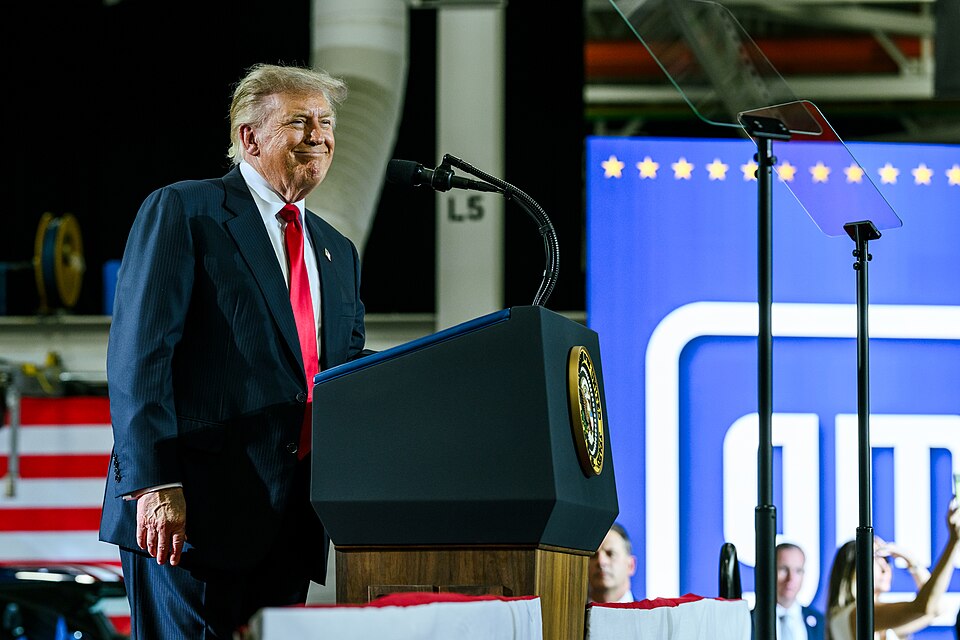
President Trump is not playing around.
President Donald Trump is warning that people who illegally leak sensitive information about America’s military capabilities could face serious consequences — including lengthy prison sentences.
The president issued the warning Thursday while strongly disputing reports that the United States is dangerously short of certain weapons following recent military operations overseas.
Trump insists America still possesses “massive amounts” of munitions and says U.S. defense manufacturers are rapidly expanding production.
But questions surrounding the military stockpile have created a larger debate over national security, government leaks and whether America’s defense industry can produce advanced weapons quickly enough to meet future threats.
Trump Issues Strong Warning Over Military Leaks
The latest controversy followed a Washington Post report about a recent Cabinet gathering at Camp David involving Trump and War Secretary Pete Hegseth.
The newspaper reported that Trump had become frustrated over information concerning the condition of U.S. weapons inventories and suggested concerns about available munitions had affected discussions about additional military action against Iran.
The White House disputes that account.
Trump responded on Truth Social by declaring that the United States has substantial quantities of weapons available.
Trump said the United States has a substantial supply of munitions, particularly in several key categories.
The president added that additional weapons are being manufactured and shipped to the United States as needed.
Trump then turned his attention to the alleged government leakers behind reports concerning the nation’s military supplies.
Trump said authorities are actively pursuing those suspected of leaking what he characterized as treasonous information, adding that his administration would seek lengthy prison terms for anyone found responsible.
The president’s warning does not mean anyone has been convicted — or even necessarily charged — with a crime. Any criminal punishment would require investigators and prosecutors to establish that specific federal laws were violated.
Still, Trump’s statement leaves little doubt that his administration views unauthorized disclosures involving sensitive military information as a major national security concern.
White House Says Report Is False
White House press secretary Karoline Leavitt also rejected the Washington Post’s description of the Camp David meeting.
Leavitt said she was present with Trump and Hegseth and maintained that the reported confrontation never occurred.
“This literally never happened,” she wrote on X.
Leavitt claimed the story had been circulated by someone seeking to damage Hegseth and emphasized that Trump continues to support his War secretary.
Trump later reinforced that message himself.
In another Truth Social post Thursday, the president said he was “extremely happy with the job that Pete Hegseth is doing.”
Trump praised Hegseth’s leadership of the military and specifically highlighted changes involving recruitment and diversity, equity and inclusion policies.
The president also pointed to recent U.S. military operations as evidence of Hegseth’s performance.
Trump then escalated his criticism of the reporting by describing it as “treasonous.”
Is America Running Low On Weapons?
Behind the political battle is a serious national security question: Does the United States have enough advanced weapons available if another major conflict erupts?
Outside defense analysts have raised concerns about inventories of several important weapons systems.
A July 27 analysis published by the Center for Strategic and International Studies estimated that America’s inventory of Patriot interceptors had declined significantly following recent military operations.
Patriot interceptors are an important component of U.S. missile defense because they can be used against incoming missiles and other aerial threats.
According to the CSIS estimate, the United States possessed approximately 2,330 Patriot interceptors before Operation Epic Fury began on February 28.
The organization estimated that the inventory subsequently fell to roughly 800.
Those numbers are outside estimates rather than figures confirmed by the Trump administration, making that distinction important.
CSIS also estimated that the U.S. inventory of Terminal High Altitude Area Defense, commonly known as THAAD, interceptors declined from approximately 452 before the conflict to around 250.
THAAD is designed to intercept ballistic missiles at high altitudes and represents another important layer of American missile defense.
Trump Administration Disputes Shortage Claims
Other reports have painted an even more concerning picture.
Reuters reported that the United States had used nearly all of its available Army Tactical Missile Systems, known as ATACMS, and Precision Strike Missiles during the Iran conflict.
The Trump administration has disputed that characterization.
Trump’s position is that America remains heavily armed while defense manufacturers are increasing production to replenish weapons that have been used.
That distinction is critical.
The debate is not simply about whether the United States has weapons. It is about whether America possesses sufficient quantities of specific advanced munitions to handle multiple potential conflicts while maintaining the reserves necessary for national defense.
Pentagon Pushes Defense Companies To Increase Production
Hegseth has said the Pentagon is working with American defense contractors to accelerate weapons production.
That effort has become increasingly important after years of American military assistance to Ukraine following Russia’s invasion, along with more recent U.S. military operations.
Advanced missiles and interceptors cannot always be replaced quickly.
Unlike ordinary consumer products, sophisticated weapons may require specialized manufacturing facilities, highly trained workers, sensitive components and lengthy production schedules.
Some outside defense experts have estimated that replacing certain high-end munitions used in recent operations could take as long as two years.
That has placed renewed attention on America’s defense industrial base — an issue that extends far beyond the current dispute involving Trump and Hegseth.
Trump Says New Defense Factories Are Coming
Trump says the answer is a major expansion of American manufacturing.
The president said defense companies are constructing an extraordinary number of plants and factories in the United States as the country works to increase weapons production.
Expanding domestic defense manufacturing could have implications beyond military readiness.
New facilities can potentially create American manufacturing jobs, support local economies and reduce dependence on foreign supply chains for strategically important components.
For conservative voters who have long supported rebuilding America’s manufacturing sector, the debate connects two major priorities: a strong military and increased domestic production.
The challenge is speed.
Constructing factories and expanding production lines can take considerable time, while global security threats can develop much faster.
The Bigger Question Is Military Readiness
The controversy comes as the United States faces complicated security challenges around the world.
Washington must consider military commitments and potential threats involving the Middle East, Russia, China and other adversaries while maintaining sufficient weapons to protect American forces and the homeland.
Every missile transferred overseas or used during a military operation eventually has to be replaced.
That makes the strength of America’s defense manufacturing sector increasingly important.
For decades, the United States benefited from overwhelming military and industrial advantages. The latest debate raises questions about whether Washington adequately prepared its manufacturing capacity for an era in which sophisticated weapons could be consumed rapidly during prolonged conflicts.
Regardless of which estimates prove most accurate, ensuring that America’s military has adequate supplies should remain a central priority for any administration.
What Happens To The Alleged Leakers?
Trump’s threat of lengthy prison sentences is likely to generate significant attention.
Federal employees and contractors who unlawfully disclose classified national defense information can potentially face serious criminal charges.
However, describing a leak as “treasonous” does not automatically make it treason under federal law.
Investigators would first have to identify the source of any disclosure and determine exactly what information was provided, whether it was classified or otherwise legally protected, and which laws — if any — were violated.
Prosecutors would then have to decide whether criminal charges were justified.
That means Trump’s demand for long prison terms should currently be viewed as a statement of the punishment he wants pursued against anyone investigators determine illegally disclosed protected national security information — not as a sentence already imposed on an identified individual.
National Security Battle Is Far From Over
The political dispute surrounding Trump, Hegseth and America’s weapons stockpile ultimately involves two separate questions.
First, does the United States have enough advanced munitions available to respond to future threats?
Second, did anyone inside the government illegally disclose protected military information?
Trump says America remains well armed, weapons production is expanding and his administration intends to aggressively pursue anyone responsible for unlawful national security leaks.
Outside analysts continue to warn that inventories of certain advanced weapons deserve close attention.
Both issues could become increasingly important as the United States attempts to rebuild its military stockpiles while confronting an unpredictable global security environment.
For Americans concerned about military readiness, government accountability and national security, the most important question may not be the political argument in Washington.
It is whether America’s armed forces have the weapons they need when the country needs them most.