Here’s what was said.
A former military aide who once carried the nuclear “football” for President Bill Clinton is raising serious concerns about the disclosure of sensitive details surrounding President Donald Trump’s recent overseas security operation.
Retired Air Force Lt. Col. Robert “Buzz” Patterson says the extraordinary measures used to protect Trump during his departure from Ankara, Turkey, were impressive — but the public exposure of how those measures worked could create national security problems long after Trump leaves the White House.
Patterson, who served as Clinton’s senior military aide, praised the operation as a sophisticated example of presidential protection.
“It was brilliant,” Patterson told Fox News Digital.
But what happened afterward is what concerns him.
Patterson believes information about presidential decoys, aircraft changes and other protective measures should remain closely guarded because those tactics may someday be needed to protect another president — Republican or Democrat.
Former Clinton Aide Sounds Alarm Over Trump Security Details
Patterson spent two years working in close proximity to President Clinton and was responsible for carrying the emergency satchel containing materials needed if a president must respond to a nuclear crisis.
That experience gave him an unusually close look at the security infrastructure surrounding the commander in chief.
According to Patterson, presidential movements in potentially dangerous situations are intentionally compartmentalized. Only a limited number of people may know the complete plan.
That makes the disclosure of detailed information particularly troubling to him.
“There’s only a few people who actually know exactly what’s going down, and that’s by design,” Patterson said.
Patterson believes authorities should determine how information surrounding Trump’s operation became public and whether classified or otherwise protected information was improperly disclosed.
For him, the concern isn’t merely political.
The same presidential security procedures could be needed years from now under an entirely different administration.
Inside Trump’s Unusual Air Force One Maneuver
The controversy stems from Trump’s July 8 departure from a NATO summit in Ankara.
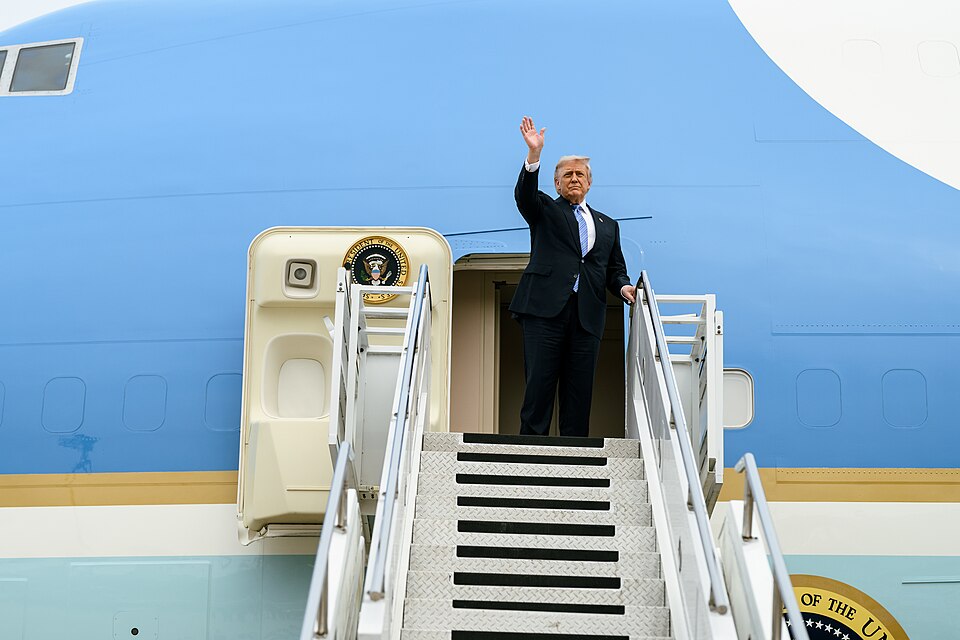
According to published reports, Trump initially boarded the familiar blue-and-white Boeing 747 commonly associated with Air Force One.
But his trip reportedly took an unexpected turn.
Trump was moved discreetly from the aircraft using an airport catering vehicle and transferred to a smaller Air Force C-32A.
The larger Boeing 747 then departed for the United Kingdom while Trump traveled separately.
Secretary of State Marco Rubio, Treasury Secretary Scott Bessent and members of the traveling White House press corps were reportedly aboard the larger aircraft.
A senior Trump administration official subsequently told Fox News that U.S. fighter jets protected the plane during its flight to Britain.
Journalists aboard were reportedly instructed to keep the aircraft’s window shades closed.
Trump later reunited with the presidential aircraft in the United Kingdom before continuing his overseas travel.
The president said he had followed instructions from the Secret Service and U.S. military.
Why Presidential Decoys Are Used
While the maneuver attracted significant attention, Patterson says the basic strategy is hardly unprecedented.
Presidential security teams have relied on deception for decades.
“We use decoys all the time,” Patterson said.
The principle is relatively simple.
When security officials believe there could be a threat against a president, preventing a potential attacker from knowing the president’s exact location can provide an additional layer of protection.
Similar techniques can be employed during presidential motorcades.
Multiple vehicles may be used, routes can change and security personnel can take steps designed to make the president’s precise movements harder to predict.
Aircraft can serve a similar purpose.
On major international trips, additional presidential aircraft can also provide logistical support and redundancy in case something happens to the primary plane.
For Americans watching from home, these movements may appear extraordinary.
For people who have worked around presidential security, Patterson says they are part of a much larger protective system.
Fighter Jets Protected The Presidential Aircraft
One question surrounding the episode was whether government officials and journalists aboard the larger aircraft had been placed in unnecessary danger after Trump switched planes.
Patterson disputes that suggestion.
The aircraft reportedly wasn’t traveling alone.
According to a senior administration official cited by Fox News, American fighter jets provided protection as the aircraft traveled toward the United Kingdom.
Patterson said such military protection is precisely what he would expect when presidential aircraft operate in a high-threat environment.
He recalled similar security measures during the Clinton administration.
“We damn sure always do when we’re going to a theater of high threat,” Patterson said.
The presence of Cabinet officials, journalists and an Air Force crew also matters.
Patterson argues that military planners wouldn’t simply disregard the safety of the Americans remaining aboard the aircraft.
Clinton Used Secret Presidential Travel Tactics Too
Perhaps the most interesting part of Patterson’s account is that Trump apparently wasn’t the first president he witnessed using an airport catering vehicle for discreet transportation.
Patterson says the Clinton administration used a similar maneuver decades earlier.
During one incident, according to Patterson, Clinton was unable to board the presidential aircraft using its normal front stairs.
Security personnel instead used a catering truck to move him discreetly to another entrance.
Only a small number of people knew what was happening.
The incident received little public attention.
That secrecy, Patterson argues, was a feature rather than a problem.
Clinton’s Secret Christmas Trip To Bosnia
Patterson also pointed to President Clinton’s surprise visit to American troops in Bosnia on Christmas Eve in 1997.
Taking a sitting U.S. president into a potentially dangerous region required extraordinary secrecy.
Advance disclosure could have increased the danger not only for Clinton but also for American military personnel responsible for protecting him.
Patterson participated in that trip and said the president’s movements were kept closely guarded.
The comparison illustrates why he believes the dispute surrounding Trump should transcend partisan politics.
During the Clinton administration, secrecy helped get a Democratic president safely into a dangerous region.
During Trump’s recent operation, secrecy was reportedly used to move a Republican president safely away from a potential threat.
The circumstances were different.
The national security principle was similar.
Presidential Security Goes Beyond Party Politics
Patterson is a conservative and has publicly criticized Clinton since serving in his administration.
But he says those political disagreements never changed his responsibility while working for the president.
He had taken an oath.
His responsibility was to protect the presidency and perform his duties regardless of whether he personally supported Clinton’s policies.
That principle remains important today.
Secret Service agents, military officers, pilots and other personnel responsible for Trump’s security aren’t merely protecting Donald Trump as an individual.
They are protecting the sitting president of the United States.
And the same system will eventually protect Trump’s successor.
“These programs exist to protect no matter who the president is and the team around him,” Patterson said.
That distinction is particularly important during an era of intense political division.
Presidents change.
America’s national security responsibilities remain.
Patterson Warns Against Exposing The Presidential Playbook
Patterson’s central concern is that too much public disclosure could eventually make proven presidential security tactics less effective.
A security procedure provides an advantage partly because an adversary doesn’t know exactly what American officials will do.
Once the procedure becomes predictable, that advantage can shrink.
Patterson described excessive disclosure of presidential protection methods as “incredibly dangerous.”
And the potential danger doesn’t stop with Trump.
Secret Service personnel, military flight crews, Cabinet officials, White House staff and journalists can all become part of presidential movements overseas.
Revealing enough information to help hostile actors predict those movements could potentially increase risks for everyone involved.
Secret Presidential Trips Have Happened For Decades
Trump and Clinton are far from the only presidents whose travel involved extraordinary secrecy.
Presidents from both parties have made surprise or tightly guarded trips to dangerous regions.
Clinton used decoy aircraft during a 2000 trip to Pakistan.
Later presidents traveled under intense secrecy to Iraq and Afghanistan.
President Joe Biden’s surprise 2023 visit to Kyiv, Ukraine, likewise required extensive security planning.
The details have varied considerably from administration to administration.
But one principle has remained remarkably consistent:
When the commander in chief travels into a dangerous environment, secrecy can be one of the most valuable layers of protection.
Could Future Presidents Face Greater Danger?
Patterson believes the consequences of exposing security tactics could stretch well beyond the current controversy.
If hostile governments or other potential attackers learn enough about how presidential deception operations function, the government could eventually have to redesign portions of its security procedures.
That could be expensive, complicated and potentially dangerous.
“If we were to expose everything, we would have to overhaul the entire security apparatus of the United States of America,” Patterson warned.
There is another potential consequence.
Presidents have traditionally visited American service members stationed in dangerous regions, particularly around major holidays or during wars.
Those visits carry symbolic importance for the military and the country.
But they are only possible when security officials believe they can manage the risks.
If protective methods become too predictable, Patterson fears future presidents could have fewer opportunities to make such trips safely.
The Bigger National Security Question
The debate surrounding Trump’s flight is therefore about much more than one president or one unusual trip aboard Air Force One.
It raises a broader question about how much Americans need to know about the methods used to protect their commander in chief.
Transparency is an important part of American government.
But presidential security has always required a degree of secrecy.
There is a reason the Secret Service doesn’t publicly release every detail about motorcade formations, emergency escape procedures, aircraft movements and contingency plans.
Potential adversaries can read the news too.
Patterson’s experience serving a Democratic president while personally holding conservative views gives his argument an unusual perspective.
For him, protecting Trump isn’t simply about protecting a Republican president.
It is about protecting the institution he once helped safeguard under Clinton.
Why The Trump Operation Matters Beyond 2026
Eventually, another president will occupy the Oval Office.
That person could be a Republican or a Democrat.
He or she will inherit many of the same security institutions now responsible for protecting Trump.
And someday that future president may need to secretly enter a war zone, escape a credible threat or make an unexpected visit to American troops overseas.
The procedures being debated today could become essential during that future emergency.
That is why Patterson believes Americans should be cautious about demanding every operational detail surrounding presidential travel.
Political arguments come and go.
The responsibility to protect the president — and preserve continuity of the United States government — does not.
For Patterson, that makes the controversy surrounding Trump’s Air Force One operation a national security issue with consequences that could last for years.
“We just need to leave them alone,” Patterson said.