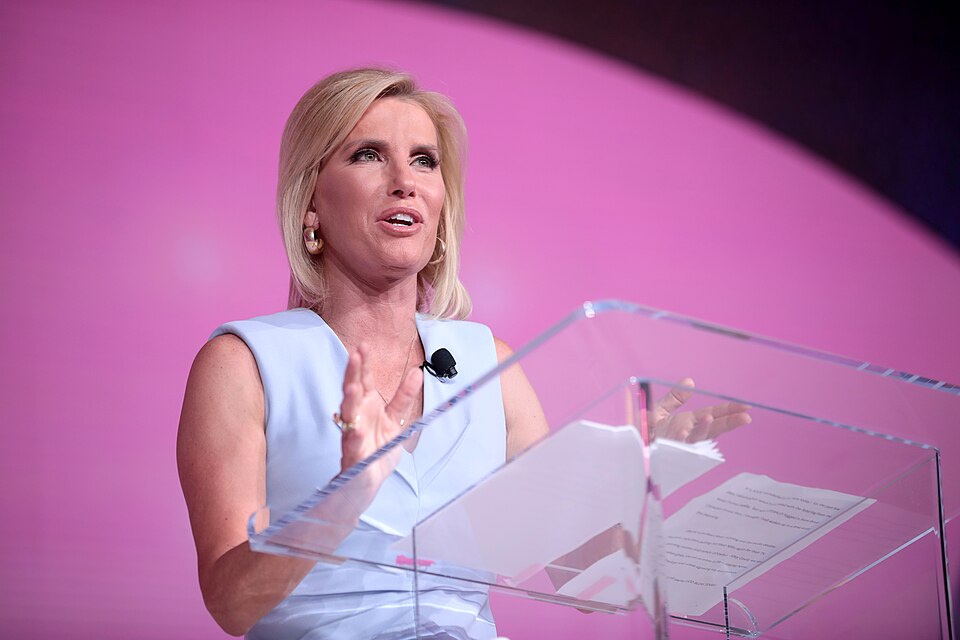
Fox News host Laura Ingraham is sounding the alarm over what she believes could be a major problem inside the Republican Party as the November midterm elections approach.
Her concern is not simply that Republicans could lose control of Congress.
Ingraham suggested that some GOP lawmakers may privately be comfortable with that outcome because being in the minority would free them from the responsibility of passing President Donald Trump’s legislative agenda.
The striking accusation came during a discussion about the economy, Republican messaging and the approaching battle for control of Congress.
Ingraham Questions Republicans on Capitol Hill
During an episode of “The Ingraham Angle,” Ingraham argued that some Republicans may actually feel relieved if their party loses its congressional majority.
“I actually think there are a lot of Republicans on the Hill who will be happy not to have the burden of having to pass legislation,” Ingraham said.
She added that those lawmakers could be “relieved” to spend some time in the minority.
The comments represented Ingraham’s assessment of congressional Republicans rather than evidence that specific GOP lawmakers are deliberately attempting to lose the election.
Still, her remarks highlight a familiar source of frustration inside the Republican coalition: the difference between campaigning on conservative priorities and successfully turning those priorities into legislation once in power.
Ingraham Says Republicans Aren’t Selling Their Economic Record
Ingraham made the remarks during a conversation with Fox Business host Larry Kudlow.
Both criticized Republican lawmakers and candidates for what they described as inadequate messaging about recent economic developments.
One of the biggest numbers discussed was household income.
According to newly released U.S. Census Bureau data, real median household income climbed to $87,460 in 2025.
That represented a 2.6% increase from $85,210 in 2024.
It was also the highest real median household income figure recorded since the Census Bureau began tracking the statistic in 1967.
For Ingraham, the question was simple: Why aren’t Republicans talking about those numbers more?
“Why aren’t Republicans screaming this from the rooftops?” she asked.
Her argument was that Republicans have economic statistics they can point to while making their case to voters but are failing to communicate those developments effectively.
Skilled Trades Become Part of the Economic Debate
Kudlow also focused on opportunities available to Americans who work in skilled trades rather than jobs requiring a traditional four-year college degree.
He pointed to professions such as welding, electrical work and pipe fitting while arguing that skilled workers can command strong salaries.
Ingraham went further, describing the current environment as particularly favorable for men without college degrees.
That demographic has been politically important to Trump and Republican candidates in recent elections.
The broader economic issue could prove especially important in November because Americans continue to rank inflation and the cost of living among their leading concerns.
Republicans Face a Complicated Economic Picture
The political challenge for Republicans is that strong income statistics exist alongside considerable voter dissatisfaction over prices and the broader economy.
The Census Bureau reported that real median household income reached a record $87,460 in 2025. It also reported that median household income after taxes and credits increased 3.1% from 2024 to 2025.
Those numbers provide Republicans with positive economic data to discuss.
However, polls suggest many voters remain unhappy with current economic conditions.
A September Marquette Law School national poll found Democrats holding an advantage over Republicans when respondents were asked which party would do a better job handling the economy and inflation.
The same survey found Republicans maintaining advantages on national defense, crime, and immigration and border security.
That divide helps explain why both parties are placing so much emphasis on economic messaging before the midterms.
Cost of Living Remains a Major Concern
For millions of Americans, statistics about national income are only part of the picture.
Household budgets are also affected by groceries, gasoline, housing, insurance, utilities and other everyday expenses.
Inflation and cost-of-living concerns ranked as the top issue in the September Marquette survey.
A separate September Reuters/Ipsos poll also found substantial dissatisfaction with Trump’s handling of living costs and showed Democrats leading Republicans on the congressional ballot among the adults surveyed.
Those findings create a messaging challenge for Republican candidates.
They can point to improvements in household income, but they must also address voters who say their everyday expenses remain difficult to manage.
Ingraham Raises a Bigger Question About the GOP
Ingraham’s criticism ultimately went beyond economic messaging.
She raised a larger question about what Republican lawmakers actually want to accomplish while they control Congress.
Winning elections gives a party power.
It also brings responsibility.
Majorities must negotiate legislation, resolve disagreements among their own members and take votes that can later become politically difficult.
Minority parties face fewer of those governing pressures because they can oppose the majority’s agenda without being solely responsible for producing legislation.
Ingraham suggested that this dynamic could make minority status appealing to some Republicans.
She did not identify individual lawmakers or provide evidence that particular Republicans are intentionally trying to defeat their own party.
Her comments were instead a broader criticism of Republican lawmakers whom she believes have not fought aggressively enough for Trump’s priorities.
Trump’s Agenda Depends Heavily on Congress
The stakes are substantial for the Trump administration.
A president can use executive authority in numerous areas, but major changes involving taxes, spending and federal law generally require congressional action.
That makes control of the House and Senate critical to any president attempting to advance a legislative agenda.
If Republicans lose one or both chambers, the political environment in Washington could change considerably.
Congressional investigations, federal spending negotiations and the prospects for major legislation could all be affected by a change in party control.
That is why internal Republican divisions have become an important issue as voters prepare for the midterm elections.
Polling Shows Republicans Have Challenges — and Strengths
Recent polling does not present a uniformly negative picture for Republicans.
The September Marquette survey showed Democrats ahead on issues including healthcare, Medicare and Social Security, inflation and the economy.
At the same time, Republicans held advantages on national defense, crime and immigration and border security.
That suggests the election debate could depend heavily on which issues dominate voters’ attention when they cast their ballots.
Economic concerns currently remain especially prominent.
The Midterms Put Republican Unity to the Test
For Republican voters, the dispute highlighted by Ingraham raises a broader issue heading into November: what should voters expect from Republican lawmakers when the party has power?
Ingraham believes Republicans should be making a much stronger case for the economic developments that occurred under Trump.
She also believes some members of the party may be more comfortable criticizing Democrats from the minority than accepting the difficult responsibility of governing from the majority.
Whether voters share that assessment is another matter.
But Republicans are entering the final stretch before the midterms facing pressure from multiple directions: defending their congressional majorities, responding to concerns about the cost of living, promoting positive economic indicators and managing disagreements within their own party.
For Trump, the outcome will carry consequences beyond Election Day.
The makeup of Congress will help determine how much of his legislative agenda can realistically advance during the remainder of his presidency.
And Ingraham’s warning puts one uncomfortable question squarely in front of the GOP:
If Republicans retain power, will the party be united enough to use it?