Here’s what happened.
President Donald Trump’s escalating battle with several major news organizations is heading deeper into federal court as CNN, MS NOW and POLITICO seek additional protection from restrictions on their White House access.
The three media companies are asking a federal judge to extend an order preventing the Trump administration from again imposing a broader ban while their lawsuit continues.
The dispute has quickly grown beyond ordinary disagreements between a president and the press. It now raises significant questions about presidential authority, White House security, due process and the First Amendment.
At the center of the latest fight is CNN’s ability to participate in the White House press pool and travel with the president during official trips.
Media Companies Return to Federal Court
Attorneys representing CNN, MS NOW and POLITICO argue that the White House could restore wider restrictions against their journalists unless the court intervenes.
The organizations claim the administration has enforced its rules inconsistently and contend that continued uncertainty is harming their ability to cover the president.
Their lawsuit argues that excluding news organizations because of their coverage or editorial viewpoint would violate constitutional protections.
The White House has taken a different position, maintaining that access to restricted presidential areas is a privilege rather than an unlimited right.
That disagreement is now being tested in federal court.
Judge Previously Restored Press Credentials
The latest filing comes only days after U.S. District Judge Timothy Kelly temporarily blocked the administration’s earlier action against the three outlets.
Kelly ordered the White House to restore their press credentials after finding that the organizations had shown a strong likelihood of succeeding on their due-process claim.
The ruling provided temporary relief while the larger constitutional case continues.
Reporters from CNN, MS NOW and POLITICO subsequently returned to the White House.
However, the ruling did not settle every question involving presidential press access.
CNN-Air Force One Dispute Adds New Tension
The conflict intensified again when CNN was excluded from Air Force One during Trump’s trip to Tennessee for a college football game.
CNN had been scheduled to participate as part of the television pool covering the president.
Instead, conservative outlet Real America’s Voice traveled aboard Air Force One.
The episode became particularly important because Judge Kelly’s earlier temporary order focused on White House press credentials and access to White House grounds. It did not specifically resolve every issue involving Air Force One or presidential travel.
That distinction has opened another front in the legal fight.
What Is the White House Press Pool?
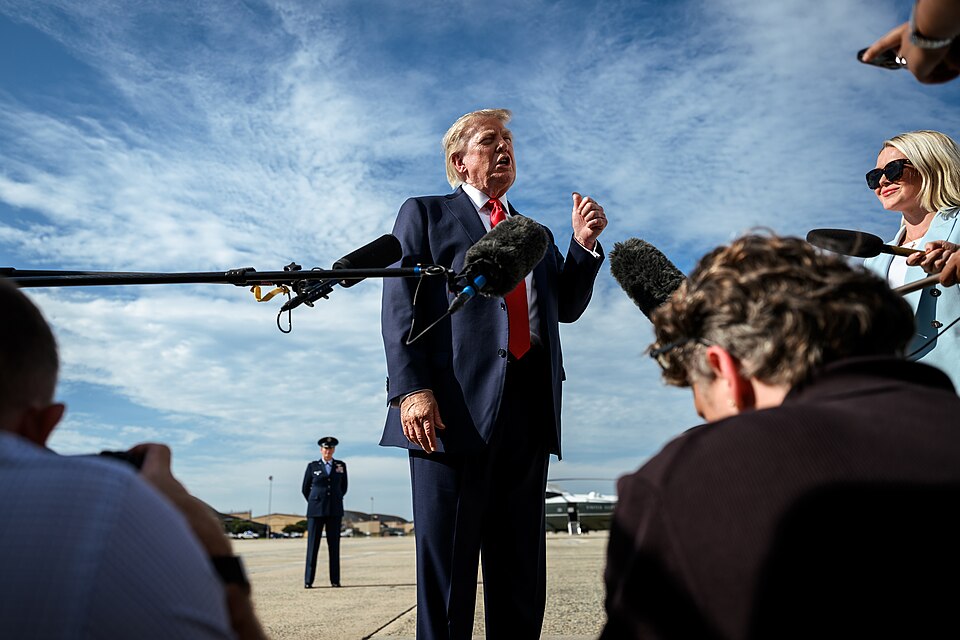
The controversy also shines a spotlight on a part of presidential coverage that many Americans rarely think about: the White House press pool.
Because hundreds of reporters cannot accompany the president into every meeting, event or restricted location, a smaller rotating group of journalists is selected to represent the larger press corps.
Those journalists provide reports, photographs and video that can then be distributed more broadly.
Major television networks have traditionally rotated responsibility for supplying video coverage.
CNN is part of that rotation, which means restrictions against the network can affect coverage available to other news organizations as well.
That is one reason the dispute has drawn attention far beyond CNN itself.
Trump Has Long Battled Major Media Outlets
Trump’s confrontational relationship with the national media stretches back years.
The president has repeatedly accused CNN and other organizations of unfair reporting and frequently uses the term “fake news” when criticizing coverage he believes is inaccurate or politically biased.
During the current dispute, the administration has argued that White House access is not an automatic entitlement for every news organization.
The media companies counter that once the government establishes a system for granting press access, officials cannot selectively punish outlets simply because they object to their reporting.
Those competing arguments are likely to remain central as the lawsuit proceeds.
First Amendment Questions Loom Over the Case
The case potentially carries consequences reaching well beyond the three organizations involved.
Presidents require substantial control over security, scheduling and access to sensitive locations. Space aboard Air Force One, inside the Oval Office and at many presidential events is necessarily limited.
But courts have also recognized constitutional protections involving government treatment of journalists.
The legal question is therefore not simply whether every reporter has a right to enter every presidential event.
Instead, the courts may have to determine how far an administration can go when restricting an established news organization from access that is available to comparable outlets.
The media organizations argue that restrictions based on unfavorable coverage amount to unconstitutional viewpoint discrimination.
The administration disputes their broader interpretation of the law.
Conservative Media and Liberal Media Both Have a Stake
Although the immediate case involves organizations frequently criticized by Trump and many conservatives, the legal precedent could ultimately affect news organizations across the political spectrum.
Rules established under one administration can potentially be used by future presidents against media outlets with very different viewpoints.
A future Democratic administration, for example, could face similar legal questions if it attempted to restrict conservative organizations because officials objected to their coverage.
For that reason, the case involves a broader issue than the politics of CNN, Trump or any single administration: how much discretion should a president have when determining which established news organizations receive access?
The courts will ultimately have to sort out the constitutional boundaries.
Another Major Deadline Approaches
The legal battle is moving quickly.
CNN, MS NOW and POLITICO are seeking continued court protection while their broader lawsuit proceeds.
CNN also faces upcoming assignments in the White House television pool, meaning the administration’s handling of those assignments could provide another indication of how it intends to interpret the judge’s order.
Meanwhile, the Trump administration is expected to respond to the media companies’ latest arguments in court.
That response could provide additional clarity on whether the White House intends to continue challenging the outlets’ access beyond the immediate dispute over credentials.
Court Fight Could Shape Future White House Press Rules
Whatever the final outcome, the case could influence the relationship between future presidents and the journalists assigned to cover them.
Trump has made no secret of his frustration with news organizations he considers hostile or inaccurate.
CNN, MS NOW and POLITICO argue that criticism from a president cannot become grounds for government retaliation against the press.
The White House, meanwhile, maintains that the president and his administration retain substantial authority over access to restricted government property and presidential events.
For now, the outlets have regained access to White House grounds under the temporary court order.
But with disagreements continuing over presidential travel and press-pool assignments, the larger fight is nowhere near finished.
The next round in federal court could help determine where presidential authority ends — and constitutional protections for the press begin.