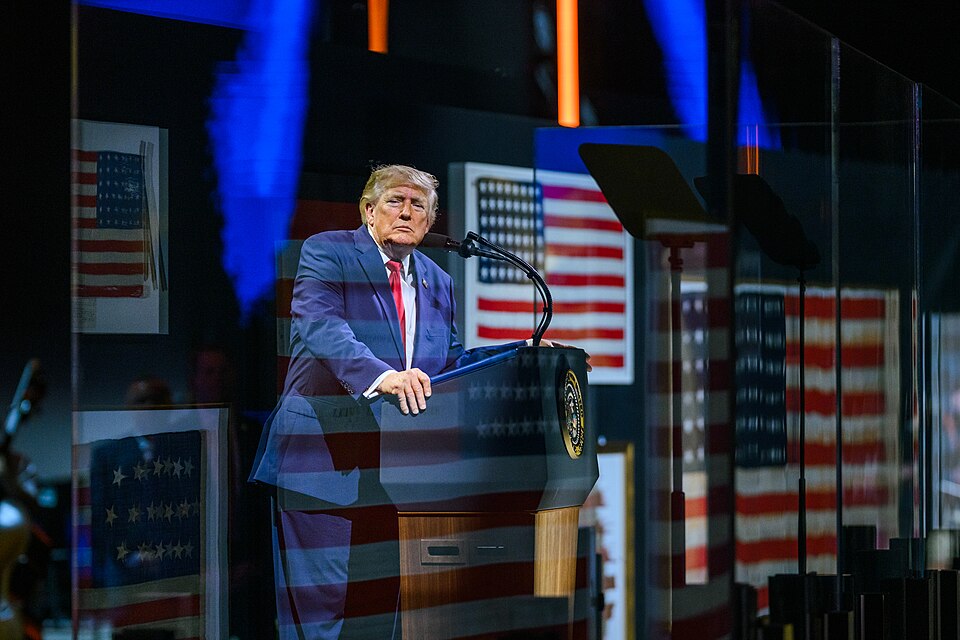
Trump is clearly not happy.
President Donald Trump is firing back after a liberal think tank challenged one of the central arguments behind his administration’s law-and-order agenda, claiming National Guard deployments in major American cities did not produce measurable reductions in violent crime.
Trump strongly rejected the accusation Monday and threatened legal action against the organization behind the report.
The dispute erupted after the Center for American Progress (CAP) published research examining roughly $1.7 billion in National Guard deployments under the Trump administration.
CAP concluded that violent crime was already declining in several cities before National Guard troops arrived, calling into question whether the deployments deserve credit for subsequent improvements.
Trump isn’t buying that argument.
The president blasted CAP and Chandler Hall, the report’s author, following Hall’s appearance on C-SPAN’s “Washington Journal.”
Trump accused the organization of pushing a politically motivated narrative while insisting that Americans have seen major improvements in public safety since he returned to the White House.
“Crime is way down since I took Office, and they know it,” Trump wrote on Truth Social.
Trump also threatened to take the dispute beyond political rhetoric.
The president said he intends to file a lawsuit and suggested some financial contributors to CAP could potentially be added to the legal action.
Trump Targets Liberal Think Tank Over Crime Report
Trump’s response came after Hall, CAP’s associate director of public safety, appeared on television to discuss the organization’s findings.
The July report examined whether deploying National Guard troops to American cities had a measurable impact on violent crime.
According to Hall, researchers studied multiple cities, datasets and time periods but were unable to identify a clear change in violent crime that could be attributed specifically to the arrival of National Guard troops.
CAP’s argument is not that crime hasn’t fallen.
Instead, the organization maintains that crime was already heading downward and that the available evidence doesn’t establish the Guard deployments as the cause.
That distinction has become the center of an increasingly heated political fight.
Trump has made combating crime and restoring law and order a major priority of his administration. His critics, meanwhile, have questioned whether deploying military personnel to assist in American cities represents an effective or appropriate use of federal power.
Trump Says Crime Is Down
The president points to declining crime as evidence that his administration’s broader public safety agenda is working.
Washington, D.C., has become a particularly important example in Trump’s argument.
Trump recently described the nation’s capital as dramatically safer than it had been previously, contrasting current conditions with the city’s past struggles with violent crime.
CAP disputes the president’s interpretation.
Hall said Washington’s violent crime and homicide numbers were already moving downward before the National Guard deployment.
He also acknowledged an important limitation when comparing crime statistics nationwide: Cities do not always use identical systems or definitions when collecting and reporting violent crime data.
That can make sweeping comparisons more difficult.
Major-City Crime Numbers Show Sharp Declines
There is little dispute about one important part of the story: Several major categories of violent crime have fallen.
Data from the Major Cities Chiefs Association covering the first six months of the year found homicides declined by slightly more than 17 percent compared with the same period a year earlier.
Robberies dropped by more than 16 percent.
Those are significant improvements for Americans concerned about public safety.
What the statistics alone cannot determine is precisely how much credit should go to Trump’s National Guard deployments, local police departments, prosecutors, changing crime trends or other policies.
That is where the political disagreement begins.
Trump and his supporters can point to falling crime as evidence that a tougher approach to public safety is producing results.
CAP argues the timeline does not support giving the National Guard credit for declines that were already underway.
Trump Goes After CAP’s Financial Supporters
Trump didn’t limit his criticism to the researchers behind the report.
In his Truth Social post, the president named several wealthy individuals and major corporations that he said have financially supported CAP.
Among those mentioned by Trump were George Soros, Bill and Melinda Gates, Apple, Visa, Goldman Sachs, Citigroup, Wells Fargo, Bank of America, Walmart, Toyota, T-Mobile and NBCUniversal.
Trump characterized CAP as a radical-left organization and suggested some contributors could become part of his threatened lawsuit.
It remains to be seen whether the president will ultimately file such a case, what specific legal claims it would contain or whether any donors would actually be named as defendants.
For now, Trump’s comments represent a threat of legal action rather than an announced court filing.
$1.4 Billion Price Tag Raises Taxpayer Questions
The controversy isn’t only about whether crime has fallen.
There is also the question of cost.
The Washington Post recently reported that continuing the National Guard deployment in Washington could cost another $1.4 billion through the end of Trump’s current presidential term in 2029.
That makes the effectiveness of the program particularly important for taxpayers.
If National Guard deployments are significantly improving public safety, supporters could argue that protecting residents and restoring order justifies the expense.
If the deployments are having little measurable effect beyond crime reductions that were already occurring, critics will likely question whether billions of taxpayer dollars could be better spent elsewhere.
For fiscal conservatives in particular, both questions matter: Is the federal government fulfilling its responsibility to protect Americans, and is taxpayer money being spent effectively?
Critics Accuse Trump Of Federal Overreach
CAP’s objections go beyond crime statistics.
The organization’s report accused the Trump administration of using National Guard deployments to expand federal authority at the expense of cities and local governments.
Hall similarly argued during his C-SPAN appearance that the deployments represent expensive federal intervention without sufficient evidence that they are responsible for lower violent crime.
Trump’s supporters are likely to view the situation differently.
For voters frustrated by years of violent crime, carjackings, robberies and disorder in some major cities, stronger federal intervention may be welcomed when local officials appear unable or unwilling to restore public safety.
That creates a fundamental disagreement over the proper role of Washington.
Should the federal government intervene more aggressively when major cities struggle with crime, or should those decisions remain primarily in the hands of state and local officials?
Falling Crime Is Good News — But Who Gets Credit?
Beyond the political fighting, falling violent crime is undeniably welcome news for American families.
The harder question is determining why it is happening.
CAP says its research shows no measurable evidence that National Guard deployments caused the decline.
Trump says crime has fallen dramatically and argues his administration’s policies are delivering results.
Both arguments will face continued scrutiny as additional crime statistics become available.
The controversy also carries larger political implications as Trump continues promoting law and order, border security and public safety as defining priorities of his presidency.
For voters — particularly older Americans who remember periods when many major cities were considerably safer — the debate is about more than statistics.
It’s about whether families feel safe in their neighborhoods, whether police have the resources and political support necessary to enforce the law, whether Washington should intervene when local governments struggle, and whether taxpayers are getting results for the billions of dollars being spent.
CAP has now challenged one of Trump’s signature public safety strategies.
Trump has made clear he isn’t going to let that accusation go unanswered.