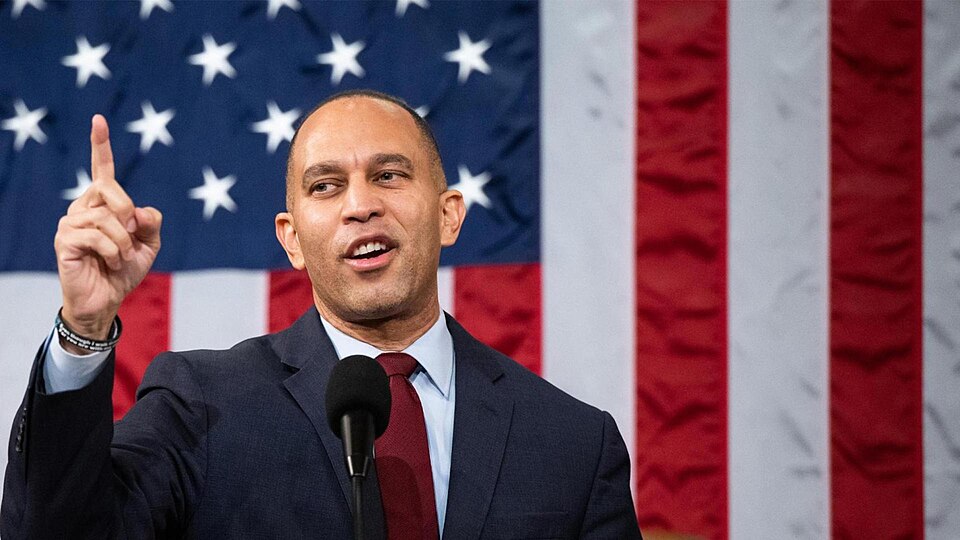
A major political confrontation is developing in Washington after House Democratic Leader Hakeem Jeffries made a dramatic declaration about one of President Donald Trump’s closest and most influential advisers.
Jeffries is demanding the removal of Stephen Miller, Trump’s newly appointed White House chief of staff, and says Democrats will refuse to work with him.
The announcement comes just days after Democrats secured sweeping victories in the 2026 midterm elections, giving the party control of both chambers of Congress when the new legislative session begins in January.
With Republicans facing a major political setback and Democrats preparing to take power on Capitol Hill, the dispute could create additional obstacles for Trump’s legislative agenda.
And Jeffries is making it clear that his opposition to Miller goes far beyond an ordinary disagreement over White House personnel.
Top Democrat Takes Aim at Trump’s White House Shakeup
During a Sunday appearance on ABC News’ “This Week,” Jeffries strongly criticized Trump’s decision to promote Miller to the powerful chief of staff position.
Miller was selected to replace Susie Wiles, who departed the position following the Republican Party’s disappointing midterm election results.
The appointment gives Miller, a longtime Trump ally, an even greater role in directing White House operations and helping advance the president’s policy priorities.
However, Jeffries made it clear that Democrats have no intention of embracing the change.
“It’s an awful choice,” Jeffries said when asked about the appointment.
The New York Democrat went further, accusing Miller of promoting policies that he believes have harmed the country.
Jeffries also characterized the decision as irresponsible, arguing that Miller represents the very approach to governing that voters rejected during the midterm elections.
The unusually sharp criticism signals that Democrats are preparing for a contentious relationship with the Trump administration as they move toward controlling Congress.
Jeffries Says Democrats Will Refuse to Work With Miller
Perhaps the most significant development came when Jeffries addressed whether congressional Democrats would maintain direct communication with Trump’s new chief of staff.
Traditionally, White House chiefs of staff serve as important intermediaries between presidents and congressional leaders.
Even when the two parties strongly disagree, communication between those offices can help facilitate negotiations involving federal spending, legislation, and national priorities.
Jeffries acknowledged that he previously maintained occasional communication with former Chief of Staff Susie Wiles.
However, he said that arrangement would not continue under Miller.
“There’s not going to be any opportunity, certainly, to work with Stephen Miller and what he represents,” Jeffries declared.
When ABC News host Jonathan Karl pressed him about whether the communication that existed under Wiles would end, Jeffries confirmed his position.
That decision could complicate negotiations between the White House and congressional Democrats, especially as both sides prepare for major battles over government spending, immigration enforcement, and federal oversight.
Although Democrats could still communicate with other administration officials, Jeffries’ refusal to engage with Miller illustrates the depth of the political divisions emerging in Washington.
Trump’s Immigration Agenda Sparks Fierce Criticism
At the center of the dispute is Miller’s longstanding role in shaping Trump’s immigration policies.
Miller has been among the administration’s most prominent advocates for stronger border enforcement, expanded deportation operations, and tougher measures targeting illegal immigration.
Those priorities have been central to Trump’s political message and his efforts to strengthen enforcement of federal immigration laws.
Supporters of the president argue that immigration enforcement is necessary to protect national security, uphold existing laws, and address the consequences of illegal border crossings.
Democrats, however, have increasingly criticized the administration’s enforcement tactics and questioned whether certain operations have gone too far.
During his television appearance, Jeffries accused Miller of helping develop policies that he linked to the deaths of American citizens Alex Pretti and Renee Nicole Good.
Those were serious political allegations made by Jeffries, rather than established findings that Miller personally caused their deaths.
Nevertheless, the accusations demonstrate how immigration enforcement remains one of the most divisive issues separating the two parties.
With Democrats preparing to control Congress, the administration’s immigration operations could face additional investigations, oversight hearings, and legislative challenges.
Midterm Election Results Give Democrats New Leverage
The timing of Jeffries’ comments is particularly significant.
The November 3 midterm elections delivered a major setback to Republicans, with Democrats winning control of both the House of Representatives and the Senate.
The results give Democratic lawmakers considerably greater influence over the direction of federal legislation and congressional investigations beginning in January.
Jeffries has interpreted the election outcome as a rejection of the Trump administration’s policies and governing approach.
He suggested that Democratic control of Congress would create a barrier against White House initiatives his party opposes.
However, the election results also present Democrats with a difficult challenge.
While the party will gain significant power over legislation and oversight, President Trump will remain in the White House, retaining executive authority and the ability to veto legislation.
That means lawmakers from both parties may eventually need to negotiate on matters affecting millions of Americans.
Federal spending, economic concerns, immigration policy, and national security are among the issues that could require cooperation.
Whether such cooperation is possible remains an open question.
White House Faces Growing Democratic Opposition
Jeffries’ criticism of Miller comes as Democrats prepare for a broader confrontation with the Trump administration.
The House Democratic leader has also expressed support for a proposed impeachment resolution targeting Defense Secretary Pete Hegseth.
During the same ABC News interview, Jeffries said he would support the measure, citing concerns about Hegseth’s leadership and the administration’s military policies.
The development suggests that Democrats intend to use their newly acquired congressional power to scrutinize several prominent members of Trump’s administration.
For the president, the changing political environment could make advancing his agenda increasingly difficult.
Republicans will no longer control the congressional committees responsible for overseeing many areas of federal policy.
Democrats will also gain greater authority to conduct investigations, issue subpoenas, and hold public hearings.
Still, congressional oversight does not automatically mean that Democrats can force changes to White House personnel.
The president retains broad authority to choose his senior White House advisers, including his chief of staff.
That makes Jeffries’ demand for Miller’s removal primarily a political challenge rather than an action Congress can directly impose.
Could the Dispute Lead to More Washington Gridlock?
The disagreement is raising broader concerns about the ability of Washington’s political leaders to work together during the remaining years of Trump’s presidency.
Following the midterm elections, Trump indicated that cooperation with Democrats could be possible.
However, his decision to elevate Miller has already generated intense criticism from prominent Democratic figures.
Jeffries’ refusal to work with the new chief of staff suggests that negotiations may be difficult before the next Congress even begins.
For Americans concerned about inflation, household expenses, retirement security, border enforcement, and government spending, the consequences of political gridlock could extend beyond disagreements between party leaders.
Congress will still be responsible for addressing major legislative priorities, regardless of which party controls the White House.
Both Republicans and Democrats will face pressure to demonstrate that they can govern effectively while defending their respective policy positions.
The dispute over Miller may therefore become an early test of whether the two sides can separate personal and political disagreements from the practical responsibilities of government.
What Happens Next for Trump and Stephen Miller?
For now, Trump has shown no indication that he plans to reverse his decision to appoint Miller.
The longtime adviser remains an important figure within the president’s political operation, and his promotion demonstrates the confidence Trump continues to place in him.
Jeffries, meanwhile, is preparing to lead a Democratic majority in the House and has made opposition to Miller a clear priority.
As the next Congress approaches, both sides will have to determine how to handle negotiations over legislation, federal spending, and other national concerns.
Whether Democrats maintain their refusal to communicate with Miller or eventually find alternative ways to negotiate with the administration remains uncertain.
One thing is already clear: The battle over Trump’s new chief of staff has become an early flashpoint in the next major confrontation between the White House and congressional Democrats.
And with control of Congress changing hands, the political consequences could reach far beyond Washington.