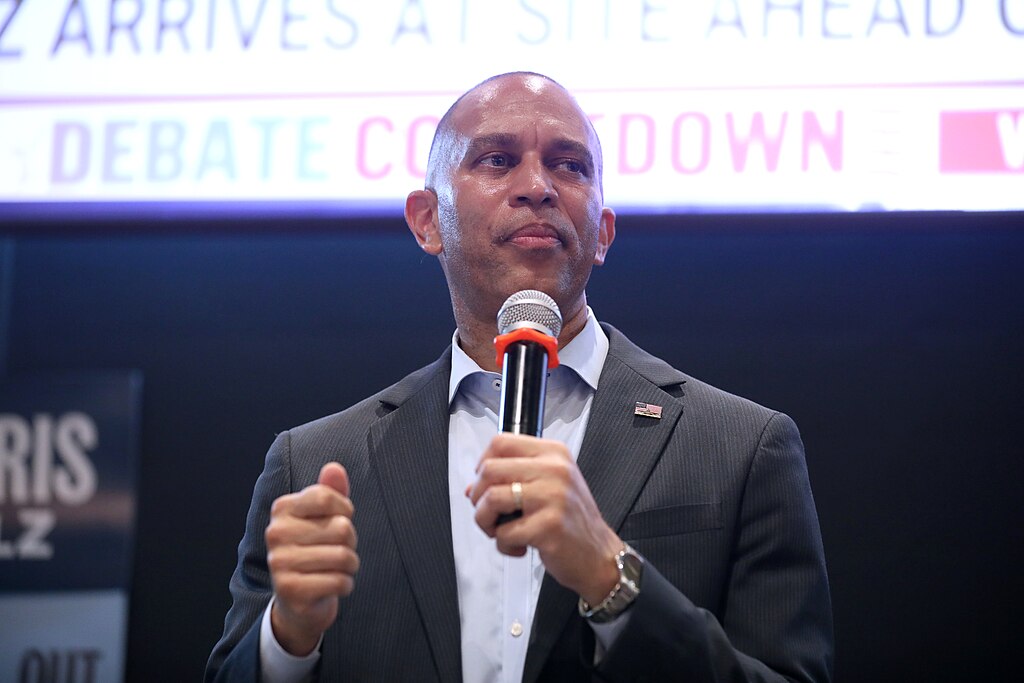
Jeffries crossed the line.
House Minority Leader Hakeem Jeffries launched a blistering attack on President Donald Trump following Tuesday night’s State of the Union address, accusing the president of misleading Americans about the state of the economy.
During an appearance on MSNBC’s Morning Joe, Jeffries argued that the president’s address was “dirty and rotten lies” and faulted him for what he characterized as a deepening cost-of-living crisis.
But the contrast between the two visions could not be clearer — and for millions of Americans over 50, the real question isn’t political rhetoric. It’s this:
Are your everyday costs going down — or up?
Trump Declares Economic Momentum Is Back
During his nationally televised address, President Trump painted a confident picture of America’s financial future, declaring the country is now “bigger, better, richer and stronger than ever before.”
He pointed to several economic indicators that matter most to middle-class families and retirees:
- Lower gas prices
- Easing mortgage rates
- Stabilizing grocery costs
- New efforts to reduce prescription drug prices
- Expanded domestic energy production
- Trade reforms aimed at strengthening American industry
“The economy is roaring,” Trump told lawmakers, framing his policies as part of a long-term strategy to restore American manufacturing, reduce foreign dependence, and ease the tax burden on working families.
For seniors living on fixed incomes, Social Security recipients, and retirement investors watching inflation closely, those factors carry significant weight.
Supreme Court Ruling and New Tariff Strategy
The president’s economic message comes amid a recent ruling by the Supreme Court involving authority under the International Emergency Economic Powers Act.
After the Court limited certain emergency trade levies, President Trump pivoted quickly — invoking separate authority under the Trade Act of 1974 to impose broader global tariffs (excluding Canada and Mexico).
Trump described the new approach as more structured and potentially stronger.
“They’re a little more complex, but they’re probably better,” he said, adding that tariff revenue could significantly offset federal income tax burdens over time.
If realized, such a shift could reshape long-term tax policy — a major issue for Americans concerned about retirement income, capital gains, and estate planning.
Jeffries Accuses GOP of “Rubber Stamping”
Jeffries also criticized House Republicans, accusing them of failing to challenge the president’s trade policies and executive authority.
He framed the Democratic position as focused on lowering the cost of living, reforming health care, and implementing what he described as humane immigration enforcement.
Meanwhile, Virginia Governor Abigail Spanberger delivered the official Democratic rebuttal, centering her remarks on affordability concerns.
The Real Issue: Cost of Living vs. Growth Strategy
At the heart of this clash is a broader economic debate:
- Should America rely more heavily on tariffs and domestic production?
- Or should trade barriers be minimized to reduce short-term consumer prices?
- Can tariffs truly replace parts of the modern income tax system?
- Will energy independence continue to lower fuel and food costs?
For voters age 50 and above — particularly homeowners, retirees, small business owners, and investors — these are not abstract policy questions. They affect:
- Property values
- 401(k) performance
- Prescription drug affordability
- Grocery bills
- Utility costs
- Retirement security
A Sharp Political Divide
Supporters of President Trump argue his America-first trade policies, energy expansion, and regulatory rollbacks are rebuilding economic strength and reducing long-term inflationary pressure.
Critics say affordability challenges remain and question whether tariffs will increase consumer prices in the short term.
The political divide is deep — and with economic stability ranking as a top issue among older voters, this debate is far from over.
Bottom Line
The clash between Jeffries and Trump highlights two competing economic visions for America.
One emphasizes aggressive trade reform and domestic industry revival.
The other focuses on consumer affordability and government-led cost controls.
As inflation, taxes, prescription drug costs, and retirement savings remain front-of-mind for millions of Americans, the coming months will reveal which strategy delivers measurable results.