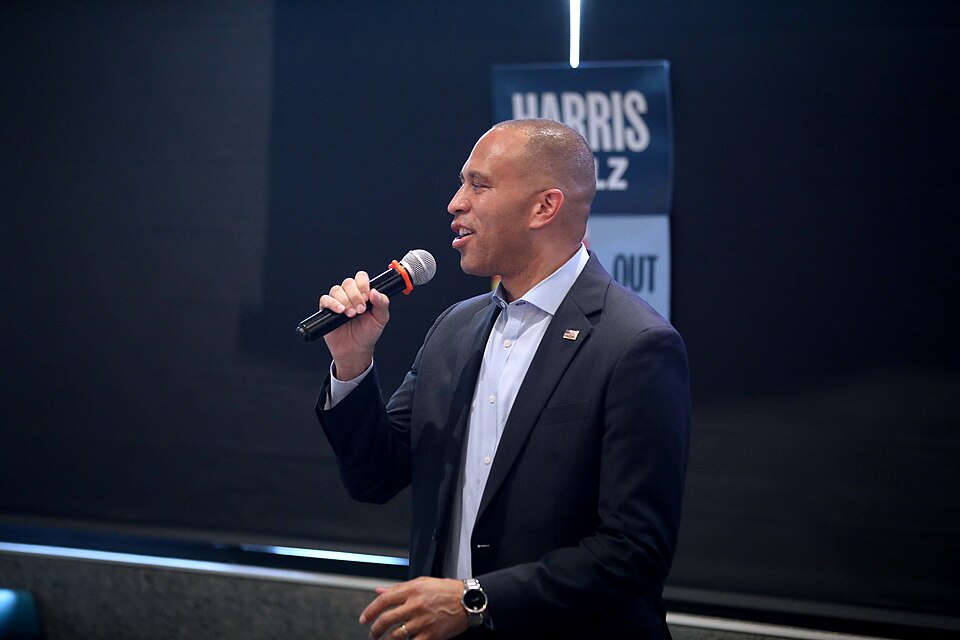
This was surprising to see.
House Democratic Leader Hakeem Jeffries is drawing a new line between himself and the Democratic Socialists of America, highlighting a growing political divide inside the Democratic Party just months before the 2026 midterm elections.
During an appearance Sunday on NBC’s “Meet the Press,” Jeffries said plainly that he does not support the agenda promoted by the Democratic Socialists of America, commonly known as the DSA.
“I don’t support the DSA agenda, as has been articulated by the DSA itself,” Jeffries told host Kristen Welker.
The statement is notable as democratic socialists and progressive candidates continue building influence within Democratic politics. Rep. Alexandria Ocasio-Cortez of New York remains one of the country’s most recognizable progressive politicians, while New York City Mayor Zohran Mamdani has emerged as another nationally prominent figure associated with democratic socialism.
Jeffries, however, appears determined to make clear that Democratic leadership does not automatically embrace the DSA’s broader political platform.
For voters watching the Democratic Party’s move to the left, his comments raise an important question: How much influence will democratic socialists have if Democrats regain control of the House?
Jeffries Rejects the DSA Agenda
Jeffries did not say that democratic socialists should be excluded from the Democratic Party.
Instead, the House minority leader emphasized that Democrats represent a wide range of political views.
He acknowledged that candidates elected through Democratic primaries could eventually become members of the House Democratic Caucus, including lawmakers whose political views are considerably further left than his own.
“It’s going to be a broad caucus,” Jeffries said.
He specifically mentioned progressives, New Democrats and Blue Dogs, demonstrating the ideological differences that already exist inside his party.
That leaves Jeffries attempting a difficult balancing act.
He wants to distance Democratic leadership from policies that could prove unpopular with moderate and independent voters while simultaneously keeping progressive voters and lawmakers inside the Democratic coalition.
With control of Congress on the line in November, that distinction could become increasingly important.
Ocasio-Cortez Remains a Powerful Voice on the Left
Alexandria Ocasio-Cortez has become one of the leading figures associated with the progressive movement since entering Congress in 2019.
The New York congresswoman has championed proposals involving health care, climate policy, labor rights and an expanded role for the federal government.
She also has a national political profile extending far beyond her congressional district.
That influence makes the ideological debate inside the Democratic Party difficult for leaders such as Jeffries to ignore.
While establishment Democrats frequently focus on winning moderate swing districts, progressive activists argue that Democrats should pursue more ambitious changes to the economy and government.
Those competing approaches have produced years of tension within the party.
Now, with the midterms approaching, Jeffries is making his own position clearer.
Mamdani Adds to the Democratic Socialism Debate
Zohran Mamdani’s rise in New York politics has added another dimension to the national debate over socialism and the future of the Democratic Party.
Mamdani has openly embraced democratic socialist politics and has become one of the movement’s most recognizable elected officials.
His political success demonstrated that progressive economic policies can attract significant support in heavily Democratic areas.
The challenge for national Democrats is whether the same message can succeed in competitive congressional districts across the country.
Many suburban, working-class and independent voters remain skeptical of socialism, particularly when debates involve taxes, government spending, policing and government control of the economy.
That creates a potential vulnerability Republicans are likely to emphasize throughout the midterm campaign.
What Does the Democratic Socialists of America Support?
The Democratic Socialists of America describes its goal as creating a society in which ordinary Americans have greater power over their workplaces, neighborhoods and broader economic system.
The organization also advocates greater collective control or ownership over major economic institutions.
Supporters argue those policies would give workers and ordinary families greater economic security and political influence.
Conservatives and other critics see the matter very differently.
They warn that dramatically expanding government involvement in the economy could mean higher taxes, additional federal spending and reduced private-sector freedom.
Those fundamental disagreements help explain why Jeffries’ comments matter.
Republicans can now point to an unusual political situation: The Democratic leader in the House says he rejects the DSA agenda while politicians associated with democratic socialism remain influential members of the broader Democratic coalition.
Jeffries Focuses His Fire on President Trump
Despite distancing himself from the DSA, Jeffries made clear that President Donald Trump and congressional Republicans remain his primary political targets.
Jeffries said he is excited about Democratic candidates attempting to flip Republican-held House seats in November.
His objective is straightforward: win enough races to give Democrats control of the House and use that majority to challenge President Trump’s agenda.
Jeffries accused Trump of “extremism” and argued that Democrats would move America in a different direction.
Republicans strongly dispute that characterization and are expected to make the policies of progressive Democrats a major part of their argument to voters.
That could put Jeffries in an uncomfortable position.
While he can personally reject the DSA agenda, Republicans are likely to ask whether progressive lawmakers would gain additional influence over taxes, spending, health care, energy policy and other major issues under a Democratic-controlled House.
Democrats Face an Internal Battle Ahead of the Midterms
The disagreement exposes a larger challenge facing the Democratic Party.
To regain control of Congress, Democrats need enthusiasm from younger and progressive voters. But they also need moderates, independents, seniors and working-class Americans in competitive districts.
Those groups do not necessarily want the same policies.
Progressive Democrats have pushed for sweeping government programs and major economic changes. Moderate Democrats have generally favored a more cautious approach, particularly in districts where Republicans remain competitive.
Jeffries must somehow keep both factions moving in the same direction through Election Day.
That becomes harder as democratic socialist candidates gain political influence.
Republicans, meanwhile, have an obvious incentive to highlight those divisions and force Democratic candidates to explain exactly where they stand.
Republicans Could Turn Socialism Into a Midterm Issue
For President Trump and the Republican Party, Jeffries’ comments could provide new ammunition heading into November.
Republicans can argue that Democratic leaders are attempting to distance themselves from socialism during an election year while continuing to rely on progressive lawmakers and voters to build a congressional majority.
Democrats can counter that their party has always contained different ideological factions and that individual lawmakers should be judged on their own records.
Ultimately, voters will decide which argument is more convincing.
The debate could be particularly important for Americans concerned about inflation, retirement security, Medicare, taxes, energy costs and the overall direction of the economy.
For older Americans who have watched the ideological battles between capitalism and socialism play out for decades, the growing prominence of democratic socialism in American politics is likely to receive additional scrutiny.
Jeffries Draws a Line — But the Bigger Question Remains
Jeffries has now publicly stated that he does not support the Democratic Socialists of America’s agenda.
What remains uncertain is how Democratic leadership would handle an increasingly influential progressive faction if the party wins control of Congress.
Ocasio-Cortez and Mamdani have demonstrated that democratic socialist ideas can attract enthusiastic supporters, particularly in heavily Democratic areas.
Jeffries, meanwhile, is tasked with winning the much broader coalition necessary to capture a national congressional majority.
That leaves Democrats confronting a political question that is unlikely to disappear before November:
Can the party embrace its progressive voters while convincing the rest of America that democratic socialists will not determine its agenda?
With President Trump in the White House and control of Congress hanging in the balance, the answer could help shape the outcome of the 2026 midterm elections.