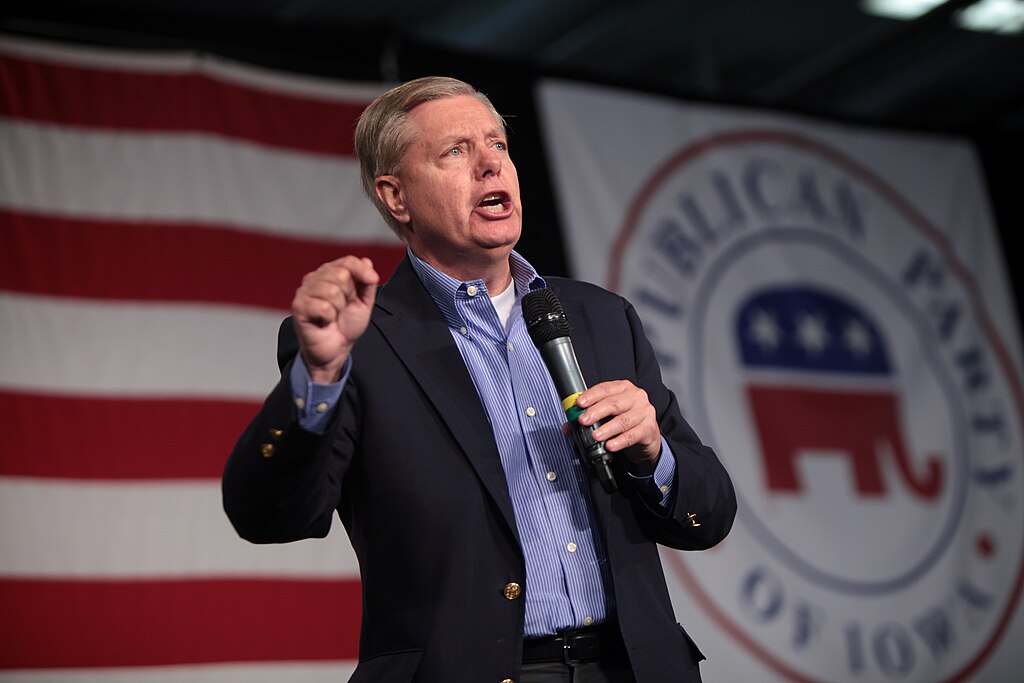
Is Lindsey Graham right?
Senator Lindsey Graham set off a wave of speculation Sunday after hinting that President Donald Trump’s next foreign policy target could be Cuba once the current confrontation with Iran reaches its conclusion.
During an appearance on Fox News’ Sunday Morning Futures, the South Carolina Republican held up a black hat with bold lettering that read “Free Cuba.”
His message was simple — and it immediately grabbed attention.
“See this hat? ‘Free Cuba.’ Stay tuned,” Graham said. “The liberation of Cuba is coming. It’s only a matter of time.”
The remark fueled new debate about the Trump administration’s expanding strategy abroad as conflicts and power struggles continue to reshape global politics.
Graham Praises Trump’s Global Strategy
Graham, one of President Trump’s most vocal allies in Congress, used the interview to praise the administration’s approach to foreign policy.
According to the senator, the president is reshaping international alliances while confronting hostile regimes that threaten global stability.
“We’re marching through the world cleaning out the bad guys,” Graham said during the interview.
“We’re going to build relationships with new leaders that will make America prosperous and safe.”
He went even further, comparing Trump’s leadership to one of the most celebrated Republican presidents in modern history.
“I’ve never seen anything like it,” Graham said. “This is Ronald Reagan plus.”
The senator argued that Trump is fundamentally changing the balance of power across the globe.
“Donald Trump is resetting the world in a way nobody could have imagined a year ago,” he added.
Venezuela Oil Pressure Impacts Cuba
The conversation about Cuba comes as the United States has tightened economic pressure on Venezuela, a key ally of the Cuban government.
In recent weeks, the Trump administration has enforced an oil quarantine on Venezuela, aimed at restricting petroleum exports from the socialist regime in Caracas.
Venezuela holds the largest proven oil reserves in the world, and for years it has supplied Cuba with subsidized fuel.
That arrangement helped keep Cuba’s struggling economy afloat.
But the new restrictions have significantly disrupted those shipments.
As a result, Cuba has been dealing with severe fuel shortages and rolling blackouts, affecting millions of residents across the island.
Although the administration recently allowed limited oil shipments to resume, most restrictions remain in place.
Trump Signals Cuba Could Become a Priority
President Trump himself has hinted that Cuba could soon become a larger focus of U.S. policy.
Speaking at the Shield of the Americas Summit in Florida, Trump told a group of Latin American leaders that several of them had privately urged him to take action regarding the communist island.
“Many of you came here today and said, ‘We hope you can take care of Cuba,’” Trump told the gathering.
According to the president, multiple leaders even made the request directly.
“A few of you said, ‘Could you do us a favor and take care of Cuba?’” Trump explained.
His response drew applause from the audience.
“I’ll take care of it,” the president said.
Cuba sits just 90 miles from Florida, and tensions between Washington and Havana have existed for decades.
For many Cuban-Americans and supporters of democracy in the region, the idea of a “Free Cuba” remains a powerful political message.
Iran Conflict Still the Immediate Focus
While talk of Cuba is gaining attention, the Trump administration’s immediate focus remains the ongoing conflict with Iran.
Graham strongly defended the military campaign known as Operation Epic Fury, arguing that the mission is necessary to prevent Iran from obtaining nuclear weapons.
The senator cited intelligence assessments shared by special envoy Steve Witkoff, who warned that Iran had accumulated large quantities of uranium enriched to 60 percent purity.
Although weapons-grade uranium typically requires enrichment of about 90 percent, nuclear experts say the final jump from 60 percent to weapons-grade can happen relatively quickly.
For Graham, that risk justifies decisive action.
“Best money you ever spent,” he said of the military effort.
According to the senator, confronting Iran now could reshape the Middle East for decades.
“When this regime falls, we’re going to see a new Middle East,” Graham said.
“We’re going to make a ton of money, and nobody will threaten the Strait of Hormuz again.”
The Strait of Hormuz is one of the world’s most critical shipping routes for global energy supplies.
Global Energy and Strategic Competition
Graham also framed the conflict in terms of global energy competition.
He noted that Iran and Venezuela together control roughly 31 percent of the world’s known oil reserves.
If those regions were eventually governed by more cooperative governments, Graham argued, it could dramatically shift global economic power.
“Trump is a man of peace and business,” Graham said.
“Venezuela and Iran have 31 percent of the world’s oil reserves. Imagine partnerships with those resources.”
According to Graham, such a development would have major implications for global rivals.
“That’s China’s nightmare,” he said.
Critics Push Back on Graham’s Comments
Not everyone agreed with the senator’s remarks.
Meghan McCain, daughter of the late Senator John McCain and a longtime acquaintance of Graham, criticized the comments following the Fox News interview.
She warned that the senator’s aggressive tone could raise concerns among Americans already uneasy about rising global tensions.
Still, Graham has long advocated for a strong U.S. presence on the world stage and has remained one of Trump’s most reliable defenders in Washington.
And if his latest comments are any indication, the administration’s foreign policy strategy may not be finished evolving.
With pressure building on Iran, Venezuela, and now potentially Cuba, the coming months could shape the next chapter of America’s role in global affairs.