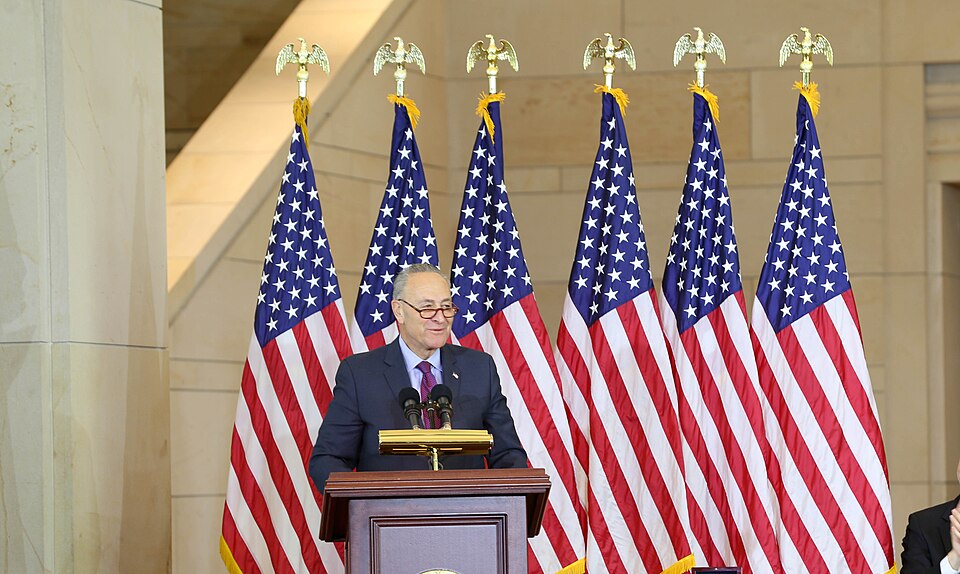
Here’s what Schumer revealed.
Senate Democratic Leader Chuck Schumer has revealed a major political strategy that could threaten President Donald Trump’s ability to appoint another conservative justice to the United States Supreme Court.
With Democrats preparing to take control of the Senate following their victories in the 2026 midterm elections, Schumer is making it clear that his party intends to use its newfound power to challenge Trump’s judicial nominations.
His comments have raised the possibility of a major constitutional and political showdown in Washington, particularly if a Supreme Court vacancy emerges before the 2028 presidential election.
For conservatives who consider Trump’s judicial appointments among his most important accomplishments, the announcement carries serious implications.
Schumer Reveals Democrats’ Supreme Court Plans
During a November 5 interview with The Associated Press, Schumer publicly outlined his party’s intentions regarding future Supreme Court nominations.
“The bottom line is we’re not going to allow a right-winger on the court,” Schumer declared.
The statement offers one of the clearest indications yet that Democrats intend to oppose additional conservative appointments during Trump’s remaining two years in office.
Schumer also suggested that his party would take a tougher approach toward nominees for lower federal courts and positions within the Trump administration.
His remarks come as Democrats prepare to assume control of the Senate in January 2027, giving them considerable influence over presidential appointments.
Under the Constitution, the president nominates Supreme Court justices, but those nominees must receive Senate approval before taking their seats.
That requirement means Democrats could prevent Trump from filling a vacancy if they maintain a united majority.
For Republicans, the announcement raises questions about whether qualified conservative nominees would receive a fair opportunity for confirmation.
Democrats Gain New Power After Midterm Victories
The political landscape in Washington changed dramatically following the November 3 midterm elections.
Democrats secured control of the Senate, winning at least 54 seats, with the possibility of expanding their majority as additional election results are finalized.
The party also captured control of the House of Representatives, creating a divided government for the final two years of Trump’s presidency.
The Senate majority is particularly significant because judicial nominees generally need only a simple majority for confirmation.
Unlike most major legislation, Supreme Court confirmations are not subject to the Senate’s traditional 60-vote filibuster requirement.
That gives Democrats a powerful opportunity to influence the direction of the federal judiciary without requiring Republican cooperation.
Schumer believes the election results will force Trump to consider more moderate nominees if vacancies arise.
However, the president’s supporters could view the strategy as an effort to prevent the administration from carrying out one of its most significant policy priorities.
Trump’s Supreme Court Legacy Faces a Major Test
Throughout his first term, President Trump successfully appointed three justices to the Supreme Court.
Neil Gorsuch, Brett Kavanaugh, and Amy Coney Barrett helped establish the court’s current 6-3 conservative majority.
Those appointments became a defining achievement of Trump’s presidency and reshaped the court’s approach to several major constitutional questions.
The conservative majority has played an important role in decisions involving religious liberty, gun rights, abortion, federal regulations, and presidential authority.
For many Republican voters, the judiciary remains one of the most important reasons to support conservative presidential candidates.
Supreme Court justices serve lifetime appointments, meaning their decisions can influence American law long after a president leaves office.
That makes the possibility of another Trump appointment especially consequential.
But with Democrats preparing to control the Senate, the president’s opportunity to strengthen or preserve the court’s conservative majority could be significantly restricted.
Could Democrats Leave a Supreme Court Seat Vacant?
Perhaps the most significant unanswered question concerns what Democrats would do if a Supreme Court justice retires or another vacancy develops.
During his interview, Schumer declined to say whether Democrats would consider leaving a seat vacant until after the 2028 presidential election.
Such a decision could prevent Trump from making another appointment during his current term.
The possibility recalls the political battle surrounding the Supreme Court in 2016.
That year, Republican Senate Majority Leader Mitch McConnell refused to advance President Barack Obama’s nomination of Merrick Garland following the death of Justice Antonin Scalia.
McConnell argued that voters should have a voice in the court’s future through the upcoming presidential election.
Following Trump’s victory, Republicans confirmed Neil Gorsuch to fill the vacant seat.
Now Democrats could have the opportunity to employ a similar strategy.
Schumer has not committed to doing so, but his refusal to rule it out leaves open the possibility of another prolonged confirmation battle.
Two Conservative Justices Draw Attention
The ages of the Supreme Court’s senior conservative justices have also become part of the discussion.
Justice Clarence Thomas, 78, and Justice Samuel Alito, 76, are the court’s oldest members.
Both have played influential roles in shaping conservative constitutional jurisprudence.
Neither justice has announced plans to retire.
Nevertheless, speculation about possible vacancies has intensified because of the upcoming change in Senate leadership.
If either justice were to leave the court, the resulting nomination would immediately become a major political issue.
The outcome could influence the court’s ideological balance for decades.
For conservatives, the concern is not simply whether Trump could appoint another justice, but whether Democrats might block the confirmation of a conservative successor.
Any such confrontation would likely draw enormous attention from voters across the country.
Schumer Prepares for Broader Battles With Trump
Schumer’s judicial strategy is part of a larger effort by Democrats to challenge the Trump administration following their midterm victories.
The Democratic leader has identified healthcare, housing affordability, energy prices, childcare, and tariffs as important priorities for the incoming Congress.
He has also discussed increasing congressional oversight of the administration and examining federal immigration enforcement policies.
However, passing major legislation will remain difficult.
Trump will retain the power to veto legislation, and Republicans can still use Senate procedures to challenge many Democratic proposals.
Judicial confirmations present a different opportunity because Democrats can reject nominees through a majority vote.
Consequently, the fight over federal judges could become one of the most important political confrontations of the next two years.
What Schumer’s Announcement Means for America
The Supreme Court has considerable influence over the direction of the country.
Its decisions can affect constitutional freedoms, the authority of the federal government, election laws, property rights, and the relationship between Washington and individual states.
For Americans who favor limited government, constitutional originalism, and strong protections for individual liberty, the composition of the court is particularly important.
Conservatives have long argued that federal judges should interpret the Constitution according to its text and original meaning rather than create new policies through judicial decisions.
Many Democrats favor a different judicial philosophy and have criticized several major rulings issued by the current conservative majority.
Those competing visions make Supreme Court nominations among the most consequential decisions any president can make.
Schumer’s announcement demonstrates that Democrats intend to play an aggressive role in shaping those decisions.
A High-Stakes Showdown Ahead
With Democrats preparing to assume control of the Senate, President Trump faces a difficult political environment for future judicial nominations.
Schumer has publicly promised to oppose additional conservative Supreme Court appointments, while leaving unanswered whether Democrats would keep a vacancy open until after the next presidential election.
No new Supreme Court vacancy has been announced, and the ultimate consequences of the Democratic strategy remain uncertain.
Nevertheless, the political battle lines are already being drawn.
For voters concerned about the Constitution, the balance of power in Washington, and the future of the Supreme Court, the next two years could prove especially significant.
The central question now is whether Trump will have another opportunity to shape the nation’s highest court—or whether Democrats will use their Senate majority to stop him.