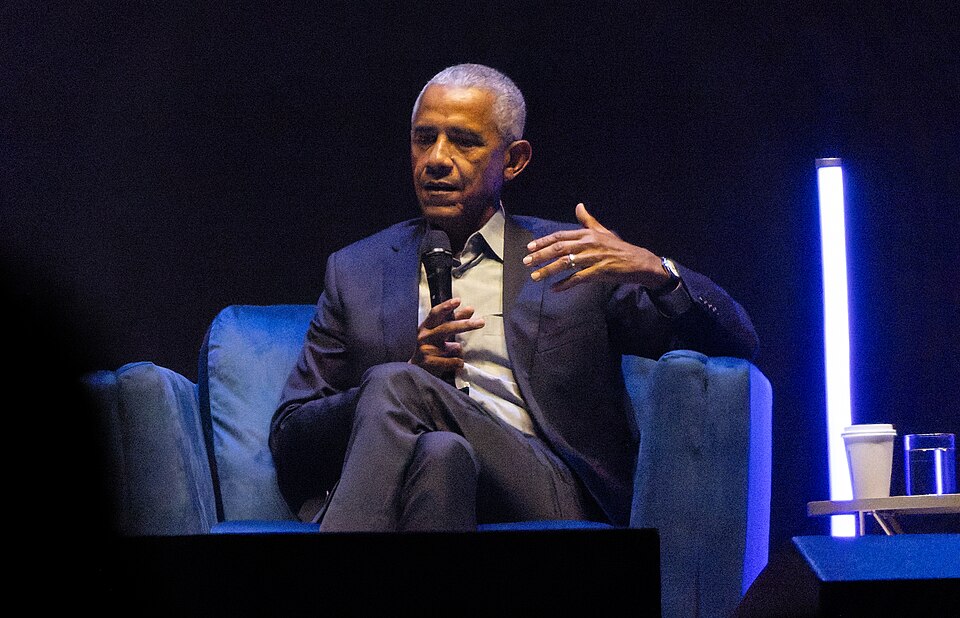
Here’s what Obama had to say.
Former President Barack Obama is warning that artificial intelligence could pose serious risks if Washington fails to keep pace with the rapidly developing technology, offering a noticeably different emphasis from President Donald Trump’s push to keep America at the forefront of the global AI race.
Speaking Thursday at a private Democratic fundraiser in New York City, Obama urged Democratic leaders to make artificial intelligence a major part of their policy agenda heading into the midterm elections and eventually the 2028 presidential race.
The former president appeared alongside House Minority Leader Hakeem Jeffries of New York and argued that lawmakers need to begin addressing the enormous economic and social changes that could accompany increasingly powerful AI systems.
Obama warned that AI is advancing rapidly under the control of private companies and could become dangerous if policymakers fail to establish appropriate oversight.
But Obama did not portray artificial intelligence as entirely negative.
He acknowledged that the technology could potentially accelerate medical research, including drug development, while also helping scientists tackle difficult energy and technological challenges.
The larger question, according to Obama, is whether government can establish appropriate safeguards while those advances are taking place.
Obama Pushes Democrats To Act On AI
Obama reportedly encouraged Democrats to make artificial intelligence much more prominent in their political agenda.
He specifically urged Jeffries to prepare a framework for a national discussion about AI if Democrats take control of the House.
Obama urged Democrats to develop a clear framework for a broad public discussion on artificial intelligence if Jeffries becomes House speaker.
Obama also had advice for Democrats considering presidential campaigns in 2028.
He said prospective candidates should develop a “very clear plan” for artificial intelligence and make the issue one of their central priorities.
Among his concerns are two issues that could directly affect American families: employment and children.
As AI systems become capable of performing more sophisticated tasks, businesses are already examining how the technology could change their workforces. At the same time, parents and lawmakers are confronting questions about how increasingly advanced AI tools should interact with younger users.
Trump Has Put America’s AI Race With China Front And Center
President Trump has placed greater emphasis on rapidly expanding American artificial intelligence capabilities and preventing China from gaining the technological advantage.
For Trump, AI has increasingly become an issue of economic and national security.
His administration unveiled a national AI legislative framework in March that called for a consistent national approach to the technology while addressing issues ranging from child safety and free speech to energy costs and intellectual property.
The administration has argued that Washington must establish appropriate rules without creating a regulatory environment that prevents American companies from competing globally.
That creates a significant difference in emphasis between the current and former presidents.
Obama is highlighting the potential dangers of allowing the technology to advance faster than government oversight.
Trump has emphasized the danger of allowing excessive restrictions to slow American innovation while China continues developing its own AI capabilities.
Their positions are not entirely incompatible, however.
Both approaches recognize that artificial intelligence presents risks requiring safeguards. The larger disagreement involves how aggressively Washington should intervene and how those safeguards should be balanced against America’s need to remain technologically competitive.
Americans Are Increasingly Concerned About AI
The debate in Washington is unfolding as Americans become more familiar with artificial intelligence — and increasingly concerned about what it could mean for their lives.
An April Fox News survey found that 63% of voters viewed artificial intelligence as harmful to personal privacy.
Another 56% said AI hurts U.S. job creation, while only 21% believed it helps create American jobs.
Those numbers illustrate one of the biggest challenges facing elected officials.
AI companies and their supporters frequently point to enormous potential gains in productivity, medicine, scientific research and economic growth. Workers, meanwhile, are understandably interested in whether some of those same productivity gains could eventually eliminate or substantially change their jobs.
That concern could become increasingly important as artificial intelligence moves beyond technology companies and into offices, factories and businesses throughout the country.
Republicans Debate How Much Government Control Is Necessary
Concerns about AI are not limited to Democrats.
Amy Kremer, an RNC member and chairwoman of Humans First, told Fox News Digital that policymakers should recognize both the opportunities and risks associated with artificial intelligence.
But she rejected the idea that Washington bureaucrats or major technology companies should receive excessive control over the industry’s future.
Kremer argued that the solution should neither give federal officials greater authority nor allow major technology companies to establish the rules governing their own industry.
She instead called for safeguards focused on American workers, children and national security while ensuring the United States remains competitive with China.
That distinction could become increasingly important as Congress considers future AI legislation.
The debate is no longer simply about whether artificial intelligence should be regulated. Lawmakers must decide who establishes those rules, how extensive they should be and whether restrictions could inadvertently weaken American companies against foreign competitors.
Even Technology Leaders Are Sounding Alarms
Warnings about the pace of artificial intelligence development are also coming from inside the technology industry.
Anthropic CEO Dario Amodei recently urged the AI industry to ease the pace of development, cautioning that rapidly advancing systems could eventually outstrip humanity’s ability to fully understand and manage them.
Other prominent technology executives have expressed support for increased attention to AI safety.
That adds another complication to the debate.
Some of the people most familiar with the technology’s capabilities are simultaneously promoting its enormous potential and warning that its development requires careful attention.
AI Could Become A Major Political Issue
For years, artificial intelligence was largely viewed as a specialized technology issue.
That is rapidly changing.
AI now touches some of the biggest concerns facing American families: employment, privacy, children’s safety, electricity prices, national security and competition with China.
Obama clearly believes Democrats should capitalize on those concerns by developing a comprehensive AI agenda.
Trump, meanwhile, has made American technological dominance a central part of his approach, arguing that winning the AI race is critical to the country’s future.
The divide is therefore more complicated than simply being “for” or “against” artificial intelligence.
The emerging debate is about how fast America should move, how much authority Washington should exercise, what protections Americans need and how the country can establish safeguards without surrendering its technological advantage to China.
Those questions are unlikely to disappear.
As artificial intelligence becomes more powerful and more deeply integrated into everyday life, Washington’s decisions could affect American workers, businesses and families for decades to come.