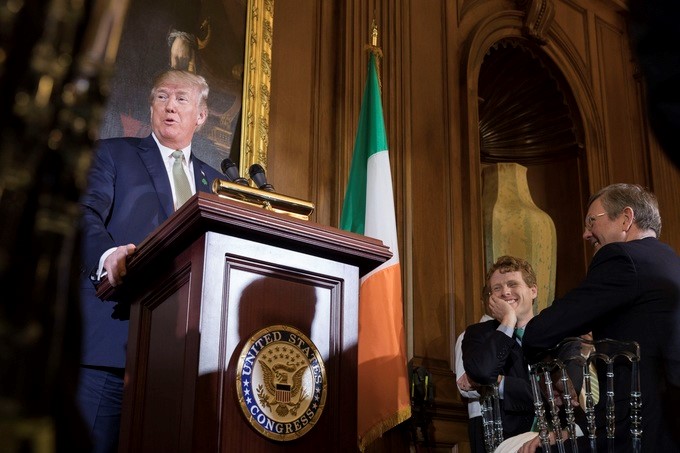
Here’s what Trump said.
President Donald Trump created a fresh diplomatic headache for the United Kingdom during his visit to Ireland after openly expressing support for the possibility of a united Ireland.
Trump said he would “love” to see the Republic of Ireland and Northern Ireland unified, wading into a politically sensitive debate that has shaped relations between Ireland and Britain for generations.
His comments were especially notable because Northern Ireland remains part of the United Kingdom, and any attempt to change that status would require a formal democratic process.
“I have friends on both sides, great people,” Trump said while discussing the issue.
Trump acknowledged that Britain would have its own position on reunification but argued that bringing the island together could ultimately be positive.
The remarks quickly attracted attention in the UK, where the future of Northern Ireland remains a contentious political subject.
Trump Weighs In On Irish Unification
Trump’s comments came as British leaders continued to push back against the prospect of an immediate referendum on Northern Ireland’s constitutional future.
British Prime Minister Andy Burnham has said that a referendum is not currently on the table, making Trump’s public support for eventual reunification particularly significant.
The American president did not announce any new U.S. policy toward Northern Ireland. Instead, his remarks represented his personal view about what he would like to see happen.
That distinction is important because the future of Northern Ireland cannot simply be decided by the United States, Britain or Ireland without the democratic process established under existing agreements.
Good Friday Agreement Determines What Happens Next
The 1998 Good Friday Agreement provides the framework governing any potential change to Northern Ireland’s constitutional status.
Under the agreement, the British government can call a referendum on whether Northern Ireland should remain within the United Kingdom or join a united Ireland when the necessary conditions are met.
Any successful reunification process would require democratic approval on both sides of the Irish border.
Northern Ireland has been part of the United Kingdom for more than a century following the partition of Ireland in the early 1920s.
That complicated history helps explain why comments from an American president about reunification can generate significant attention on both sides of the Irish Sea.
Trump Also Raises Falkland Islands Question
Trump did not stop with Northern Ireland.
During the same trip, he addressed another sensitive territorial issue involving Britain: the Falkland Islands.
The South Atlantic islands are controlled by the United Kingdom but have long been claimed by Argentina. Britain and Argentina fought a war over the territory in 1982 after Argentine forces invaded the islands.
Asked about the Falklands during his Ireland visit, Trump recalled the conflict and pointed to the enormous distance separating Britain from the territory.
“That is very far away,” Trump said.
His comments came amid renewed discussion of the islands and Argentina’s longstanding claim to them.
Trump also suggested that he could potentially become involved as a mediator if tensions escalated.
“I’m sure I’ll be called into that potential disaster,” he said.
Two Sensitive Issues For Britain
Taken together, Trump’s comments placed the president in the middle of two territorial disputes that carry considerable historical and political importance for the United Kingdom.
Northern Ireland and the Falkland Islands involve very different circumstances, legal arrangements and histories. But both remain politically sensitive subjects in Britain.
Trump’s willingness to publicly discuss them added an unexpected diplomatic dimension to what was otherwise a high-profile visit to Ireland.
Trump Heads To Doonbeg
Following his political meetings, Trump traveled to his golf property in Doonbeg, County Clare, where he was attending the Irish Open.
His visit generated considerable attention both inside and outside Ireland, but his remarks about reunification ensured that the political consequences of the trip extended well beyond golf.
For Britain, Trump’s intervention arrived at an uncomfortable moment as officials sought to maintain their existing position on Northern Ireland.
For Ireland, his comments placed renewed international attention on a debate that has continued for decades.
And for Trump, the episode once again demonstrated his willingness to speak publicly about sensitive international disputes — even when America’s closest allies may disagree with what he has to say.