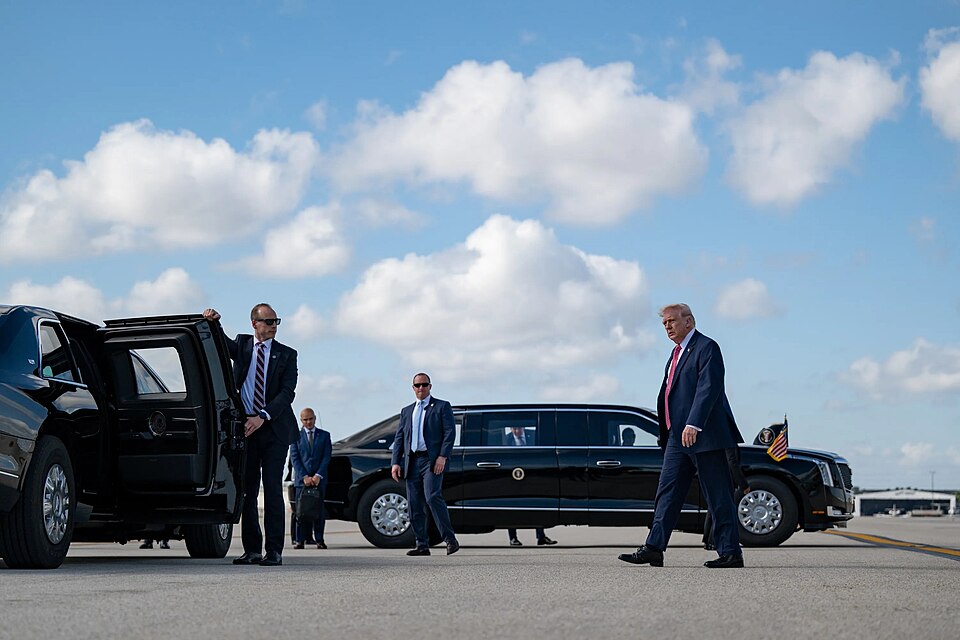
Here’s what happened.
President Donald Trump’s motorcade reportedly reached speeds approaching 100 miles per hour Thursday after severe weather forced an unexpected change to the president’s travel plans between Texas and Oklahoma.
Journalists traveling with the presidential convoy reported that vehicles in the motorcade reached speeds of approximately 98 mph during the roughly 90-mile trip from Denton, Texas, to Durant, Oklahoma.
The extraordinary drive immediately drew attention because speeds approaching 100 mph would ordinarily be far above normal highway limits.
But whether the presidential motorcade actually violated traffic law is a more complicated question.
Bad Weather Forces Trump Onto The Highway
Trump had been scheduled to travel from his appearance at the Peterbilt Motors manufacturing facility in Denton to another event in Durant.
Under normal circumstances, the president could have made part of the journey aboard Marine One or another aircraft.
Stormy weather changed those plans.
Unable to make the expected flight, Trump and his security detail instead traveled north by motorcade.
That turned what would have been a routine presidential transfer into an unusual high-speed highway journey.
Trump discussed the change of plans while the motorcade was underway.
In a Truth Social post, he told supporters in Oklahoma that weather conditions had prevented planes and helicopters from landing.
Trump said there had been discussion about postponing the event, but he refused to cancel his appearance.
He also drew attention to the speed of the presidential limousine.
“The Beast,” Trump wrote, was traveling “faster than it has ever gone before.”
Motorcade Reportedly Reaches 98 MPH
Members of the traveling press reported that vans accompanying the president reached approximately 98 mph during the drive.
That figure quickly became one of the biggest talking points surrounding the trip.
For an ordinary driver, traveling at nearly 100 mph could result in serious consequences depending on the road, posted speed limit and circumstances.
A presidential motorcade, however, is not an ordinary group of vehicles.
Presidential travel involves extensive security coordination between the U.S. Secret Service and federal, state and local law-enforcement agencies.
Police may secure intersections, temporarily control traffic and establish a protected route around the president.
Those circumstances matter when determining whether normal traffic rules apply.
Did Trump’s Motorcade Break The Speed Limit?
Despite the attention-grabbing speed, the fact that vehicles reportedly reached 98 mph does not automatically establish that anyone broke the law.
Texas transportation law contains exceptions allowing certain authorized emergency vehicles to exceed normal maximum speed limits under specified circumstances.
The law also addresses police escorts and allows qualifying emergency vehicles to disregard certain traffic restrictions when legally conducting those duties.
Drivers are still required to consider the safety of other people and property.
There has been no publicly established finding cited in reports surrounding the trip showing that Trump, the Secret Service or another member of the presidential motorcade received a speeding citation or was officially determined to have violated Texas traffic law.
That distinction is important because the headline-grabbing speed and the legal question surrounding it are two different things.
Trump Describes High-Speed Trip To Oklahoma
After finally reaching Durant, Trump discussed the unusual journey with supporters.
He said he asked members of his team how fast “The Beast” could travel after learning that weather had disrupted the original transportation plan.
According to Trump’s account, he was told the armored presidential vehicle could travel close to 100 mph.
Trump responded by insisting that the group get into the vehicles and continue toward Oklahoma.
The president eventually arrived approximately two hours behind schedule.
Instead of canceling because of the delay, Trump appeared before the waiting crowd and explained why he had decided to make the lengthy drive.
Why Trump Said He Wouldn’t Cancel
Trump told the Oklahoma audience that he was determined to appear because of his political history with the state.
He pointed to his strong electoral performances in Oklahoma during his presidential campaigns and noted that he had carried all 77 counties.
The president presented the decision to continue by road as a commitment to supporters who had waited for his arrival.
The episode also offered a rare public look at what can happen when presidential security plans suddenly change.
Travel involving a sitting president is normally planned in extensive detail, with multiple transportation and security contingencies.
Severe weather can force those plans to change rapidly.
In this case, the result was a presidential convoy traveling approximately 90 miles between two states while trying to reach an event that was already significantly delayed.
Why Presidential Motorcades Operate Differently
Presidential motorcades are designed primarily around security.
The Secret Service works with other law-enforcement agencies to keep the president’s vehicle moving through a controlled environment.
That can include blocking intersections, redirecting motorists and temporarily restricting access to portions of roads.
The presidential limousine itself is also unlike an ordinary passenger vehicle.
Commonly known as “The Beast,” the heavily armored vehicle is specifically designed to transport and protect the president.
Although many details about its security features remain confidential, its appearance on an interstate highway at reported speeds approaching 100 mph was enough to generate widespread attention.
Public Safety And Presidential Security
The incident raises a broader question about the balance between presidential security, urgent travel requirements and public safety.
For most Americans, posted speed limits establish how quickly motorists can legally travel.
Emergency vehicles and law-enforcement operations can operate under different rules when legal requirements are satisfied.
Texas law permits qualifying authorized emergency vehicles to exceed maximum speed limits in certain circumstances, including specified emergency and police-escort situations, provided applicable safety requirements are followed.
That means the reported speed of Trump’s motorcade should not automatically be treated as proof of illegal conduct.
The circumstances surrounding the individual vehicles, the role of law enforcement and the legal status of the motorcade would all matter.
A Routine Trip Turns Into An Unusual Presidential Journey
What began as a weather disruption ultimately became one of the more unusual moments of Trump’s trip through Texas and Oklahoma.
Instead of flying between appearances, the president traveled approximately 90 miles by road as his motorcade reportedly approached triple-digit speeds.
Trump eventually made it to Durant, despite arriving significantly later than planned, and addressed supporters who had remained at the event.
The story generated attention because nearly 100 mph would be extraordinary for an everyday motorist.
But presidential travel comes with security considerations and legal rules that do not always apply to ordinary drivers.
For that reason, while the reported speed is notable, it should not be described as definitive proof that Trump’s motorcade illegally violated the speed limit unless authorities make such a determination.