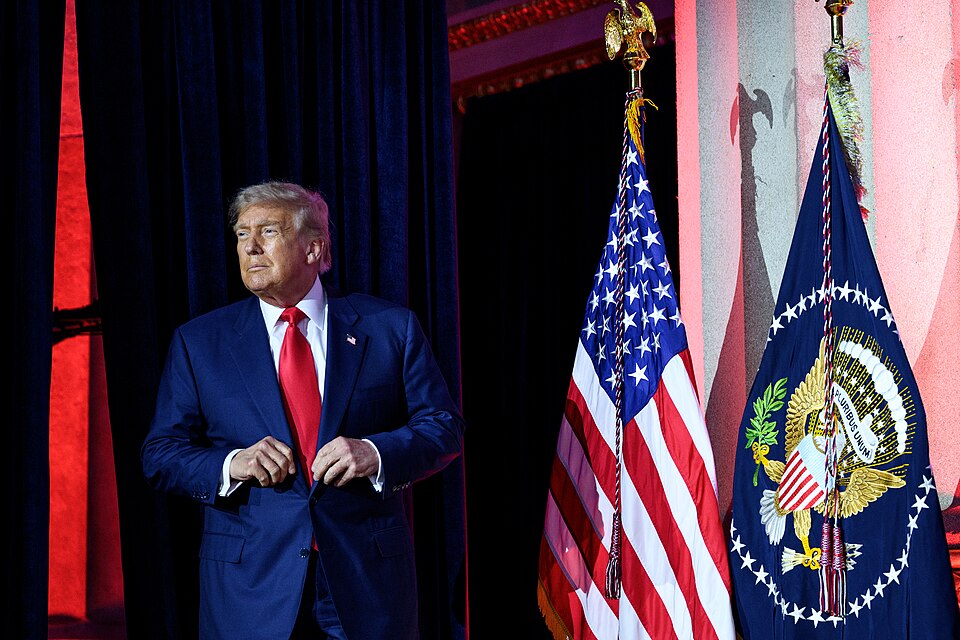
Here’s what Trump asked Americans.
President Donald Trump is proposing a new name for artificial intelligence, arguing that the term commonly used to describe one of the world’s fastest-growing technologies may no longer accurately reflect what AI can do.
Trump took the question directly to his followers Saturday, posting a poll on Truth Social that offered three possible replacements for “Artificial Intelligence.”
The choices were “Superior Intelligence,” “Extreme Intelligence” and “Supreme Intelligence.”
Trump said the current name is “inaccurate” and suggested his alternatives provide a more fitting description of a technology that is rapidly transforming American business, communications, national security and everyday life.
The president also described the growth of AI as an ongoing technological “revolution” and asked users to vote for their preferred name.
More than 27,000 people had reportedly participated in the poll by early Saturday afternoon.
Trump Wants a New Name for AI
Trump’s proposal may sound unusual, but it comes as artificial intelligence becomes an increasingly important economic and political issue in Washington.
AI technology is already being used across industries including manufacturing, health care, finance, transportation, defense, advertising and communications.
Supporters say the technology could increase productivity, accelerate scientific discoveries and strengthen America’s position in the global economy.
Critics and lawmakers, however, have raised questions about privacy, surveillance, electricity demand, cybersecurity and the enormous data centers required to operate advanced AI systems.
Those competing concerns are now creating an increasingly complex debate over how America should approach artificial intelligence.
Data Centers Raise Concerns Over Electricity Costs
One major issue involves the rapid construction of enormous data centers needed to power AI systems.
Sen. Jon Husted, R-Ohio, has introduced legislation aimed at preventing households and small businesses from being required to cover infrastructure costs associated with large new data centers.
His Ratepayer Protection Act would require states to consider standards governing how major electricity users pay for the infrastructure required to connect them to the power grid.
The House approved the measure in a bipartisan 417-3 vote on September 16.
Husted then attempted to advance the bill through the Senate on September 17, but an objection prevented its passage by unanimous consent.
The debate reflects a growing concern among Americans as AI companies invest billions of dollars in computing facilities that require enormous amounts of electricity.
For families already watching monthly utility bills closely, the question of who pays for that new infrastructure could become increasingly important.
AI Surveillance Creates New Privacy Questions
Privacy is another major concern.
Sen. Josh Hawley, R-Mo., has launched an investigation into companies operating AI-powered surveillance camera networks.
Hawley invited executives from Flock Safety, Axon Enterprise, Motorola Solutions and Verkada to testify before a Senate Judiciary subcommittee on September 23.
His investigation focuses partly on how companies collect, store and use information gathered by AI-assisted cameras and license plate readers.
According to Hawley’s office, Flock operates approximately 120,000 AI-powered cameras across the United States.
The technology can help law enforcement identify vehicles and investigate crimes, but its widespread use has also generated questions about how much information private companies should collect about ordinary Americans.
That debate places two longstanding priorities — public safety and personal privacy — directly alongside the rapid expansion of artificial intelligence.
Washington Divided Over AI Regulation
Lawmakers are also divided over how aggressively the federal government should regulate the industry.
House Speaker Mike Johnson has warned that dramatically slowing American AI development could give China a competitive advantage.
Johnson has nevertheless said there is room for safeguards, including greater transparency and independent auditing of AI companies.
His position reflects an emerging debate in Washington: how to encourage American innovation while establishing protections against potential abuse or unintended consequences.
Trump has generally favored a lighter regulatory approach.
His administration has emphasized rapid AI development as part of a broader competition with China for technological and economic leadership.
Reuters reported September 19 that Trump also announced plans for a new AI adviser and an “AI force,” while continuing to oppose additional regulation that he believes could slow the industry.
Tech Executives Sound the Alarm
Some of the industry’s own leaders have taken a different position.
Executives and researchers at major AI companies have publicly raised concerns about how quickly increasingly powerful systems are being developed.
Anthropic CEO Dario Amodei has argued that developers should slow the rate at which advanced AI capabilities improve so researchers and governments have more time to understand potential risks.
Reuters reported that concerns over rapidly advancing systems have intensified across the industry, while some technology leaders continue to argue that slowing development could allow competitors to gain ground.
The disagreement shows how dramatically the conversation surrounding artificial intelligence has changed.
The debate is no longer simply about whether AI will become important.
It is increasingly about how powerful the technology should become, who should control it and what rules should govern its use.
China Looms Over America’s AI Debate
China is another major factor driving Washington’s approach.
Both the United States and China view artificial intelligence as strategically important for economic growth, military technology and national security.
The two countries are competing over advanced computer chips, AI models and access to the computing infrastructure necessary to operate them.
That competition has encouraged some U.S. lawmakers and technology executives to warn against regulations that could slow American companies while Chinese developers continue advancing.
At the same time, security experts have raised concerns about autonomous weapons, cybersecurity and the possibility that advanced AI technology could be exploited by foreign governments or criminal organizations.
Trump Has Been Talking About Renaming AI for Months
Trump’s latest proposal is not the first time he has questioned the name “artificial intelligence.”
He previously suggested calling the technology “supreme intelligence,” though he indicated at the time that technology industry leaders would ultimately decide what terminology to use.
Saturday’s poll takes the idea further by asking the public to choose between several possible alternatives.
Whether any of those names catch on remains uncertain.
The term “artificial intelligence” has been used for decades and is deeply embedded in business, universities, government agencies and technology companies worldwide.
Changing such an established term would likely require widespread adoption across the industry rather than a government decision alone.
AI Debate Is Only Getting Bigger
Whatever it is ultimately called, artificial intelligence is becoming increasingly difficult for Americans to ignore.
The technology is influencing jobs, electricity demand, privacy, national security, consumer products and America’s economic competition with China.
For Washington, the challenge will be determining how much oversight is necessary without discouraging innovation or weakening American companies in an increasingly competitive global technology race.
Trump’s proposed name change may be the latest headline surrounding AI, but the much larger debate over the technology’s future is only beginning.