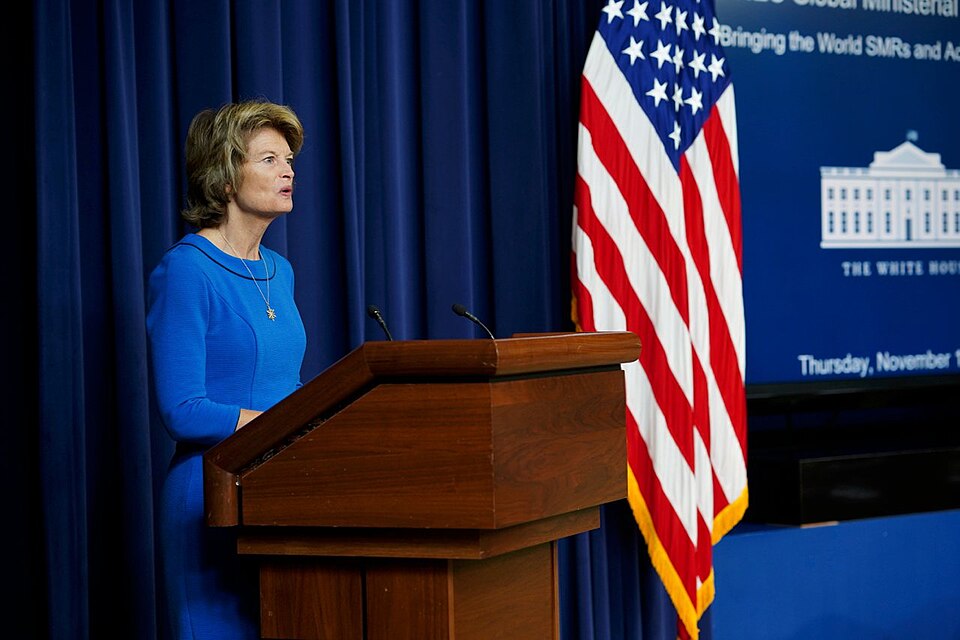
Here’s what 1 Republican said about Trump’s SAVE Act.
The debate over President Donald Trump’s proposed SAVE Act is intensifying as one Republican senator warns the legislation could create significant costs for some Americans seeking to register to vote.
Sen. Lisa Murkowski (R-Alaska) outlined her concerns in a Wall Street Journal opinion column published Friday, arguing that the Safeguard American Voter Eligibility (SAVE) Act could make voter registration far more difficult for residents of Alaska’s remote communities. According to the senator, some voters could face travel expenses exceeding $1,000 simply to complete the registration process.
The proposal remains one of President Trump’s top election priorities and is strongly backed by many congressional Republicans, who say it is necessary to strengthen election integrity by ensuring only U.S. citizens participate in federal elections. However, critics—including Murkowski—argue the measure could unintentionally create new hurdles for eligible voters, particularly in rural states.
Murkowski Raises Concerns About Alaska
In her opinion piece, Murkowski said she supports efforts to prevent non-citizens from voting but believes the SAVE Act would create unique challenges for Alaska due to its geography and limited election infrastructure.
The measure would require people signing up to vote in federal elections to prove their U.S. citizenship with records such as a passport, birth certificate, or naturalization document. Many applicants would need to submit the paperwork directly to election authorities in person.
Murkowski argued that requirement would effectively eliminate the convenience of online voter registration for many Alaskans.
She noted that Alaska has only six state election offices where the documentation requirement could clearly be fulfilled, despite being the nation’s largest state by land area. Approximately 80 percent of Alaska’s communities are not connected by roads, making travel difficult and expensive.
Registration Could Become Costly
To illustrate the potential impact, Murkowski described the situation facing an 18-year-old first-time voter living in Savoonga, a remote community in the Bering Sea.
According to the senator, that individual would likely need to purchase a round-trip flight to Nome costing roughly $780, followed by an overnight hotel stay exceeding $300 before even accounting for meals or local transportation. The total cost, she argued, could easily surpass $1,000 simply to register to vote.
Murkowski also expressed concern that older residents and some Alaska Native voters could face additional obstacles if they do not have immediate access to birth certificates or other citizenship documents required under the proposal.
Previous Opposition
This is not the first time Murkowski has opposed the legislation.
Earlier this year, she voted against the SAVE Act, arguing that election administration has traditionally been the responsibility of individual states rather than the federal government.
She has also publicly stated that while she supports voter identification requirements, she does not support the SAVE Act in its current form.
What the SAVE Act Would Do
The SAVE Act would make proof of U.S. citizenship a condition for registering to vote in federal elections.
Supporters argue the measure would strengthen confidence in American elections by ensuring only eligible U.S. citizens can register. Opponents counter that non-citizen voting is already illegal and argue the new documentation requirements could create unnecessary burdens for lawful voters who do not have easy access to citizenship records.
President Trump has repeatedly urged Congress to approve the legislation, calling it an essential safeguard for election security. During a recent address, he argued that passing the bill is necessary to protect the integrity of future elections.
Virginia Republican Rep. Ben Cline also voiced support, saying Americans deserve confidence that federal elections are conducted securely and that the SAVE Act would help reinforce those protections.
Critics Question the Proposal
Voting rights organizations and Democratic lawmakers remain opposed to the legislation.
They argue that millions of eligible Americans may not have immediate access to documents such as passports or birth certificates, potentially delaying or complicating voter registration.
A 2024 study from the Brennan Center for Justice and its research partners estimated that about 21 million adult U.S. citizens lack easy access to documents proving their citizenship. It also found that millions more had lost those records, had them destroyed, or had never obtained replacements.
Supporters of the bill dispute the significance of those findings and maintain that stronger verification standards are necessary to protect election integrity.
Where the Legislation Stands
Although House Republicans have approved versions of the SAVE Act multiple times, the measure continues to face an uncertain future in the Senate, where most legislation requires 60 votes to advance.
Previous efforts to attach the proposal to other legislation have fallen short, with several Republican senators joining Democrats in opposition.
Texas Rep. Chip Roy, the bill’s lead House sponsor, has urged the Senate to act quickly, while President Trump continues encouraging lawmakers to send the legislation to his desk before the 2026 midterm elections.
Some Republican senators, however, have questioned whether state and local election offices would have enough time to implement the new requirements before November.
For now, the SAVE Act remains one of the most closely watched election bills in Congress, with supporters calling it a critical election security measure and opponents warning it could impose significant new burdens on eligible voters.