Democrats are creating a new headache for Trump.
A political storm is brewing after the Supreme Court struck down major portions of President Donald Trump’s tariff policy — and now New York Democrats are demanding billions of dollars be returned to American taxpayers.
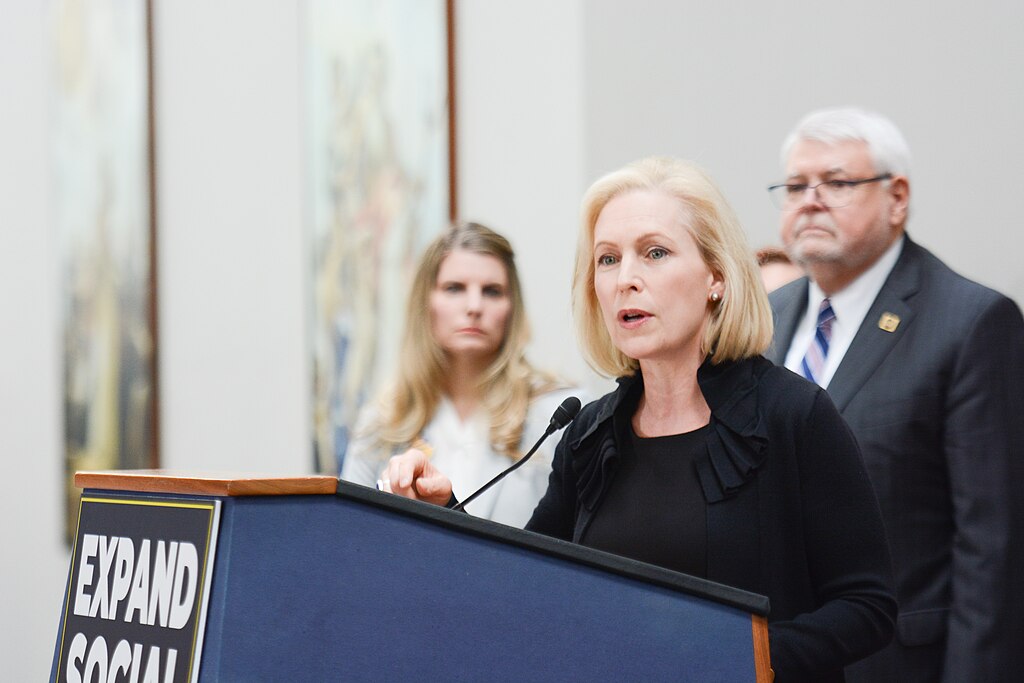
Sen. Kirsten Gillibrand is leading the charge, calling on the Trump administration to immediately refund what she describes as excessive tariff costs paid by small businesses and consumers.
During a virtual press conference, Gillibrand claimed that American households absorbed the vast majority of tariff-related expenses, estimating roughly $130 billion in federal revenue was generated through the trade measures.
“That’s money that President Trump now owes back to the American people,” she said.
Conflicting Cost Estimates Raise Questions
One of the most striking elements of the debate is the conflicting data.
- Gillibrand estimates the average New York household paid about $4,200 per year due to tariffs.
- Meanwhile, Gov. Kathy Hochul referenced Yale Budget Lab data estimating the impact closer to $1,751 per household annually.
The significant gap between those figures has fueled skepticism among critics who argue the numbers may be politically amplified as the 2026 election cycle approaches.
For many retirees and middle-class families already dealing with inflation and rising costs, the disagreement only adds to confusion.
Democrats Float Legal Action Against Administration
Gillibrand suggested that businesses pursue legal remedies and encouraged struggling companies to seek help from New York Attorney General Letitia James.
“I imagine our attorney general will file a lawsuit,” she stated, indicating litigation may be the path forward to secure refunds.
Governor Hochul’s office stopped short of confirming legal action but said the state would “explore all options” to recover funds for New Yorkers.
The move signals a potential legal battle that could escalate tensions between Albany and Washington.
Small Businesses Caught in the Middle
Senate Minority Leader Chuck Schumer spotlighted a Rochester manufacturer who reportedly lost $1 million due to tariff-related supply costs. According to Schumer, the financial strain forced the company to reduce its workforce by 20 percent.
The business owner attended President Trump’s State of the Union address as a guest, highlighting the economic debate playing out nationwide.
Supporters of the president argue that tariffs were implemented to strengthen domestic manufacturing, protect American jobs, and counter unfair foreign trade practices.
Conservatives Defend Trump’s Trade Strategy
Not all New Yorkers agree with Democratic leaders.
Gerard Kassar, chairman of the New York State Conservative Party, praised President Trump’s economic vision following the State of the Union address. He argued that tariffs were part of a broader “America First” strategy aimed at restoring U.S. economic independence.
Many Trump supporters contend that while tariffs can create short-term price pressures, they are designed to deliver long-term gains for American industry and workers.
Agriculture and Tourism Concerns
Governor Hochul also pointed to impacts on agriculture and cross-border tourism. According to her office:
- Over 80% of certain agrochemical imports
- Roughly 70% of farm machinery
come from countries subject to tariffs of 10% or higher.
To address these concerns, Hochul proposed a $30 million relief package to assist farmers facing higher equipment and fertilizer costs.
The Bigger Picture: Trade, Inflation, and Accountability
The broader debate now centers on economic accountability.
Are tariffs a necessary tool to protect American industries from foreign competition? Or should taxpayers be reimbursed after the Supreme Court’s ruling?
For millions of Americans — particularly older voters on fixed incomes — the outcome could affect everything from grocery bills to retirement budgets.
As legal threats intensify and trade policy remains front and center, this issue is likely to remain a major political flashpoint heading into the next election cycle.