Here’s what was said.
A former chairman of the Joint Chiefs of Staff is challenging the idea that Americans have already heard the complete story about conditions aboard the USS Abraham Lincoln — putting new attention on conflicting accounts from military families, the Navy and the Trump administration.
Retired Adm. Mike Mullen said Sunday that he has “great concern” about reports involving sailors aboard the aircraft carrier following its extraordinarily long deployment.
But Mullen did not directly accuse President Donald Trump of lying.
Instead, the retired four-star admiral offered a more measured assessment, saying he believes the truth about the controversy probably falls somewhere between the most alarming reports and the administration’s response.
That distinction is important as questions continue to mount about the welfare of American service members, the demands being placed on the U.S. Navy and whether America’s carrier fleet is large enough for an increasingly dangerous world.
Mullen Questions Competing Accounts
During an appearance on ABC News’ “This Week,” Mullen was asked about reports concerning conditions aboard the USS Abraham Lincoln.
Mullen, who served as chairman of the Joint Chiefs of Staff from 2007 until 2011, said he knows the carrier’s commanding officer and believes Navy leadership is working hard to address problems aboard the ship.
He nevertheless suggested Americans shouldn’t assume that either side of the public debate has presented the complete picture.
Mullen said he believes “the truth probably lies somewhere in the middle.”
His comments immediately stand out because President Trump and Defense Secretary Pete Hegseth have strongly pushed back against some of the most troubling claims surrounding the Lincoln.
Hegseth has argued that media reports have misrepresented conditions aboard the aircraft carrier.
Trump has similarly disputed concerns about the length and conditions of the deployment.
Mullen isn’t endorsing every allegation being made against the administration. But he also isn’t completely dismissing concerns raised by military families and others familiar with conditions aboard the ship.
USS Abraham Lincoln Faces Extraordinary Deployment
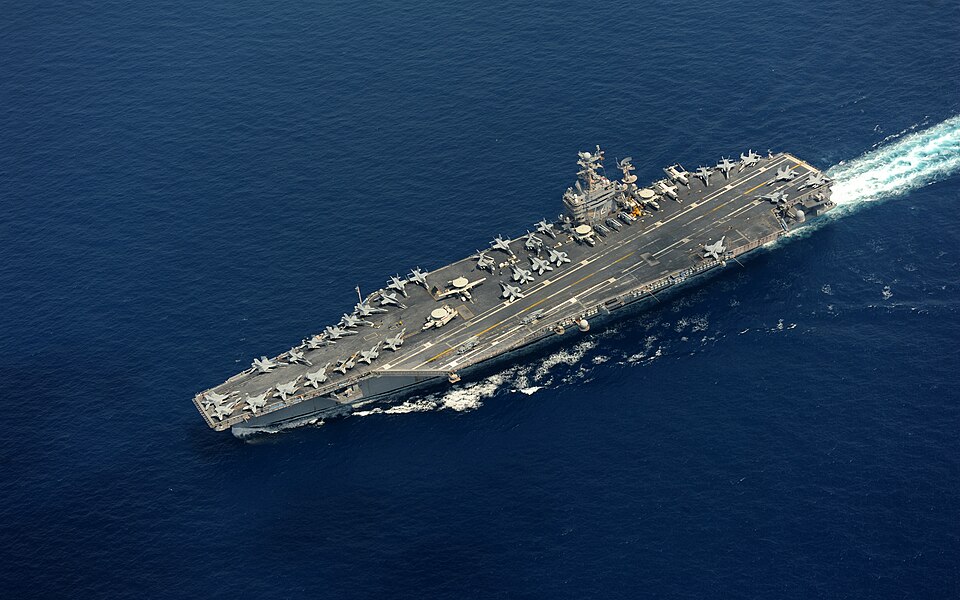
At the center of the controversy is the enormous burden placed on the roughly 5,000 sailors and Marines serving aboard the USS Abraham Lincoln.
The carrier departed on Nov. 21 and has remained deployed for more than 260 days as American forces conduct operations connected to the conflict with Iran.
That extended mission has attracted growing scrutiny.
Military families have raised concerns about morale, living conditions and the mental well-being of personnel aboard the ship.
Navy officials, meanwhile, have pushed back against claims that there has been a broad deterioration in mental health aboard the carrier.
The disagreement has created a difficult situation for Americans trying to determine exactly what is happening aboard one of the country’s most important warships.
There is little disagreement, however, about one basic fact: the Lincoln’s sailors have endured an unusually demanding deployment.
Navy Pushes Back On Reports
Acting Navy Secretary Hung Cao has attempted to provide additional context surrounding the controversy.
Cao acknowledged that a small number of mental-health cases were treated aboard the Lincoln but said those cases did not result in a loss of life.
He also addressed concerns involving food supplies.
According to Cao, meal plans had to be adjusted when fresh supplies were unavailable, but sailors continued receiving meals.
Restrictions were also placed on communications with families during certain periods because Navy officials determined that operational security threats were too high.
Those explanations present a substantially different picture from some of the more alarming accounts that have emerged.
The Lincoln, according to the Navy’s version of events, has certainly faced hardships — but many of those difficulties were consequences of operating a massive warship under dangerous combat conditions.
Trump Administration Sending Lincoln Home
There is finally relief on the horizon for the crew.
The Navy announced that the USS Abraham Lincoln will return home to San Diego as part of a planned carrier rotation.
The USS George Washington is being moved to take over responsibilities in the U.S. Central Command region.
For thousands of American military families, the Lincoln’s return will mark the end of an exceptionally difficult period.
But it won’t necessarily end the political and military debate created by the deployment.
One major question remains: Does the United States have enough aircraft carriers to meet its global responsibilities?
Mullen doesn’t think so.
Former Joint Chiefs Chairman Warns About Carrier Shortage
Mullen argued that America’s fleet of 11 aircraft carriers is being stretched by the demands placed upon it.
Aircraft carriers are among the most powerful military assets ever constructed.
A single carrier strike group gives an American president the ability to move tremendous air and naval power into a crisis zone without depending entirely on foreign governments for bases.
But that advantage comes with a limitation.
There are only so many carriers available.
Ships require maintenance. Crews require training. Sailors need time with their families. And keeping carriers continuously deployed eventually places enormous pressure on both personnel and equipment.
Mullen said he previously argued for a larger carrier fleet during the administration of former President George W. Bush.
Instead, the number eventually fell from 12 carriers to 11.
Now, decades later, Mullen believes America is dealing with the consequences.
If Washington intends to deploy carriers as aggressively as it has during the current Middle East conflict, he argues that the Navy needs more of them.
Iran Conflict Created Another Serious Problem
The Lincoln’s difficulties also demonstrate how complicated modern warfare can become.
Normally, a carrier operating overseas may be able to make port visits that provide sailors with an opportunity to rest, resupply and temporarily escape the confines of shipboard life.
The conflict with Iran made that considerably more difficult.
Mullen noted that American facilities in places such as Bahrain, Kuwait and the United Arab Emirates have faced threats during the conflict.
That reduced the number of locations military planners could safely use.
As a result, the Lincoln remained at sea for extraordinary stretches of time.
For Americans concerned about military readiness, this may be the most important part of the entire controversy.
The United States can possess the world’s most sophisticated aircraft, missiles and warships, but those weapons still depend on American men and women to operate them.
Protecting those service members isn’t a partisan issue. It is essential to maintaining an effective fighting force.
Trump’s Military Buildup Faces A Major Test
The controversy also presents a broader challenge for President Trump.
Trump has made restoring American military strength a central part of his national security agenda.
A stronger military, however, isn’t measured only by how much money Washington spends.
It also depends on having enough ships, aircraft, ammunition and trained personnel to accomplish America’s missions without unnecessarily exhausting the force.
The Lincoln deployment provides a real-world example of that challenge.
If the United States expects to maintain a powerful presence in the Middle East while simultaneously deterring China in the Pacific and responding to threats elsewhere, the Navy may need considerably more capacity.
That could mean additional ships, faster maintenance, improved logistics and potentially a larger carrier fleet.
Did Mullen Actually Call Trump A Liar?
No.
Despite the political controversy surrounding his remarks, Mullen never directly accused President Trump of lying.
What he did was question whether the public debate accurately reflects the complete reality aboard the USS Abraham Lincoln.
By saying the truth probably lies “somewhere in the middle,” Mullen left room for two possibilities at the same time.
Some reports about conditions aboard the Lincoln may have overstated the severity of the situation.
But administration officials may also not be presenting every aspect of what sailors have experienced during the lengthy deployment.
That is a much more nuanced argument than simply accusing the president of dishonesty.
Bigger Questions For America’s Military
Ultimately, the most important story may not be the political disagreement between Trump and a retired admiral.
It is what the Lincoln’s experience says about America’s ability to sustain military operations around the world.
The United States faces serious challenges from Iran, China and other adversaries. Maintaining a military capable of confronting those threats requires more than advanced technology.
It requires sufficient ships, reliable supply chains and service members who are prepared physically and mentally for demanding missions.
The USS Abraham Lincoln and its crew have carried an extraordinary burden during this deployment.
As the carrier finally prepares to return home, Washington now faces a question that extends far beyond one ship:
Is America’s Navy large enough for everything America’s leaders are asking it to do?
For conservatives who believe in peace through strength, that’s a debate worth having — because rebuilding American military power also means ensuring the men and women defending the country have the resources, equipment and support necessary to complete the mission and come home safely.