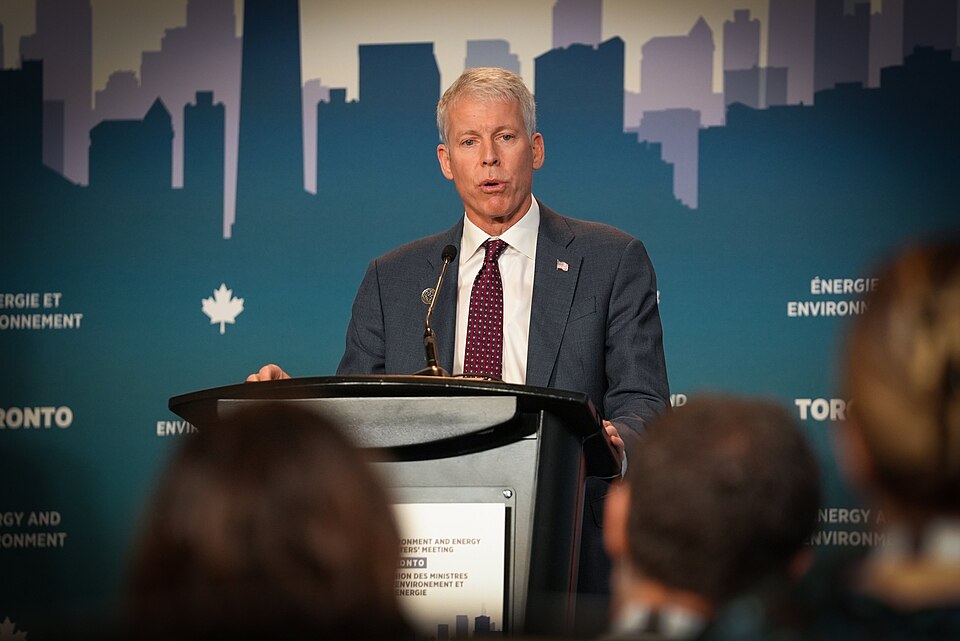
Americans hoping for a clear answer about when gas prices will finally come down did not get one Sunday from Energy Secretary Chris Wright.
With the national average for regular gasoline hovering around $4.15 per gallon, Wright was repeatedly questioned about whether drivers could soon see relief — or whether prices could climb even higher.
The exchange came during Wright’s appearance on CNN’s “State of the Union,” where host Dana Bash confronted him about his earlier prediction that high gasoline prices had peaked.
“You said on this show five months ago that high gas prices had peaked,” Bash said, before asking whether the continuing conflicts involving Iran and Russia, along with concerns about U.S. energy reserves, could push prices even higher.
Wright initially declined to make a firm prediction.
“Look, I don’t want to have an opinion on that,” Wright responded.
Instead, the Energy secretary pointed to gasoline futures, arguing that financial markets currently suggest prices could be lower in the months ahead.
According to Wright, gasoline purchased through futures contracts for roughly two months from now is priced more than 30 cents per gallon below current levels.
When Bash pressed him again for a straightforward answer, Wright finally offered his best estimate.
“If I had to guess, they’re more likely to go down than go up,” he said.
Americans Are Paying More at the Pump
Whatever happens next, motorists are currently dealing with gasoline prices substantially higher than they were a year ago.
AAA reported Sunday that the national average for a gallon of regular gasoline was approximately $4.15.
That is up sharply from roughly $3.20 per gallon at the same point last year.
The difference may not sound enormous when measured by a single gallon, but it quickly adds up for households that depend on their vehicles.
A driver filling a 15-gallon tank at $4.15 per gallon would spend about $62.25. At $3.20, that same fill-up would cost $48.
That is a difference of more than $14 every time the tank is filled.
For commuters, retirees, small-business owners and families who drive regularly, those additional expenses can become hundreds of dollars over the course of a year.
And gasoline is only part of the equation.
Diesel Prices Can Affect More Than Truck Drivers
Higher energy costs can spread throughout the economy because businesses depend on fuel to transport food, packages, construction materials and other everyday goods.
Diesel prices are particularly important.
Commercial trucks carry enormous quantities of merchandise across the United States, while farmers and other industries also depend heavily on diesel-powered equipment.
When transportation expenses increase, companies can face pressure to absorb those costs or pass at least some of them along to consumers.
That means Americans who rarely drive can still feel the effects of elevated fuel prices through the cost of groceries and other household necessities.
Iran Conflict Adds Uncertainty to Oil Markets
The continuing conflict involving the United States and Iran has become another major factor hanging over global energy markets.
The Strait of Hormuz is one of the world’s most strategically important routes for oil shipments. Disruptions involving the waterway have contributed to concerns about the availability and cost of global energy supplies.
Oil markets react quickly to fears that supplies could be interrupted.
And because crude oil represents a major component of the price consumers ultimately pay for gasoline, major movements in global oil prices can eventually reach American gas stations.
That makes predicting gasoline prices particularly difficult while military and geopolitical tensions remain unresolved.
Wright Sees Reasons Gas Prices Could Fall
Despite declining to guarantee lower prices, Wright pointed to several reasons he believes Americans could eventually receive some relief.
One is the gasoline futures market.
Another is the end of the busy summer driving season.
Gasoline demand typically changes as summer vacations end and Americans drive less during the fall. Wright also said gasoline production is expected to increase.
If supply rises while demand weakens, that combination could place downward pressure on prices.
But futures contracts are not guarantees.
Unexpected refinery problems, hurricanes, military developments or disruptions to global oil supplies could change the outlook quickly.
That leaves American motorists waiting to see whether Wright’s cautious prediction becomes reality.
Gas Prices Remain a Major Household Expense
Fuel prices have long carried political and economic importance because Americans encounter them constantly.
Unlike many economic statistics, gas prices are displayed in large numbers along highways and neighborhood streets across the country.
Consumers see the cost every time they pull into a gas station.
For Americans living on fixed incomes or carefully managed household budgets, even relatively small changes can make a noticeable difference.
A family with multiple vehicles may spend considerably more each month when gasoline approaches or exceeds $4 per gallon.
Businesses can face similar pressure when employees, delivery vehicles or equipment require significant amounts of fuel.
That helps explain why gasoline prices frequently become part of the broader national debate over inflation, energy policy and the cost of living.
Trump Administration Faces Pressure Over Energy Costs
President Donald Trump has made American energy production and lower consumer costs important parts of his economic agenda.
Current gasoline prices therefore present the administration with a highly visible challenge.
The issue also arrives as the November midterm elections approach, putting additional attention on the economy, household expenses and the administration’s handling of the conflict with Iran.
Trump has defended his approach toward Iran, emphasizing his administration’s goal of preventing Tehran from obtaining a nuclear weapon.
The administration must now balance those national security objectives against concerns about the economic consequences of prolonged instability in a region crucial to global energy markets.
Could Gas Prices Drop This Fall?
There are legitimate reasons gasoline prices could decline.
Summer driving demand is ending, gasoline production could increase, and current futures prices indicate that traders expect some relief ahead.
But there are also substantial uncertainties.
Global oil supplies, refinery capacity, weather, the Strait of Hormuz and developments involving Iran could all influence what Americans ultimately pay at the pump.
For that reason, Wright would not promise Americans a specific price or date for relief.
His assessment ultimately came down to a prediction rather than a guarantee: Gas prices are, in his view, more likely to fall than rise.
For millions of Americans currently paying around $4 or more per gallon, the question is how soon — and by how much.