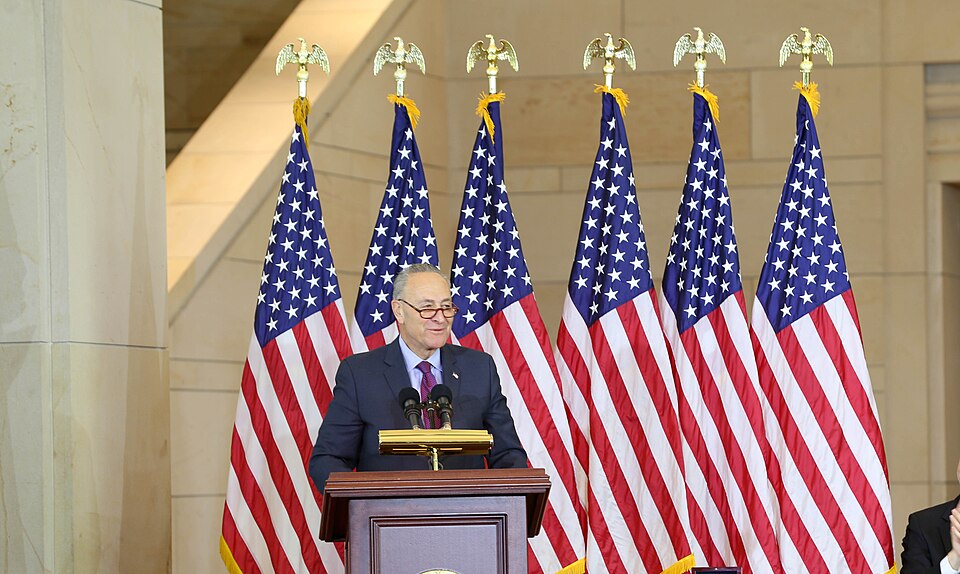
Wow! Looks like there’s a new leader in the Democrat Party and it won’t be Schumer.
A major political battle is developing inside the Democratic Party, and longtime Senate Democratic leader Chuck Schumer is finding himself under increasing pressure from members of his own party.
Newly elected Michigan Democratic Sen. Abdul El-Sayed is openly supporting a leadership change, making it clear that he would prefer Maryland Sen. Chris Van Hollen to take over as Senate majority leader.
The demand comes just days after Democrats secured control of the Senate in the 2026 midterm elections, creating an unexpected leadership controversy at a time when the party is preparing to take power.
Despite Democrats’ election victories, several incoming senators are questioning whether Schumer should continue leading the party.
For Republicans and President Donald Trump, the growing disagreement offers an early indication of the internal challenges Democrats could face when the new Congress begins.
El-Sayed Pushes For Schumer To Be Replaced
During a Thursday interview with CNN, El-Sayed reiterated his support for Van Hollen as the next Senate majority leader.
The Michigan Democrat has previously expressed his preference for Van Hollen, and his latest remarks suggest he has not reconsidered that position following the election.
“I’ve been very clear: I think he’d be an amazing Senate majority leader,” El-Sayed said.
The statement places El-Sayed among a group of incoming Democratic lawmakers who are unwilling to automatically support Schumer for another term as party leader.
El-Sayed defeated Republican Mike Rogers in Michigan’s closely watched Senate election, becoming one of the most prominent new progressive voices headed to Washington.
Throughout his campaign, El-Sayed emphasized changing the political establishment, reducing the influence of wealthy donors and expanding government involvement in health care.
His position on Schumer suggests that his calls for change also extend to the Democratic Party’s own leadership.
However, supporting a replacement does not necessarily mean Schumer will lose his position. The decision ultimately rests with Democratic senators when they hold their leadership election.
Chris Van Hollen Emerges As Possible Replacement
El-Sayed’s preferred candidate, Maryland Sen. Chris Van Hollen, has become an important figure in the debate over the Democratic Party’s future.
Van Hollen has frequently criticized the Trump administration and advocated for a more aggressive approach to advancing Democratic priorities.
He has also declined to automatically commit his support to Schumer.
Following the midterm elections, Van Hollen indicated that Democrats should have an open discussion about who is best equipped to lead the Senate.
Nevertheless, Van Hollen has not announced a formal challenge against Schumer, leaving uncertainty over whether the leadership dispute will produce an actual contest.
There is also speculation surrounding Van Hollen’s political future, including the possibility that he could seek the Democratic presidential nomination in 2028.
For now, El-Sayed’s endorsement represents support for a potential alternative rather than an organized leadership campaign.
More Democrats Question Schumer’s Leadership
El-Sayed is not the only incoming Democrat expressing concerns about Schumer’s continued leadership.
Minnesota Sen.-elect Peggy Flanagan has publicly called for new leadership, while Maine Sen.-elect Troy Jackson has also indicated that he intends to support someone other than Schumer.
Incoming Democratic senators from Illinois and Kansas have similarly expressed opposition to keeping Schumer in charge.
Other newly elected lawmakers have called for fresh leadership or indicated they want to hear more about Schumer’s plans before making a decision.
The disagreements highlight a growing debate within the Democratic Party over whether experienced establishment figures should remain in control or make room for a new generation of political leaders.
Progressive activists have also increased pressure on Senate Democrats to reconsider their leadership.
The liberal organization Indivisible has called for Schumer to be replaced, adding outside pressure to the concerns expressed by incoming senators.
The situation is particularly noteworthy because Democrats are entering the next Congress with a Senate majority.
Instead of celebrating a unified leadership team, party members are already debating who should hold one of Washington’s most influential positions.
Schumer Remains Confident He Will Keep His Job
Despite the criticism, Schumer has shown no indication that he plans to step aside.
The New York Democrat has expressed confidence that he will be elected Senate majority leader when Democrats organize for the next congressional session.
Schumer’s supporters point to the party’s sweeping midterm victories as evidence that his leadership strategy has been successful.
He played an important role in recruiting candidates, coordinating campaign efforts and directing resources toward competitive Senate races.
His political operation also invested heavily in Michigan, helping El-Sayed defeat Rogers.
That creates an unusual situation in which a newly elected senator is calling for a leadership change despite receiving substantial support from the party’s existing leadership during his campaign.
Schumer’s allies believe his experience negotiating legislation, managing a politically diverse caucus and organizing successful election campaigns makes him well suited to lead the incoming Democratic majority.
Still, election success has not silenced his critics.
The central question is whether Democratic senators will prioritize Schumer’s experience or respond to demands for a different direction.
What The Leadership Fight Means For President Trump
The disagreement could have major implications for President Donald Trump and congressional Republicans.
With Democrats preparing to control the Senate, the party will have additional power to challenge the administration’s legislative agenda, scrutinize federal agencies and influence the confirmation process for presidential nominees.
Democratic leaders have already indicated that they intend to resist Trump on major policy disputes, including judicial appointments.
A new Senate Democratic leader could pursue a different political strategy, potentially placing greater emphasis on progressive priorities and confrontations with the White House.
However, keeping Schumer would not necessarily mean a less aggressive approach toward Republicans.
The New York Democrat has made clear that he intends to use the party’s new Senate majority to advance Democratic objectives.
The internal disagreement may also complicate efforts to keep Democratic lawmakers united on spending legislation, health care, immigration and other major national issues.
For Republicans, the leadership contest will be worth watching as the balance of power in Washington changes.
A divided Democratic caucus could face challenges reaching agreements on major legislation, particularly when progressive lawmakers and more moderate Democrats have competing priorities.
Democratic Party Faces A Difficult Decision
The controversy surrounding Schumer reflects a broader struggle over the Democratic Party’s political identity following the 2026 elections.
Although Democrats achieved major victories at the ballot box, progressive lawmakers and establishment figures continue to disagree over the party’s direction.
Some Democrats believe their victories demonstrate the effectiveness of the party’s current leadership and campaign strategy.
Others argue that election success presents an opportunity to bring in new leaders and pursue more ambitious policy changes.
Those competing approaches could shape the Democratic agenda heading into the 2028 presidential election.
For El-Sayed, the decision appears straightforward: He believes Van Hollen would be a strong choice to lead Senate Democrats.
For Schumer, the challenge is convincing his colleagues that his experience and successful midterm strategy deserve another term at the top.
At this point, Schumer remains the leading candidate, and no formal challenger has emerged.
Nevertheless, the public opposition from several incoming senators demonstrates that his leadership is not universally accepted.
Democrats may have won control of the Senate, but the battle over who should lead their new majority is far from settled.