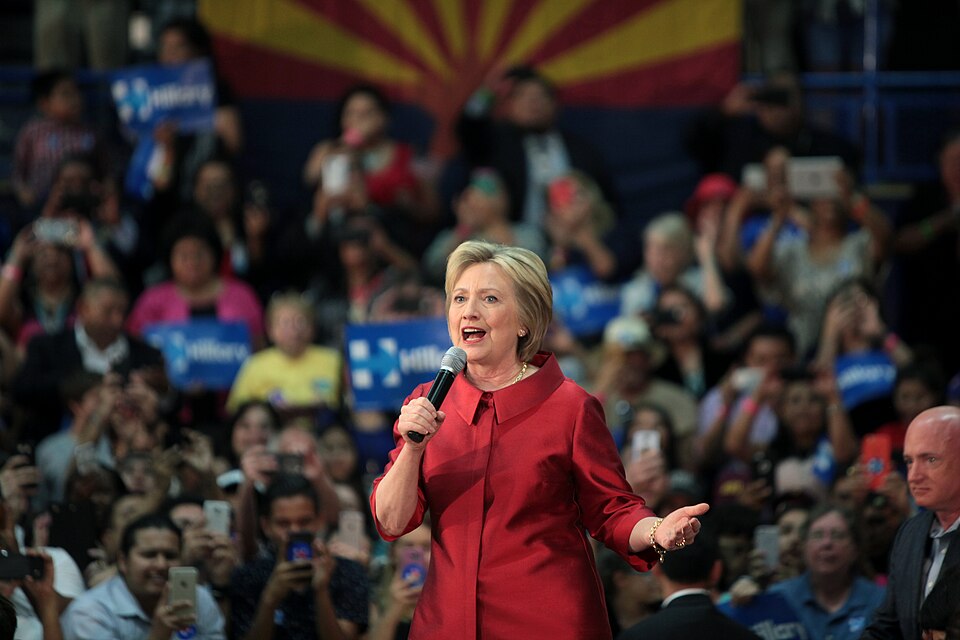
After all these years and she still hasn’t let it go.
Former Secretary of State Hillary Clinton is facing renewed criticism after revisiting her 2016 presidential election defeat to Donald Trump during a Democratic Party gathering, raising eyebrows by mentioning the controversial election alongside some of America’s most difficult moments in recent history.
The remarks, delivered Saturday during an event for Nebraska Democrats, quickly attracted attention as Clinton reflected on the political frustrations facing Democratic voters and the challenges her party faces ahead of the November midterm elections.
While discussing major events that have shaken Americans’ confidence in their government, Clinton referenced the September 11 terrorist attacks, the 2008 financial crisis, the pandemic, and her unsuccessful presidential campaign against Trump.
Her decision to include the 2016 election in that discussion has sparked fresh debate about her continued focus on the defeat nearly a decade later.
Hillary Clinton Brings Up Trump’s 2016 Victory Again
Clinton’s comments came in response to a question about Democratic voters who have become discouraged with politics and question whether participating in elections makes a difference.
The former secretary of state acknowledged that many Americans have experienced significant hardships over the past 25 years.
She recalled serving as a New York senator during the September 11 attacks and discussed the economic devastation experienced by families during the 2008 financial crisis.
Clinton then turned her attention to the 2016 presidential election, suggesting that questions surrounding that contest remain unresolved.
She also mentioned the pandemic as another major event that contributed to public frustration.
The remarks drew particular attention because Clinton’s defeat remains one of the most closely examined elections in modern American politics.
Although Clinton did not explicitly equate losing the election with the suffering caused by national disasters, her decision to include the contest in the same discussion provided critics with an opportunity to challenge her perspective.
For Republicans, the comments revived a familiar political argument surrounding Clinton’s refusal to move entirely beyond her loss to Trump.
Republicans Fire Back At Clinton
The Republican National Committee responded sharply to Clinton’s appearance, questioning her political record and criticizing the Democratic Party’s approach to governing.
RNC National Press Secretary Natalie Baldassarre argued that Clinton was poorly positioned to offer solutions to Americans who feel overlooked by political leaders.
The Republican response also criticized Democratic policies and emphasized that Clinton would never become president.
The exchange highlights the continuing tension between Clinton and the Republican Party, even as Trump serves his second term in the White House.
Trump’s 2016 victory represented a major political upset, defeating a Democratic nominee who had entered the race with decades of political experience and substantial establishment support.
His campaign focused heavily on immigration enforcement, American manufacturing, economic opportunity, and challenging Washington’s political establishment.
Those issues remain central to the national political conversation heading into the 2026 midterm elections.
Clinton Questions Trump’s Leadership
During her Nebraska appearance, Clinton also criticized President Trump’s leadership and questioned whether Americans believe their lives have improved under his administration.
She suggested that voters should examine their financial circumstances and consider whether political decisions are benefiting ordinary families.
Clinton also raised concerns about the relationship between wealthy Americans and political influence in Washington.
Her comments reflected a broader Democratic effort to focus attention on economic inequality and government accountability ahead of the upcoming congressional elections.
However, Republicans have consistently argued that Trump’s approach to economic policy, border security, and government reform represents a necessary departure from traditional Washington politics.
The competing messages illustrate the sharply different visions being presented to voters as both parties seek control of Congress.
Clinton Still Has Concerns About The Electoral College
The former Democratic presidential nominee also revisited another controversial aspect of her 2016 defeat: the Electoral College.
When an audience member asked what she would have done differently during her political career, Clinton answered that she would have preferred to win both the popular vote and the Electoral College.
Her response brought renewed attention to the constitutional system that determines presidential election outcomes.
In 2016, Clinton received more votes nationwide, but Trump secured the presidency by winning the Electoral College through victories in several critical battleground states.
The result became a defining moment in American political history.
Clinton has previously expressed strong opposition to the Electoral College and supported reconsidering the system.
Defenders of the Electoral College argue that it preserves the importance of individual states in presidential elections and ensures candidates must compete across different regions of the country.
Critics maintain that the presidency should be determined directly by the national popular vote.
The debate continues to divide Americans, particularly following presidential elections in which the popular vote winner did not secure the White House.
Democrats Face Important Midterm Elections
Clinton’s latest appearance comes as Democrats prepare for the November 3, 2026, midterm elections.
The party hopes to gain congressional seats and strengthen its ability to challenge Trump’s legislative agenda.
During the Nebraska event, Clinton expressed confidence in Democratic prospects but also emphasized that winning elections would not be enough.
She argued that Democrats must demonstrate they can deliver meaningful results for Americans who have become frustrated with politics.
Clinton has also remained involved in individual congressional races, recently endorsing Minnesota Lieutenant Governor Peggy Flanagan in her campaign for the U.S. Senate.
The endorsement demonstrates that Clinton continues to play an active role in Democratic politics despite remaining outside elected office.
Meanwhile, Republican candidates are campaigning on issues including immigration enforcement, economic growth, public safety, and the Trump administration’s record.
The outcome of November’s elections could significantly influence the president’s ability to advance his legislative priorities during the remainder of his term.
Trump’s 2016 Victory Remains A Political Flashpoint
Nearly ten years after Trump defeated Clinton, their political rivalry continues to attract national attention.
Clinton remains an influential Democratic figure, while Trump has returned to the presidency following his 2024 election victory.
Their contrasting political philosophies continue to shape debates over elections, economic policy, and the direction of the country.
For many voters, however, the most pressing concerns extend beyond political disagreements from previous presidential campaigns.
The cost of living, retirement savings, Social Security, Medicare, immigration enforcement, and national security remain important subjects as Americans evaluate the country’s future.
Clinton’s latest comments demonstrate how the 2016 election continues to influence political discussion even as the nation approaches another consequential election.
With November’s midterms approaching, voters will ultimately decide whether to reward the Republican Party’s leadership or give Democrats greater influence in Washington.
And while Clinton continues discussing the election that changed her political career, President Trump remains firmly at the center of America’s political debate.