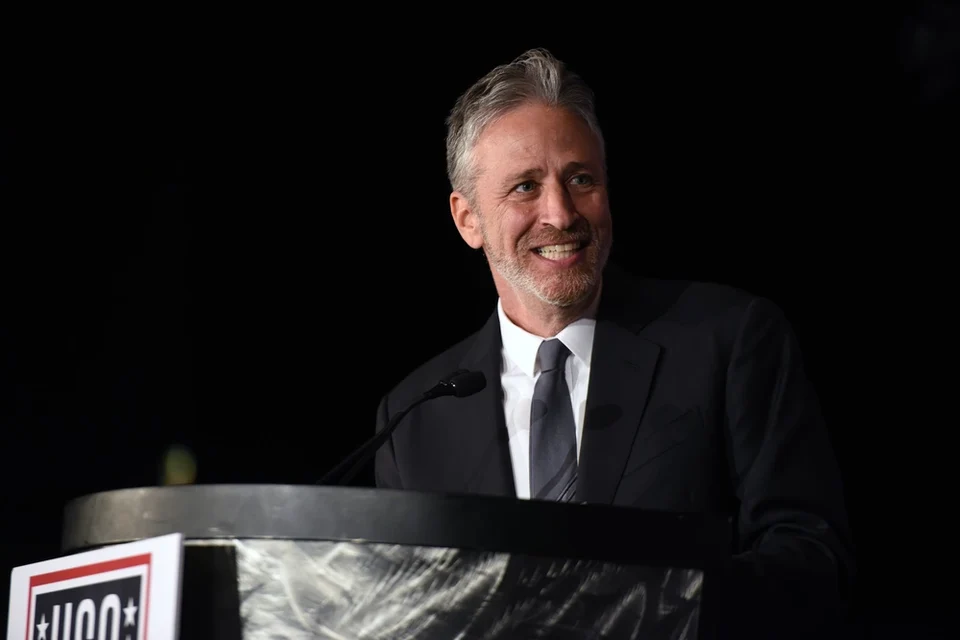
Comedian and political commentator Jon Stewart delivered a sharp attack on the U.S. Supreme Court this week, eventually raising both middle fingers toward the camera while criticizing the nation’s highest court.
The moment came during an episode of The Weekly Show, where Stewart answered questions about the Supreme Court, campaign finance and the role of the judiciary in American government.
The discussion began with a question about whether Supreme Court justices should act like baseball umpires who simply “call balls and strikes” without allowing political views to influence their decisions.
Stewart said he strongly disagreed with that description.
He accused the Court of making a series of decisions that, in his view, have made it more difficult to regulate political spending and limit the influence of money in American elections.
One of Stewart’s primary targets was the Supreme Court’s landmark 2010 decision in Citizens United v. Federal Election Commission.
The ruling held that the government generally cannot prohibit corporations and labor unions from using their own funds for independent political expenditures. It did not eliminate restrictions on direct corporate contributions to federal candidates.
Stewart argued that the decision has made campaign-finance reform far more difficult and suggested that a constitutional amendment may ultimately be necessary if lawmakers want to impose broader limits on political spending.
He also directed strong criticism at Chief Justice John Roberts and the Court under his leadership.
Stewart argued that the Supreme Court under Chief Justice John Roberts has been deeply damaging to the country over the years.
That statement reflected Stewart’s personal view of the Court rather than an objective legal conclusion.
Stewart also criticized Supreme Court decisions that have limited the authority of federal agencies, arguing that those rulings have made government regulation more difficult.
Those cases have become part of a much larger national debate over the proper balance of power between Congress, federal agencies and the courts.
Supporters of limiting agency authority argue that major policy decisions should remain with elected lawmakers rather than unelected federal regulators.
Critics, including Stewart, argue that weakening regulatory agencies can make it harder for the federal government to enforce complex laws involving areas such as environmental policy, financial regulation and workplace rules.
The conversation became more provocative when producer Gillian Spear sarcastically referred to a Supreme Court ruling that went against President Donald Trump.
Stewart responded by raising both middle fingers toward the camera and moving them around before saying, “Here’s what I say to them.”
The gesture immediately became one of the most attention-grabbing moments from the episode.
It also highlighted the increasingly intense debate surrounding the Supreme Court, whose decisions frequently affect some of the country’s most controversial political and constitutional disputes.
Stewart’s criticism centered heavily on campaign finance and the influence of money in politics.
The Citizens United decision remains one of the most debated Supreme Court rulings of the past two decades.
Supporters of the ruling argue that political spending is closely connected to First Amendment protections and that the government should not be allowed to restrict political speech simply because it comes from a corporation, labor organization or other group.
Critics argue that allowing wealthy organizations and individuals to spend large amounts of money on independent political activity can give them outsized influence over elections and public policy.
That disagreement has fueled repeated calls for campaign-finance reform, although proposals have struggled to gain enough political support to become law.
Stewart made clear which side of that debate he supports.
But rather than limiting his criticism to legal arguments, he ended the exchange with a gesture that is likely to generate just as much attention as his comments about the Court itself.
For viewers who expect political debate surrounding the Supreme Court to remain respectful, Stewart’s response may prove controversial.
For his supporters, however, the gesture appeared to represent his broader frustration with decisions he believes have fundamentally changed the relationship between money, government and American politics.
Either way, Stewart left little doubt about his opinion of the current Supreme Court.
And his two-handed gesture ensured that his criticism would be difficult to overlook.