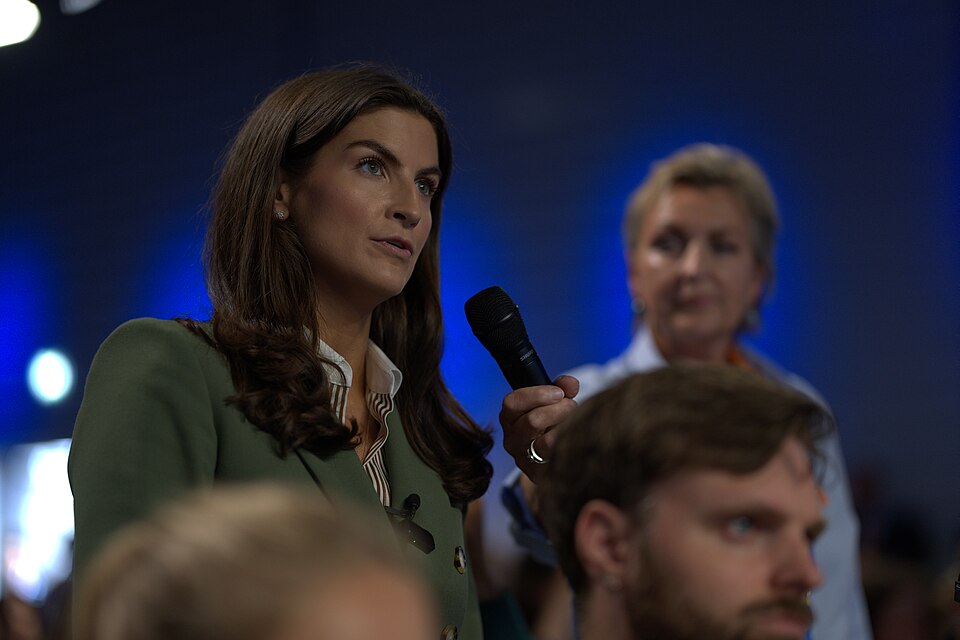
Kaitlan Collins better not be crying when Trump responds to her.
CNN anchor Kaitlan Collins has sparked a new political controversy after airing footage of empty seats at President Donald Trump’s latest campaign rally in Ohio, raising questions about crowd attendance just weeks before the November midterm elections.
The footage, broadcast Monday night on CNN’s The Source, showed sections of the Covelli Centre in Youngstown with noticeably fewer spectators than other areas of the arena.
The images immediately attracted attention because Trump has repeatedly defended the size of his political rallies and criticized news organizations that suggest his crowds are shrinking.
With Republicans fighting to maintain control of Congress, the latest episode has added another layer to the debate over Trump’s political influence heading into Election Day.
CNN Airs Footage Of Empty Seats At Trump Rally
Trump appeared in Youngstown on October 12 to campaign for Republican Senate candidate Jon Husted and Republican gubernatorial candidate Vivek Ramaswamy.
Both Republicans are facing competitive elections, making the president’s visit an important part of the GOP’s effort to energize voters.
During her broadcast, Collins showed viewers footage captured by CNN reporters and photographers inside the arena.
The images revealed empty seats in portions of the building, including areas near the upper seating sections.
Collins questioned whether the attendance might offer clues about enthusiasm for Trump’s campaign appearances, although she acknowledged that it was difficult to draw firm conclusions from the images alone.
The CNN anchor also contrasted the footage with Trump’s previous statements suggesting that his events attract large crowds, sometimes requiring additional space for supporters.
For a president who has frequently celebrated his ability to fill arenas, the televised images created an uncomfortable political moment.
Trump Has Strongly Defended His Rally Crowds
The footage comes amid Trump’s continuing disagreement with several major news organizations over their coverage of rally attendance.
Trump has repeatedly accused the mainstream media of presenting misleading accounts of his political events.
The president has maintained that his appearances attract enthusiastic crowds and that photographs showing vacant seating areas do not always reflect actual attendance.
He has also suggested that some media organizations deliberately emphasize empty seats while overlooking supporters gathered elsewhere at a venue.
In a previous dispute over attendance coverage, Trump went so far as to call for arrests in connection with reporting he considered dishonest.
The remarks attracted criticism and renewed debate over the president’s relationship with journalists.
Trump’s argument has generally been that news organizations are attempting to undermine his political standing by minimizing the enthusiasm of his supporters.
His critics, however, maintain that attendance figures are a legitimate subject of political reporting.
White House Pushes Back Against CNN’s Claims
The Trump White House disputed the implication that the vacant seating areas demonstrated weak attendance.
A White House social media account argued that some of the seats shown were affected by press equipment and an American flag that obstructed spectators’ views.
CNN challenged that explanation, reporting that seats near the press platforms were not all obstructed.
The disagreement illustrates how a relatively simple issue — whether seats were occupied — can become a much larger political confrontation.
An empty section does not necessarily establish how many people attended an event overall.
Arena layouts, security restrictions, production equipment, and decisions about which seating areas are made available can all affect the appearance of a crowd.
Nevertheless, CNN’s footage showed that at least some portions of the venue were not filled during the rally.
Democrats See Political Opportunity
The discussion on Collins’ program included Democratic strategist Karen Finney, who suggested that Trump’s campaign appearances could potentially benefit Democrats.
Finney argued that the president was attempting to recreate the atmosphere of his previous presidential campaigns despite facing a different political environment in 2026.
She also suggested that Trump’s presence could energize Democratic voters who oppose his administration.
However, that assessment remains a partisan interpretation rather than an established election outcome.
Former Vice President Mike Pence’s chief of staff, Marc Short, also participated in the CNN discussion.
Short acknowledged the importance of motivating Trump’s supporters and suggested that having the president on the campaign trail could still make sense for Republicans.
The contrasting perspectives highlighted a central question facing the GOP: Does Trump’s involvement bring more Republican voters to the polls, or does it also energize Democratic opposition?
Ohio Becomes A Major Battleground For Republicans
Ohio has become an important focus for Republicans ahead of the November 3 midterm elections.
Trump won the state in the past three presidential elections, demonstrating his considerable support among Ohio voters.
However, Republicans are now confronting competitive statewide races.
Senator Jon Husted is facing former Democratic Senator Sherrod Brown, while Vivek Ramaswamy is campaigning against Democrat Amy Acton in the governor’s race.
Trump’s campaign appearances are intended to strengthen Republican enthusiasm and encourage supporters who backed him in presidential elections to participate in the midterms.
That distinction matters because midterm elections often attract different voters and turnout levels than presidential contests.
Trump has argued that his rallies can help Republican candidates by motivating his supporters.
During the Ohio event, he emphasized the importance of electing Husted and Ramaswamy, tying their campaigns to the broader Republican agenda.
The president also encouraged voters to treat the upcoming elections as a referendum on his administration’s policies.
Economic Concerns Add Pressure Before Midterms
Beyond the argument over crowd sizes, Republicans are confronting questions about the economy and the cost of living.
Household expenses, fuel prices, government spending, and economic security remain prominent political issues heading into November.
For many Americans, the election is likely to be shaped by their views on whether government policies have improved their financial circumstances.
Republicans have emphasized Trump’s economic policies, immigration enforcement, and efforts to advance his administration’s priorities.
Democrats have focused heavily on affordability and their criticism of the president’s leadership.
Those competing messages are particularly important in Ohio, where manufacturing jobs, energy costs, and the financial health of working families remain significant concerns.
Whether Trump’s campaign appearances help Republican candidates overcome those concerns remains to be seen.
Will Empty Seats Hurt Trump’s Political Influence?
Although CNN’s footage generated considerable attention, the presence of vacant seats at one event is not sufficient evidence that Trump’s overall political support has collapsed.
Political rallies represent only one measure of campaign enthusiasm.
Fundraising, voter registration, polling, early voting, and actual election participation can provide additional information about a party’s strength.
Trump has demonstrated an ability to mobilize voters throughout his political career, and Republican candidates are continuing to seek his support as Election Day approaches.
At the same time, the president’s critics are likely to continue examining his campaign appearances for signs of changing voter enthusiasm.
For now, Collins’ footage has created another confrontation between the White House and CNN at a particularly sensitive moment in the election cycle.
With control of Congress hanging in the balance, both parties are watching closely to determine whether Trump’s campaign efforts translate into Republican victories.
The larger question is whether the attention surrounding empty seats matters more than the voters who ultimately show up at the ballot box on November 3.