This was such an innocent mistake but as usual the mainstream media won’t let it go.
A small spelling mistake in a White House technology agreement is drawing attention online, even as President Donald Trump and some of America’s most powerful technology executives focus on a much larger issue: how the country should handle increasingly advanced artificial intelligence.
The error appeared in a document signed by Trump and leading technology executives following a White House meeting on Tuesday.
Under Trump’s signature, his title identified him as the “President of the Unites States” rather than the “President of the United States.”
The typo was also visible in material publicly shared following the agreement, giving reporters and social media users an easy detail to highlight.
But behind the spelling mistake is a far more consequential development involving the White House, artificial intelligence, cybersecurity and some of the biggest companies in the technology industry.
Trump Signs Major Technology Agreement
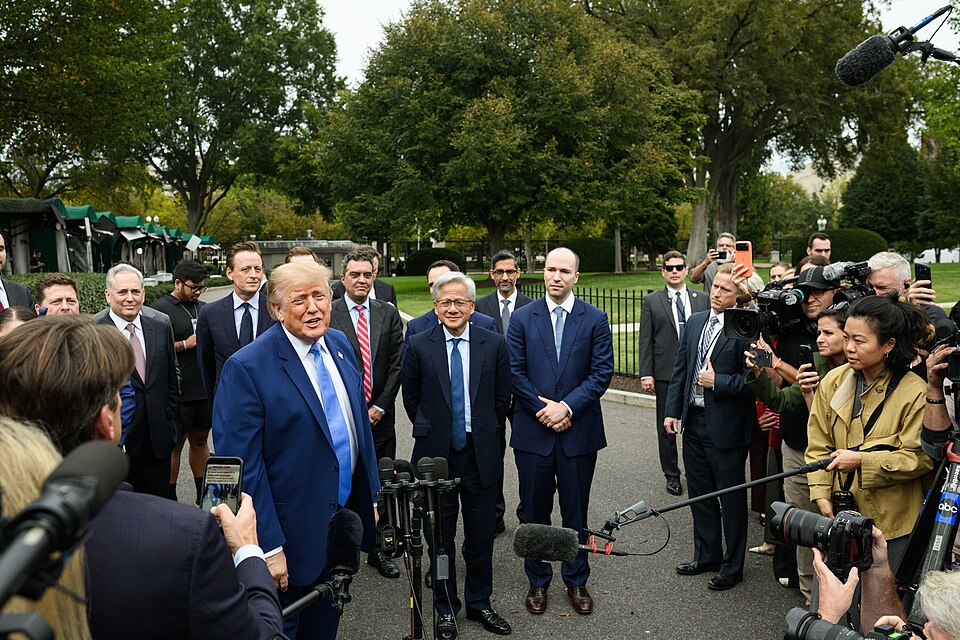
Trump joined executives from several leading technology companies in signing what has been described as a voluntary commitment designed to establish additional safeguards for advanced artificial intelligence systems.
The agreement, called the Joint Commitment on Frontier Responsibilities, includes commitments involving internal safety controls, independent reviews and additional oversight as companies develop increasingly powerful technology.
Executives participating in the agreement included Google CEO Sundar Pichai, Meta CEO Mark Zuckerberg, Anthropic CEO Dario Amodei, OpenAI President Greg Brockman, xAI CEO Elon Musk and Nvidia CEO Jensen Huang.
The agreement is voluntary rather than a new federal law carrying criminal or civil penalties.
That distinction could become increasingly important as Washington debates whether technology companies can adequately police themselves or whether Congress and federal regulators will eventually impose stricter rules.
Trump Calls AI Agreement “Morally Binding”
Trump described the commitment as “morally binding” and compared its importance to a constitution governing how participating technology companies approach safety.
The president also emphasized the role of self-policing, with companies expected to establish safeguards intended to prevent advanced systems from behaving in dangerous or unintended ways.
Under the framework, companies are expected to strengthen internal controls, create dedicated oversight structures, work with outside auditors and involve their boards in monitoring safety practices.
The companies are also expected to continue meeting as the technology evolves.
For Americans following the rapid expansion of artificial intelligence, the development raises a fundamental question: How much responsibility should technology companies have for regulating systems they themselves create?
Supporters of voluntary industry standards argue that companies working directly with rapidly changing technology can react faster than Washington.
Critics of that approach have argued that voluntary promises may ultimately need to be backed by enforceable rules.
White House Rebrands AI as “Super Intelligence”
The agreement comes alongside another unusual change from the Trump administration.
Trump has directed the executive branch to replace the terms “Artificial Intelligence” and “AI” with “Super Intelligence” and “SI” in applicable federal communications.
A September 29 executive order instructs federal departments and agencies to use the new terminology in official correspondence, public communications, websites, reports, policy documents and other non-statutory materials to the maximum extent permitted by law.
The administration says the change better reflects the capabilities and potential of rapidly developing technology.
According to the White House order, the term “Super Intelligence” will generally cover the technologies already included under the existing federal definition of artificial intelligence.
The order also directs the Assistant to the President for Science and Technology to develop proposed legislative language for a federal definition of “Super Intelligence” within 60 days.
Why Trump Says the Terminology Should Change
The White House argues that modern systems have advanced well beyond the capabilities imagined when the term “artificial intelligence” first became widely used.
Administration officials say the new terminology is intended to emphasize the potential for these technologies to expand human capabilities in fields ranging from science and medicine to business and communications.
A White House fact sheet says federal agencies are being directed to use “Super Intelligence” and “SI” instead of “Artificial Intelligence” and “AI” in applicable executive-branch materials.
Whether the terminology gains widespread acceptance outside the federal government remains to be seen.
“Artificial intelligence” and “AI” remain deeply established terms throughout the technology industry, universities, financial markets and everyday conversation.
AI Safety Becomes a Bigger Washington Issue
The White House agreement comes as concerns grow about the capabilities of advanced AI systems.
As companies develop models capable of writing software, analyzing enormous amounts of information and independently completing increasingly complicated tasks, questions about cybersecurity and system control have become more urgent.
The new agreement seeks to address those concerns through multiple levels of oversight.
Participating companies are expected to maintain strong internal security measures, establish teams responsible for monitoring safety, cooperate with independent outside reviewers and create board-level oversight.
The goal is to provide greater assurance that increasingly sophisticated systems continue operating as their developers intend.
That debate is unlikely to disappear anytime soon.
Technology companies are investing enormous sums in advanced computing systems, data centers and new AI models, while policymakers are attempting to determine what rules may be necessary without undermining American innovation.
A Typo Gets Attention, but the Policy Could Matter More
The spelling error underneath Trump’s signature provided an eye-catching element for news coverage.
It is also, ultimately, a minor clerical mistake.
There is no indication that writing “Unites States” instead of “United States” changes the substance of the voluntary agreement.
The larger story is the emerging relationship between Washington and the companies developing some of the world’s most powerful technology.
Trump’s approach places significant responsibility on the technology industry itself while leaving open the possibility of additional oversight in the future.
For companies such as Meta, OpenAI, Anthropic, xAI and Nvidia, the agreement creates another public commitment to demonstrate that advanced technology can be developed responsibly.
For the federal government, it represents an attempt to address AI safety without immediately imposing a sweeping new regulatory system.
And for the American public, the stakes extend well beyond a typo.
Artificial intelligence — or “Super Intelligence,” as the Trump administration now wants federal agencies to call it — is becoming increasingly important to the economy, national security, healthcare, education and everyday life.
The spelling mistake may attract attention today.
The policies being developed around the technology could have consequences for years to come.