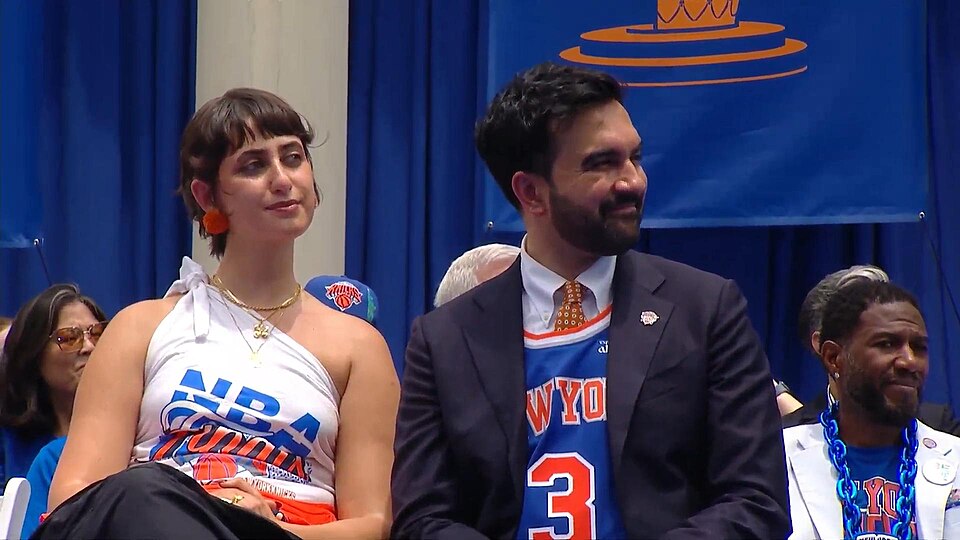
Mamdani has some explaining to do.
New York City Mayor Zohran Mamdani is facing new questions after the NYPD publicly contradicted his administration over security arrangements for his wife’s planned trip to the Middle East.
The dispute centers on Rama Duwaji, Mamdani’s wife, who reportedly plans to travel to Syria and Lebanon in September to visit family.
Both countries are subject to the U.S. State Department’s highest travel warning, commonly known as Level 4 or “Do Not Travel.”
City Hall initially indicated that Duwaji’s NYPD security detail would accompany her overseas. But the police department subsequently said officers would not be sent on the personal trip.
While the NYPD did not literally accuse Mamdani of lying, its statement directly contradicted the account previously provided by his administration — creating an embarrassing public dispute between City Hall and the nation’s largest municipal police department.
Mamdani later blamed the conflicting information on a staff “miscommunication.”
For New Yorkers concerned about crime, government accountability and taxpayer spending, the controversy raises a larger question: How did City Hall get something this important wrong?
NYPD Contradicts City Hall Over Security
The controversy began after Mamdani’s office indicated that Duwaji would receive NYPD protection while traveling to Syria and Lebanon.
A City Hall spokesperson said the decision had been made following a strong recommendation from the police department.
But the NYPD subsequently presented a very different account.
The department said it does not send officers into countries carrying Level 4 travel warnings for discretionary purposes such as personal travel.
That left New Yorkers with two conflicting versions of events.
City Hall had suggested the NYPD recommended sending the security detail.
The NYPD said officers would not be making the trip.
The contradiction quickly became another political headache for Mamdani, whose relationship with New York law enforcement has already been strained by years of controversial statements about policing.
Mamdani Blames A “Miscommunication”
As questions mounted, Mamdani attempted to explain why his administration had provided information that conflicted with the NYPD’s position.
Speaking to PIX11, the mayor attributed the controversy to a “miscommunication” involving his staff.
That explanation may resolve who made the mistake internally, but it does not eliminate questions about how inaccurate information was released publicly in the first place.
The issue is particularly important because the controversy involves police personnel, international travel and potentially significant taxpayer resources.
New Yorkers have every reason to expect accurate information from City Hall when government resources and public employees are involved.
The episode could therefore become another test of Mamdani’s ability to manage his administration and maintain an effective working relationship with the NYPD.
Police Union Leader Pushes Back
The controversy also drew a forceful response from Scott Munro, president of the NYPD Detectives’ Endowment Association.
Munro argued that New York detectives already put themselves in dangerous situations while protecting residents and investigating crime.
He made clear that the union would strongly object to detectives being sent into a dangerous foreign country for a personal trip rather than a legitimate police or intelligence operation.
Munro also emphasized another issue likely to concern many taxpayers: New York needs its detectives at home.
With public safety remaining one of the most important responsibilities of city government, critics argue that experienced law-enforcement personnel should be focused on protecting New Yorkers rather than accompanying public officials’ relatives on personal international travel.
Mamdani’s History With The NYPD Returns To Spotlight
The controversy is especially politically damaging because Mamdani spent years making harsh statements about the NYPD before becoming mayor.
During the unrest of 2020, Mamdani openly supported the movement to defund the police.
In one social-media post, he characterized the NYPD as a corrupt institution and called for it to be defunded and dismantled.
In another, Mamdani accused the department of racism and hostility toward the LGBTQ community while again promoting efforts to cut police funding.
Those statements have followed Mamdani throughout his political career.
They also stand in sharp contrast to the position he adopted while campaigning for mayor, when he explicitly said he did not want to defund the NYPD.
That change remains a source of skepticism among conservatives, police supporters and New Yorkers concerned about crime.
From “Defund The NYPD” To Working With The NYPD
Winning the mayor’s office changed Mamdani’s responsibilities dramatically.
As mayor, he can no longer treat the NYPD simply as an institution to criticize from the outside.
His administration must now work directly with police leadership on crime, counterterrorism, emergency preparedness, major public events and the everyday security needs of more than eight million residents.
That makes his previous rhetoric more than a historical political issue.
It raises questions about whether years of hostility toward the department could complicate his administration’s relationship with the officers and detectives responsible for keeping the city safe.
The dispute surrounding his wife’s security detail adds another layer to those concerns.
Taxpayer Questions Take Center Stage
The potential use of taxpayer-funded police resources is also an important part of the story.
Sending trained NYPD personnel overseas is far different from assigning officers to routine protection duties inside New York City.
International protective operations can potentially involve transportation, lodging, overtime, logistical planning and coordination with foreign authorities.
That is why the distinction between official government travel and a private family trip matters.
Duwaji reportedly plans to travel to Syria and Lebanon to visit relatives, making the trip personal rather than an official mission on behalf of New York City.
The NYPD’s position appears straightforward: officers will not be deployed to Level 4 countries for discretionary personal travel.
For fiscal conservatives, that policy may seem like common sense.
Police resources are funded by taxpayers and should primarily be used to protect the public and perform legitimate law-enforcement responsibilities.
Syria And Lebanon Travel Raises Security Concerns
The destinations themselves have also attracted attention.
Syria and Lebanon are both subject to serious U.S. government travel warnings.
A Level 4 designation represents the State Department’s highest travel advisory and tells Americans not to travel to the affected country.
Those warnings can reflect threats including terrorism, armed conflict, kidnapping, civil unrest or other serious security concerns.
That makes sending American police officers into such an environment substantially different from providing protection during ordinary domestic travel.
The NYPD’s refusal therefore involves more than the potential financial cost.
It also involves the safety of the officers themselves.
Mamdani’s Israel Record Adds Another Political Dimension
Mamdani’s views on Israel have also contributed to his complicated relationship with New York’s law-enforcement community.
He has been a vocal critic of the Israeli government and has referred to Israeli Prime Minister Benjamin Netanyahu as a “war criminal.”
Mamdani has also previously drawn a controversial connection between the NYPD and the Israel Defense Forces.
During a 2023 Democratic Socialists of America convention, he used highly charged language while arguing that policing practices in New York were influenced by Israel.
Those remarks generated criticism and remain relevant because New York City has one of the world’s largest Jewish populations outside Israel.
As mayor, Mamdani must now balance his political history with his responsibility to represent and protect residents across the entire city.
Tensions With Police Have Not Disappeared
Mamdani’s difficult relationship with portions of the law-enforcement community has remained visible since he became mayor.
He recently faced boos while appearing at a pro-police gathering on Staten Island, illustrating the lingering distrust among some officers and police supporters.
The security-detail controversy is unlikely to ease those tensions.
Instead, it gives critics another opportunity to contrast Mamdani’s past attacks on the NYPD with the responsibilities he now carries as New York City’s mayor.
For older voters who remember New York’s previous battles over crime and public safety, the disagreement could carry particular significance.
New Yorkers have seen how quickly public safety can become a defining political issue.
What Happens Next?
For now, the central question appears settled.
Duwaji may proceed with her personal trip, but NYPD officers are not expected to accompany her to Syria and Lebanon.
The unanswered question is how City Hall initially came to announce something different.
Mamdani says it was a staff communication problem.
Critics are likely to demand greater accountability, particularly when statements involve taxpayer resources and the deployment of police officers.
The episode also provides another reminder that governing is very different from campaigning.
Political rhetoric can be easy when a candidate is standing outside an institution criticizing it.
Running America’s largest city requires working with that institution every day.
The Bottom Line
The clash between Mayor Zohran Mamdani’s administration and the NYPD has turned what could have been a relatively minor travel story into a broader debate over government credibility, police resources and taxpayer accountability.
City Hall initially indicated that Rama Duwaji’s NYPD security detail would accompany her to Syria and Lebanon.
The NYPD contradicted that account and said officers would not be sent on discretionary personal travel to countries carrying Level 4 warnings.
Mamdani subsequently blamed the conflicting statements on a staff “miscommunication.”
For New Yorkers, however, the larger issue goes beyond one overseas trip.
A mayor who once championed efforts to defund the NYPD now depends on that same department to protect America’s largest city.
And when City Hall and the police department publicly offer conflicting accounts about the use of law-enforcement resources, taxpayers deserve to know exactly what happened, who got it wrong and what will be done to prevent the same kind of confusion from happening again.