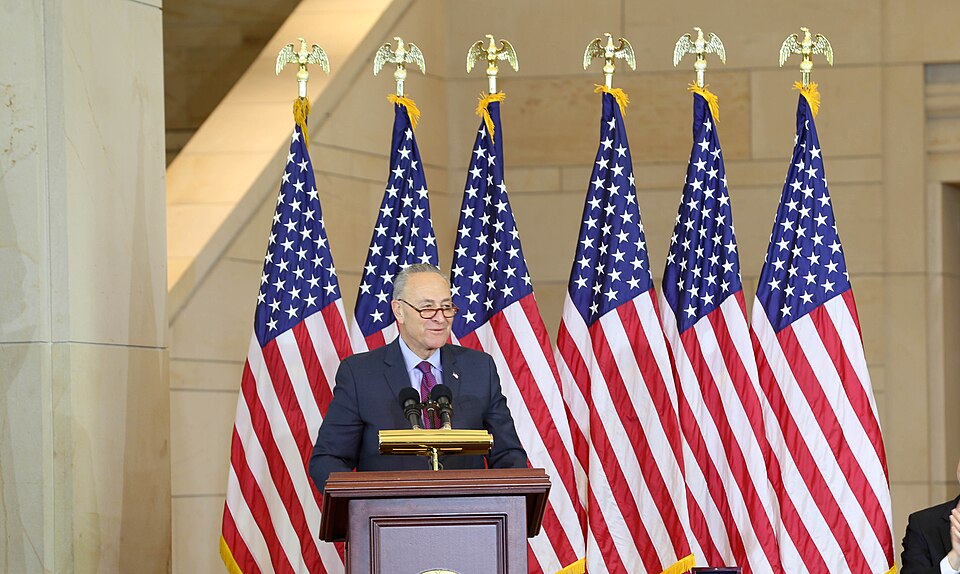
A new Justice Department legal opinion involving President Donald Trump is setting off another major confrontation in Washington — and Senate Minority Leader Chuck Schumer is making one of his strongest accusations yet.
Schumer claims Trump is “petrified” of what Democrats could investigate if they regain control of Congress in the midterm elections.
The accusation follows a new opinion from the Justice Department’s Office of Legal Counsel addressing an important question surrounding presidential power: Can executive privilege protect confidential conversations between a president and private advisers who do not work for the federal government?
According to the Justice Department, the answer can be yes.
The opinion could have significant consequences if Democrats capture control of Congress and move forward with investigations involving Trump, his administration, private advisers or his family’s business interests.
But the legal issue goes far beyond the current political fight.
At stake is a fundamental question about the presidency: How much confidentiality should a president have when seeking outside advice while carrying out official duties?
DOJ Expands Its Interpretation Of Executive Privilege
The Justice Department’s Office of Legal Counsel concluded that executive privilege can apply to certain confidential presidential communications involving private advisers.
That does not mean every conversation between Trump and a private citizen would automatically be protected.
The Justice Department laid out several important conditions.
The communication must concern official presidential decision-making, involve or reflect communications with the president or his direct advisers, and remain confidential.
Those limitations matter because Trump, like many presidents before him, frequently receives advice from individuals outside the traditional federal bureaucracy.
If Congress subpoenas a private adviser seeking information about qualifying presidential communications, the administration could potentially argue that executive privilege protects those discussions.
That could create a major obstacle for future congressional investigations.
Why The Justice Department Says Confidentiality Matters
The Justice Department’s reasoning centers on the president’s ability to receive candid advice before making important decisions.
Presidents routinely face questions involving national security, the economy, foreign policy, domestic policy and other matters with enormous consequences for the country.
Government officials are not necessarily the only people capable of providing useful expertise.
Business leaders, attorneys, academics, economists and other specialists may possess information a president wants before reaching a decision.
The Justice Department argues that those individuals could become reluctant to speak candidly if they believe confidential conversations might eventually be disclosed publicly through congressional subpoenas or hearings.
That concern could be particularly serious for private citizens whose businesses, careers or reputations might be affected by their association with a controversial policy.
The administration’s position is therefore that protecting certain confidential discussions ultimately protects the president’s ability to make informed decisions.
Presidents Have Sought Outside Advice For Generations
Although the political battle surrounding Trump is new, presidents seeking advice outside the federal government is anything but new.
American presidents have relied on unofficial advisers throughout the nation’s history.
President Andrew Jackson became famous for relying on an informal circle of advisers commonly remembered as his “Kitchen Cabinet.”
President Franklin D. Roosevelt sought guidance from academics and intellectuals associated with his “Brain Trust” while confronting the economic crisis of the Great Depression.
President Grover Cleveland consulted financier J.P. Morgan during a serious shortage involving the Treasury’s gold reserves.
President Lyndon B. Johnson also sought guidance from trusted individuals outside the government while confronting the difficult decisions surrounding the Vietnam War.
The Justice Department cited this historical tradition as part of its argument that executive privilege should not necessarily depend on whether an adviser receives a federal paycheck.
Instead, the administration argues that the important question is whether the conversation involves confidential advice connected to the president’s official responsibilities.
Schumer Sees Something More Sinister
Schumer strongly rejected the administration’s reasoning.
The New York Democrat portrayed the Justice Department opinion as an attempt to protect Trump and people close to him from congressional scrutiny.
“Donald Trump is scared,” Schumer declared in his response.
Schumer claimed Trump knows that Democrats could pursue aggressive oversight if they regain congressional power and accused the administration of attempting to protect communications involving private advisers and outside interests.
He then escalated his criticism by arguing that Trump’s actions suggested he had something he wanted to keep hidden.
According to Schumer, the president is “petrified” of the questions Democrats could demand answers to if they control Congress.
Schumer also vowed that Democrats would continue pursuing what he described as accountability.
Those are serious political accusations, but they remain Schumer’s characterization of the administration’s motives.
The Justice Department opinion itself does not establish that Trump committed wrongdoing, nor does invoking executive privilege automatically demonstrate that information being protected is improper.
Executive privilege has existed under presidents of both political parties and is rooted in the broader constitutional separation of powers.
Why The Midterm Elections Could Change Everything
The timing of the legal opinion is particularly important because control of Congress will determine which party holds powerful committee gavels.
Congress does far more than pass legislation.
Committee chairmen can launch investigations, request documents, conduct hearings and issue subpoenas.
If Democrats gain control, Trump could face a new wave of congressional investigations during the remainder of his presidency.
Democratic lawmakers have already signaled interest in examining Trump, his administration and financial matters involving his family and businesses.
Republicans are likely to argue that such investigations could become politically motivated attempts to weaken a Republican president.
Democrats will argue that aggressive oversight is a legitimate congressional responsibility.
That disagreement could set the stage for a series of legal and political confrontations.
Could Private Trump Advisers Be Subpoenaed?
This is where the new Justice Department opinion could become especially consequential.
Imagine that a congressional committee subpoenas a private businessman, attorney or outside adviser who participated in confidential discussions concerning an official presidential decision.
The Trump administration could argue that forcing disclosure of those conversations would interfere with the president’s constitutional ability to receive candid advice.
Congress could disagree and demand compliance.
If neither side backs down, the dispute could eventually move into federal court.
Judges would then have to weigh competing constitutional interests: Congress’s authority to conduct legitimate oversight against the president’s interest in confidential decision-making.
That could turn what currently sounds like an obscure legal disagreement into a significant separation-of-powers battle.
Executive Privilege Has Limits
One important distinction should not be overlooked.
Executive privilege is not an unlimited presidential power.
The Supreme Court has recognized the importance of protecting confidential presidential communications, but courts have also rejected the idea that executive privilege provides absolute protection in every circumstance.
That means the Justice Department opinion does not necessarily give Trump or his private advisers the ability to ignore every future congressional subpoena.
Each dispute could depend on what Congress is requesting, why lawmakers want the information, who participated in the conversation and whether the communication actually concerned official presidential responsibilities.
The Justice Department itself acknowledges that determining whether privilege applies to a particular communication would require examining the specific circumstances.
That nuance is important.
The opinion establishes the administration’s legal position. It does not guarantee that courts will agree with every future assertion of executive privilege.
Republicans And Democrats See Two Very Different Stories
The controversy highlights a much larger divide in Washington.
Trump’s supporters can view the Justice Department opinion as a necessary defense of presidential authority and confidential decision-making.
From that perspective, presidents should be able to consult knowledgeable Americans without automatically exposing those conversations to partisan investigations whenever control of Congress changes hands.
Democrats see a different danger.
They worry that extending executive privilege too broadly could allow presidents to shield important communications simply because the adviser involved happens to work outside the government.
That could make congressional oversight considerably more difficult.
Both arguments point toward a larger constitutional question that may ultimately require the courts to determine exactly where the boundary lies.
Schumer’s “Petrified” Accusation Raises The Stakes
Schumer’s language makes clear that Democrats are already preparing to turn the issue into a political battle.
Calling a sitting president “petrified” is considerably different from merely disagreeing with a Justice Department legal interpretation.
Schumer is suggesting that Trump’s motivation is personal — that the president fears what Democratic investigators might discover.
The administration’s legal position, however, is broader. The Office of Legal Counsel argues that presidents generally require confidential access to private expertise when carrying out their constitutional responsibilities.
That distinction will likely become central to the debate.
Is the policy primarily about protecting presidential decision-making?
Or is it, as Schumer alleges, an effort to make future Democratic investigations more difficult?
Those competing narratives could become increasingly important as the midterm elections approach.
What This Means For American Voters
For Americans watching Washington, the controversy offers another reminder that congressional elections determine far more than which party gets to pass its preferred legislation.
Control of Congress also determines who runs powerful investigative committees.
A change in congressional leadership could therefore dramatically reshape the final years of Trump’s presidency.
Democrats could pursue investigations and subpoenas. The administration could respond with assertions of executive privilege. Congress could challenge those assertions, potentially sending major disputes into the federal court system.
For older Americans who remember previous clashes between Congress and presidents from Richard Nixon through Ronald Reagan, Bill Clinton, George W. Bush, Barack Obama and Trump’s first administration, the basic struggle will sound familiar.
Presidents want room to make decisions confidentially.
Congress wants the ability to investigate the executive branch.
The Constitution gives both branches substantial authority, leaving courts to referee some of the hardest disputes.
The Bottom Line
The Justice Department has now formally argued that certain confidential communications between a president and private advisers can receive executive privilege protection when those discussions concern official presidential decision-making.
Schumer believes something much more political is happening.
He claims Trump is afraid of the investigations Democrats could launch if they regain congressional control and says the president is “petrified” of answering their questions.
Whether voters accept Schumer’s argument — or instead see the Justice Department opinion as a legitimate effort to protect presidential confidentiality — will likely depend heavily on their view of congressional oversight and executive authority.
What is certain is that this fight could become much bigger after the midterm elections.
If Washington returns to divided government, the battle over Trump’s private advisers, Democratic subpoenas and executive privilege could move from political speeches and social media posts into congressional hearing rooms — and potentially federal courtrooms.