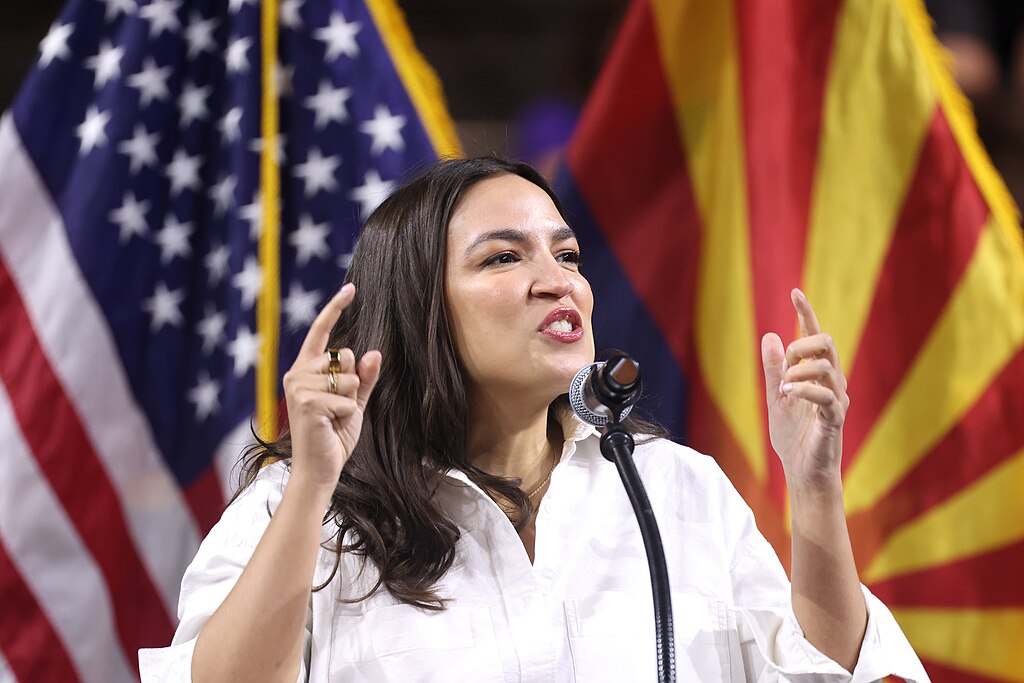
Is Alexandria Ocasio-Cortez quietly laying the groundwork for a 2028 presidential campaign?
That question gained fresh momentum after the New York Democrat appeared at the prestigious Munich Security Conference, where she outlined her foreign policy vision while sidestepping direct questions about her White House ambitions.
For many political observers — especially voters focused on America’s global leadership under President Donald Trump — her remarks sounded less like a routine congressional appearance and more like a soft launch on the international stage.
2028 Presidential Buzz Refuses to Go Away
During one panel discussion on global populism and economic inequality, Ocasio-Cortez was asked whether she would pursue policies like a wealth tax if she were to run for president in 2028.
Instead of directly addressing her future political plans, she pivoted — arguing that policies such as taxing billionaires should be implemented quickly regardless of who occupies the Oval Office.
The exchange fueled speculation rather than calming it.
At 36, she remains one of the most prominent progressive figures in the Democratic Party. With the 2028 election cycle slowly taking shape, her visibility on the world stage is unlikely to be dismissed as coincidence.
Criticism of Trump’s Foreign Policy
A major focus of her remarks centered on President Trump’s foreign policy decisions — particularly changes involving international agreements and aid commitments.
She referenced shifts in participation related to the Paris Climate Agreement and U.S. engagement with the United States Agency for International Development (USAID), arguing that alternating strategies between administrations create uncertainty for global partners.
However, when pressed to identify the single most significant change under President Trump, she did not provide a concise answer — instead offering broader commentary about partisanship and instability.
For many older voters who prioritize clarity, strength, and consistency in foreign affairs, that moment stood out.
Israel Aid Debate Highlights Sharp Differences
Ocasio-Cortez also revisited her stance on U.S. aid to Israel, stating that fully unconditional assistance “does not make sense.”
Her position reflects an ongoing divide within the Democratic Party over Middle East policy.
Conservative voters — particularly those who strongly support America’s alliance with Israel — may view such comments as a preview of how a progressive administration would approach longstanding partnerships.
As global tensions remain high, the debate over Israel, Ukraine, and broader U.S. engagement abroad is likely to define future presidential campaigns.
A Direct Challenge to Trump’s Vision
Throughout her appearance in Munich, Ocasio-Cortez described what she sees as disruption to international alliances under President Trump.
She argued that future Democratic leadership should recommit the United States to multilateral institutions and global compacts that have been reconsidered in recent years.
Her broader message: America must deepen international cooperation rather than prioritize sovereignty-first policies.
That vision stands in sharp contrast to President Trump’s “America First” approach — a doctrine that many conservative voters credit with reshaping trade, security, and border policy.
Is 2028 Already Taking Shape?
While no formal announcement was made, the symbolism was difficult to ignore:
- A high-profile international forum
- Direct foreign policy messaging
- Economic reform themes
- Criticism of President Trump’s leadership
Whether intentional or not, the optics resembled early presidential positioning.
As the 2028 election approaches, voters across the country — especially those over 50 who remember the Cold War, post-9/11 policy shifts, and decades of global realignment — will likely weigh experience, stability, and strength heavily in their decision-making.
What Comes Next?
The Democratic Party faces an internal crossroads between its progressive and moderate wings. Ocasio-Cortez represents the progressive future many activists envision — but whether that vision resonates nationally remains an open question.
For now, one thing is certain: the 2028 conversation has already begun.
And if this appearance is any indication, Rep. Ocasio-Cortez intends to be part of it.