This was clearly a bad time to ask.
A Bloomberg News reporter was barred from attending a major international summit involving President Donald Trump after asking a controversial question about an American technology executive.
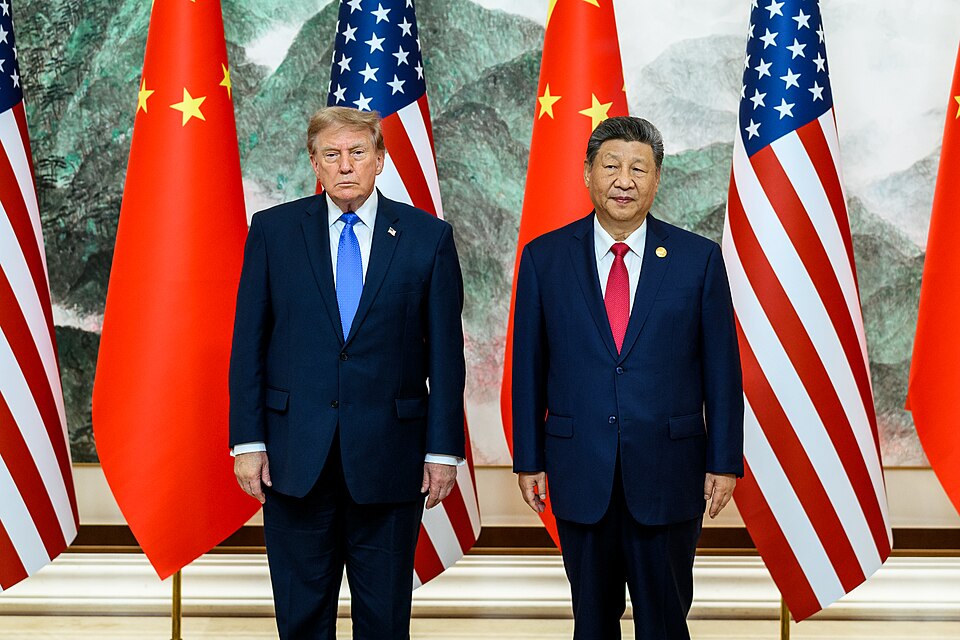
The incident occurred Thursday, November 19, during Trump’s visit to China, where he met with Chinese President Xi Jinping and Russian President Vladimir Putin.
Chinese officials reportedly took issue with the journalist’s question and refused to allow her into a subsequent meeting, even after White House representatives attempted to intervene.
The unusual confrontation has raised fresh questions about press freedom in China, America’s relationship with Beijing, and growing national security concerns surrounding the technology industry.
Reporter Asks Trump a Question That Sparks Controversy
Bloomberg Television correspondent Annmarie Hordern was covering a meeting between Trump and Xi when she called out a question about Jensen Huang, the former chief executive of Nvidia.
Hordern asked whether Huang had been disloyal to the United States.
The question referenced an ongoing controversy involving Huang and allegations surrounding his personal relationship with a woman suspected of having connections to Chinese intelligence.
The reporter’s inquiry came during a sensitive diplomatic meeting between the leaders of the world’s two largest economies.
Rather than becoming another routine exchange between the president and the traveling press corps, the question triggered an unexpected confrontation with Chinese authorities.
Hordern was subsequently denied access to a historic trilateral meeting involving Trump, Xi, and Putin in Shenzhen.
According to reports from the White House press pool, Chinese officials made the decision to exclude the journalist because of her earlier conduct.
White House Tries to Reverse Reporter’s Removal
One of the most notable aspects of the controversy was the Trump administration’s response.
Although President Trump has frequently criticized certain news organizations and reporters, White House officials reportedly attempted to restore Hordern’s access to the diplomatic gathering.
Chinese authorities refused.
According to press pool reporting, Chinese officials characterized the reporter’s behavior as extremely rude.
They had warned journalists against shouting questions during official proceedings, reflecting the country’s strict approach to managing press coverage.
The White House’s unsuccessful intervention demonstrated the difficulties American officials can encounter when operating under another country’s media restrictions.
In the United States, journalists routinely question presidents during public appearances, sometimes raising uncomfortable or unexpected subjects.
China maintains significantly tighter controls over media access and public questioning of government officials.
The confrontation highlighted those differences during one of the year’s most closely watched diplomatic events.
Why Jensen Huang’s Name Caused Such a Reaction
The question that sparked the dispute involved a developing controversy surrounding Nvidia, one of America’s most important technology companies.
Jensen Huang, who helped build Nvidia into a global leader in artificial intelligence and advanced semiconductor development, recently stepped down as chief executive following scrutiny of a personal relationship.
Reports have linked the controversy to allegations that the woman involved had connections to Chinese intelligence activities.
Those allegations have generated considerable interest because of Nvidia’s importance to America’s technology sector and the growing competition between Washington and Beijing.
However, the reported suspicions do not establish that Huang knowingly assisted a foreign intelligence service or committed any crime.
China has denied allegations that the woman was involved in espionage.
The controversy nevertheless raises broader concerns about the protection of sensitive American technology and the potential risks associated with foreign intelligence operations.
Nvidia’s advanced chips play an important role in artificial intelligence development, scientific research, and powerful computing systems.
These technologies also have significant national security implications, making their protection a priority for American policymakers.
Trump Addresses the Nvidia Controversy
President Trump has faced questions about whether the allegations surrounding Huang would influence his discussions with Chinese leaders.
During a Fox News interview, Trump indicated that he had briefly mentioned Huang’s situation while speaking with Xi.
However, the president suggested that the matter was not a central focus of their conversations.
The administration has been navigating a complicated relationship with China involving international trade, advanced technology, military competition, and national security.
The Huang controversy has added another sensitive issue to that relationship.
For American officials, the challenge involves protecting critical technology while maintaining diplomatic and economic channels with Beijing.
The question raised by the Bloomberg reporter reflected those concerns, even though Chinese officials objected to how it was delivered.
Historic Trump Summit Overshadowed by Press Dispute
The reporter’s exclusion occurred during a rare three-way meeting involving the presidents of the United States, China, and Russia.
Trump’s discussions with Xi and Putin attracted international attention because of the significant political and economic influence held by all three countries.
The summit addressed major geopolitical concerns, including international security and the possibility of reducing nuclear weapons.
Trump has emphasized the importance of direct communication between world leaders, arguing that diplomacy remains necessary even when substantial disagreements exist.
However, the reporter controversy became an unexpected side story during the summit.
The incident also illustrated the limits of American influence over media arrangements at diplomatic events hosted by foreign governments.
Although White House representatives sought to restore the Bloomberg journalist’s access, Chinese officials maintained their decision.
That refusal left an American reporter unable to cover part of a meeting involving her own country’s president.
Press Freedom Raises New Questions About China
The controversy has renewed attention on the treatment of journalists in China.
Unlike the United States, where press organizations generally operate independently of the government, China’s media environment is subject to extensive political oversight.
Authorities frequently impose restrictions on the subjects journalists can cover and the circumstances under which they can question political leaders.
International diplomatic events are often carefully organized, with limited opportunities for unscripted exchanges.
For American reporters accustomed to questioning presidents directly, those restrictions can create significant challenges.
The Bloomberg incident demonstrated how quickly a disagreement over journalistic conduct can affect access to major international events.
It also raised an important distinction: The reporter was not barred by President Trump or the White House.
Instead, Chinese authorities made the decision, despite objections from American officials.
That detail is central to understanding what actually happened.
What This Means for American National Security
Beyond the dispute over press access, the incident reflects growing concerns about America’s technological competition with China.
Advanced semiconductors, artificial intelligence systems, and other emerging technologies are increasingly important to both economic strength and national defense.
Nvidia occupies a prominent position in that landscape.
As a result, questions involving its former chief executive have attracted considerable attention from policymakers and national security observers.
The United States has spent years examining ways to prevent advanced technologies from strengthening the military capabilities of potential adversaries.
Concerns about espionage and foreign influence remain an important part of that debate.
The allegations surrounding Huang have not established criminal wrongdoing on his part. Nevertheless, the controversy underscores why government officials closely monitor potential security vulnerabilities in strategically important industries.
For American families, businesses, and taxpayers, the broader stakes involve economic competitiveness, national security, and the country’s ability to maintain its technological advantages.
The Bottom Line
A Bloomberg reporter’s question about former Nvidia chief Jensen Huang resulted in her exclusion from a major international meeting involving President Donald Trump, Xi Jinping, and Vladimir Putin.
Chinese officials reportedly made the decision after objecting to the journalist’s conduct during an earlier meeting.
White House officials attempted to reverse the restriction but were unsuccessful.
The episode has drawn attention to the differences between American and Chinese press practices while highlighting growing concerns about national security and the protection of sensitive technology.
As Washington continues navigating its relationship with Beijing, the incident serves as a reminder that even a single question can create controversy during high-stakes international diplomacy.