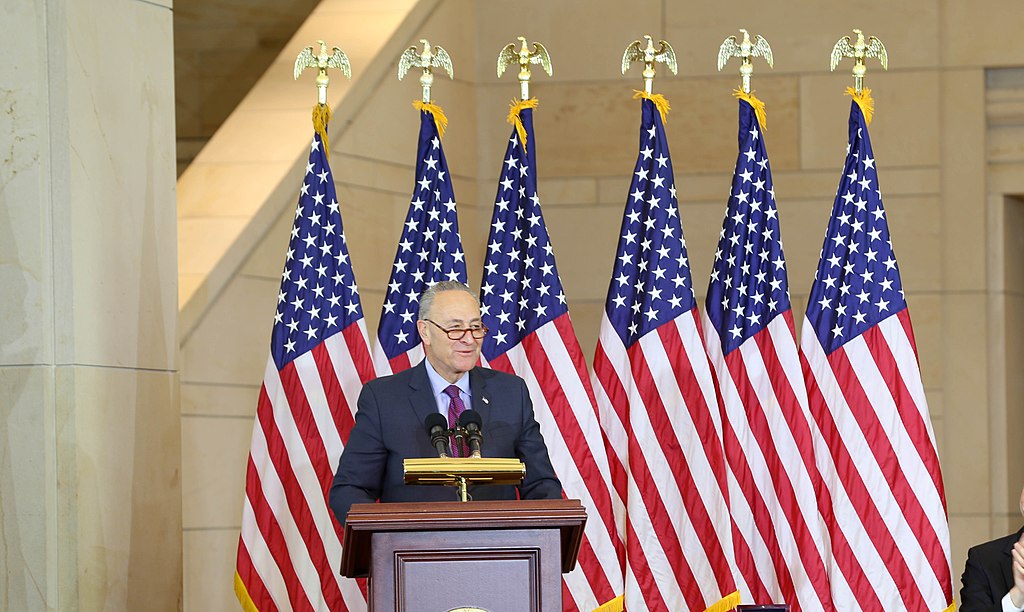
Democrats aren’t happy watching Trump make progress.
House Democrats are facing a growing internal revolt after a spending deal negotiated by Senate Democrat leader Chuck Schumer with President Donald Trump’s White House sparked sharp resistance inside the party—raising new doubts about when the government shutdown will end.
Multiple congressional sources say House Democrat leaders are refusing to automatically support the Senate deal, exposing deep divisions between Democrats in Washington and their leadership in the upper chamber.
House Minority Leader Hakeem Jeffries reportedly warned Speaker Mike Johnson that Democrats would not help fast-track the legislation, forcing Republicans to rely almost entirely on their slim House majority to move the bill forward.
That puts the spending package on a slow and uncertain path, with several procedural hurdles still ahead before a final vote can occur—likely no sooner than Tuesday.
The federal government has been partially shut down since early Saturday morning after Congress failed to pass a full-year budget by the January 30 deadline. While some agencies remain funded, critical departments—including Defense, Transportation, Health and Human Services, and Homeland Security—are still operating without long-term funding certainty.
According to sources familiar with the talks, House Democrats do not feel bound by the agreement negotiated by Senate Democrats and the Trump administration. Many are privately frustrated that they were expected to support a deal they had little role in shaping.
As one House Republican put it, Democratic infighting is now becoming a major obstacle to reopening the government.
Republicans, meanwhile, face challenges of their own. Some GOP lawmakers have raised concerns about provisions that could reopen negotiations on President Trump’s immigration enforcement policies. Others are using the moment to push conservative priorities before offering support.
Rep. Anna Paulina Luna has made clear she will oppose the bill unless it includes a requirement for proof of citizenship when registering to vote—legislation long supported by Republican voters.
Speaker Johnson initially explored passing the bill under a “suspension of the rules,” a fast-track process requiring a two-thirds vote. That option now appears unlikely, sending the bill instead to the House Rules Committee for review before it can advance to the floor.
House Majority Whip Tom Emmer suggested the Democratic caucus may splinter further, noting that party leaders cannot guarantee their members will fall in line behind the Senate deal.
The Senate package combines several spending bills already passed by the House but avoids a long-term solution for Homeland Security. Instead, it temporarily funds the department for two weeks while Democrats push negotiations that could limit Immigration and Customs Enforcement operations.
Jeffries stopped short of endorsing the plan, stating only that House Democrats would review the legislation and determine their next steps.
If the standoff continues, paychecks for military personnel, airport workers, and other federal employees could be delayed—while funding for disaster response and federal healthcare programs remains uncertain. For now, Washington’s shutdown drama is being driven not by Republicans, but by growing division inside the Democratic Party.