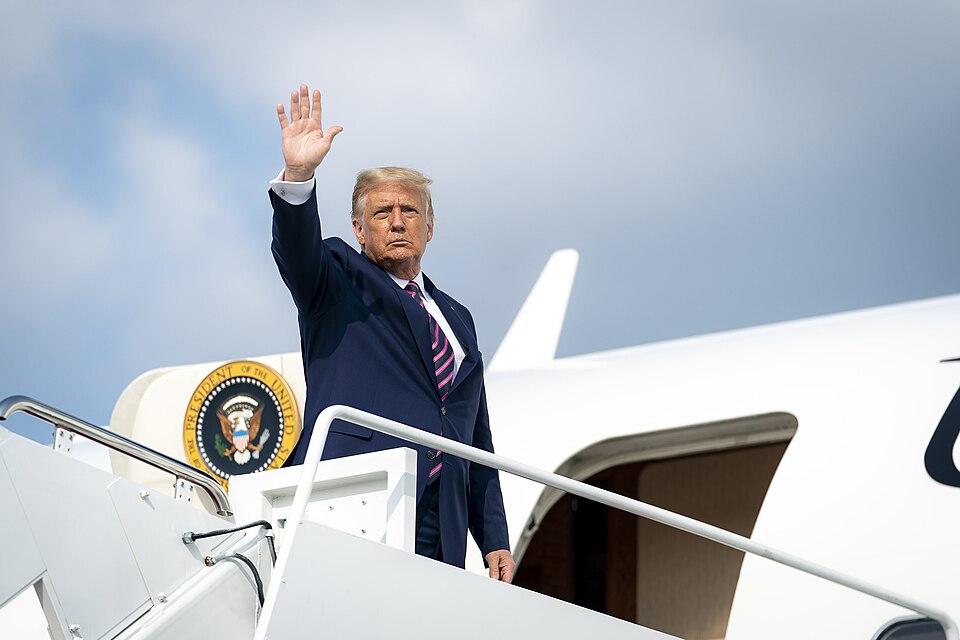
Here’s what Trump said.
President Donald Trump is refusing to rule out invoking the Insurrection Act or declaring a national emergency as the November midterm elections draw closer.
The president addressed the possibility during a wide-ranging interview with TIME, raising new questions about presidential authority, domestic unrest and what could happen if political tensions escalate before or after Election Day.
“I’m not committing to anything,” Trump said when asked about the limits of his presidential power.
Trump added that his administration would have to see how ongoing legal battles play out in court.
His comments come at a critical moment in Washington, with Republicans fighting to maintain control of Congress and Democrats hoping to gain power in the House, Senate or both.
White House Preparing for Possible Democratic Victory
According to TIME, White House advisers have already discussed how the administration could operate if Democrats regain control of one or both chambers of Congress.
One administration official suggested such an outcome could force the White House to work more closely with Democrats.
The official acknowledged that much of the administration’s agenda has been pursued along partisan lines but argued that divided government could change that approach.
Trump has offered a different warning.
The president has repeatedly argued that a Democratic-controlled Congress could once again pursue impeachment proceedings against him.
During the TIME interview, Trump also dismissed unfavorable polling surrounding himself and Republican candidates as inaccurate. TIME reported that Trump plans to campaign extensively for Republican candidates ahead of the November elections.
What Is the Insurrection Act?
The Insurrection Act is a group of federal laws that allows a president, under certain circumstances, to deploy military forces inside the United States or place National Guard troops under federal control.
Normally, federal law sharply limits the military’s ability to perform domestic law-enforcement functions.
The Insurrection Act provides an exception in certain situations involving rebellion, insurrection or serious obstruction of federal law.
That makes the law one of the most significant emergency powers available to a president.
Its use has historically been rare and has often generated intense debate over the proper balance between federal authority, state authority and civil liberties.
Trump Has Considered Using the Law Before
This is not the first time Trump has discussed invoking the Insurrection Act.
During his first presidency, Trump considered deploying federal military forces amid the unrest that followed the death of George Floyd in Minneapolis in 2020.
He has also raised the possibility during his second term in connection with demonstrations and unrest involving federal immigration enforcement.
Those episodes have fueled an ongoing legal and political debate over how much authority the president possesses when responding to disorder inside American cities.
Why the Insurrection Act Matters
Under ordinary circumstances, military forces are generally restricted from directly enforcing civilian laws inside the United States.
The Insurrection Act creates important exceptions.
Depending on the circumstances, federal law permits a president to use military forces when ordinary judicial enforcement becomes impracticable or when rebellion, insurrection or obstruction makes it difficult to enforce federal law.
The law therefore gives presidents substantial authority—but that authority is tied to specific statutory conditions rather than providing unlimited power.
Legal disputes can also arise over whether those conditions have actually been satisfied.
National Guard Authority Is Separate
Presidents also possess other legal authorities involving the National Guard.
Those powers should not automatically be confused with the Insurrection Act.
Under portions of Title 10 of the U.S. Code, a president can federalize National Guard forces under specified circumstances.
Invoking those authorities does not necessarily mean that the president has formally invoked the Insurrection Act.
The distinction could become important if the Trump administration deploys federal personnel in response to unrest surrounding the midterm elections.
A Law With More Than 200 Years of History
The Insurrection Act traces its origins to 1807 during the presidency of Thomas Jefferson.
Its passage came during a turbulent period involving former Vice President Aaron Burr, who was accused of participating in a conspiracy involving western territories.
Burr was eventually tried for treason but acquitted.
Over the following two centuries, presidents have relied on the Insurrection Act during some of the most serious episodes of domestic unrest in American history.
Presidents Dwight Eisenhower and John F. Kennedy used federal authority during battles over school desegregation, when federal intervention was needed to enforce court orders and protect civil rights.
When Was the Insurrection Act Last Invoked?
The most recent invocation occurred under President George H.W. Bush in 1992.
Bush deployed federal forces during the Los Angeles riots following the acquittal of police officers charged in connection with the beating of Rodney King.
The unrest resulted in widespread violence, fires and property destruction throughout parts of Los Angeles.
Federal forces were ultimately sent in after California officials requested additional assistance.
The 1992 deployment remains an important modern example of how the Insurrection Act can be used during a major breakdown in public order.
Could Trump Invoke It Around the Midterms?
For now, Trump has not announced that he will invoke the Insurrection Act.
His comments instead show that he is unwilling to remove the possibility from consideration.
Whether such authority could legally be used would depend heavily on the circumstances at the time, including the nature of any unrest, obstruction or inability to enforce federal law.
Simply holding a contentious election or experiencing political disagreement would not by itself amount to an insurrection.
Any attempt to use extraordinary presidential powers would almost certainly receive intense scrutiny from Congress, state officials, civil liberties groups and the courts.
Midterm Battle Raises the Stakes
The renewed discussion comes as both parties prepare for a consequential November election that will determine control of Congress.
A Democratic victory in either chamber could dramatically change Trump’s final two years in office, potentially limiting his legislative agenda and increasing congressional investigations.
Republican victories would give the administration greater opportunity to continue pursuing its agenda through Congress.
Against that backdrop, Trump’s refusal to rule out emergency powers is certain to keep questions about presidential authority in the spotlight.
For now, however, no invocation of the Insurrection Act has been announced.
What happens next will depend on the election, developments across the country and how the courts interpret the administration’s authority.