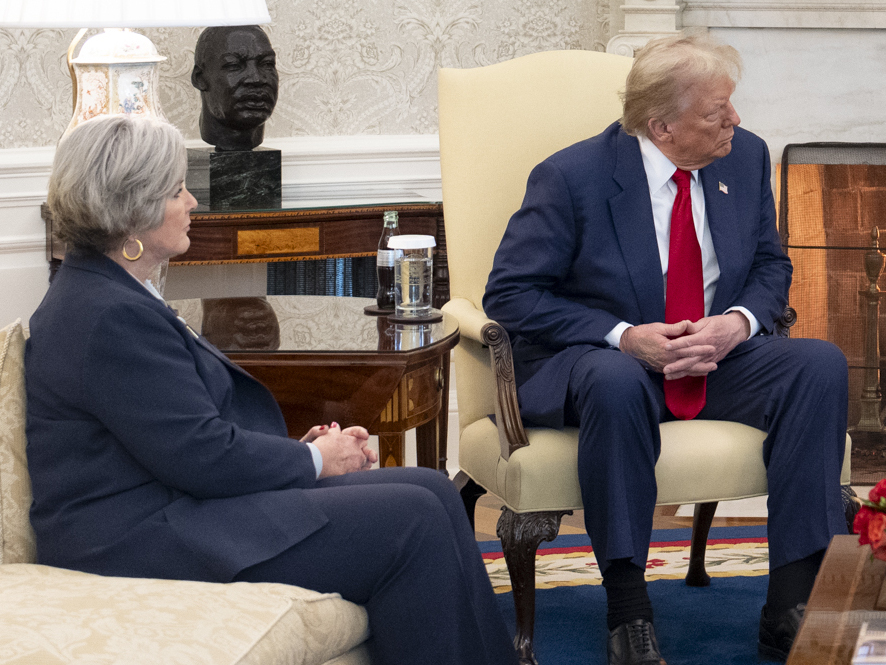
President Donald Trump’s White House has delivered a stern warning to a major American news organization, demanding an apology and the removal of disputed reports about one of his most trusted advisers.
The Trump administration is taking its fight with the national media to a new level after accusing Politico of publishing false and damaging claims about White House Chief of Staff Susie Wiles.
In a formal letter, White House counsel William Scharf demanded that the Washington-based news outlet retract three controversial stories and publicly apologize to both Trump and Wiles.
The administration gave Politico just 48 hours to respond.
And the warning came with a potentially serious consequence.
If the publication refused, the White House said it would consider additional action, including legal remedies and a review of Politico’s relationship with the administration.
The confrontation has intensified a longstanding debate about media accountability, journalistic standards, and the responsibility of news organizations to correct inaccurate information.
Trump White House Issues 48-Hour Ultimatum
The dispute became public after Scharf sent a letter to Politico’s leadership on October 19, 2026.
The letter challenged three articles published October 15 and 16 concerning alleged turmoil inside the Trump administration.
According to reporting from Fox News and Axios, the White House argued that the articles contained false assertions about Trump’s relationship with his chief of staff.
Administration officials demanded that Politico correct or retract the disputed reports, remove the challenged material from its archives, and apologize publicly.
Scharf warned that failing to comply would prompt the White House to consider further steps.
Those measures could include reviewing the publication’s access and professional relationship with the administration, as well as pursuing available legal options.
The letter did not establish that Politico had violated any law, and its allegations remain disputed.
Nevertheless, the administration’s decision to issue a formal demand marked a significant escalation beyond the usual exchange of statements between government officials and reporters.
What Did Politico Report About Susie Wiles?
At the center of the controversy is Susie Wiles, a longtime Trump adviser who helped manage his successful 2024 presidential campaign.
Wiles subsequently became White House chief of staff, placing her among the most influential officials in the administration.
Politico published reporting suggesting that Trump was considering replacing Wiles amid internal disagreements.
A separate account described a negative reaction inside the White House after the initial report appeared.
Those stories drew an immediate response from administration officials, who disputed the allegations and rejected suggestions that Wiles was losing Trump’s confidence.
The White House maintained that Politico’s reporting misrepresented relationships and events inside the administration.
The controversy was particularly sensitive because of Wiles’ longstanding relationship with Trump and her central role in managing White House operations.
However, Politico has defended its reporting, and the administration’s objections alone do not establish that the disputed claims are false.
Another Report Adds Fuel to the Controversy
The dispute also involved an article concerning former White House press secretary Katie Zacharia and her appearance on Sean Hannity’s Fox News program.
Politico initially published an account suggesting that Wiles played a role in arranging the television appearance.
The report became controversial because of allegations about how Zacharia was treated and whether Wiles was responsible for the circumstances surrounding the interview.
Subsequent information prompted Politico to correct part of its coverage.
The correction clarified Wiles’ lack of direct involvement in arranging the appearance.
That development became an important part of the White House’s argument that the outlet needed to reconsider its broader reporting.
But correcting one factual point does not necessarily resolve every dispute involving the other articles.
Politico has continued to defend its reporting against the administration’s more sweeping demands.
White House Demands Public Apology
The administration’s demands went beyond a routine correction.
Scharf’s letter called for public apologies to both President Trump and Wiles.
The White House argued that the reporting had created an inaccurate impression of dysfunction and internal disagreements at the highest levels of government.
Administration officials also objected to the way Politico relied on information about private White House discussions.
From the administration’s perspective, the controversy is about whether a major news organization should be held accountable when officials directly challenge its factual assertions.
Politico, however, has resisted the demand to retract all three reports.
Its attorneys responded on October 21, rejecting the White House’s broader claims.
The disagreement therefore remains unresolved, with both sides defending their positions.
Could Trump Take Legal Action Against Politico?
One of the most important questions is whether the White House will pursue the legal options mentioned in its warning.
The letter raised that possibility but did not announce a lawsuit.
Under American defamation law, public officials generally face a particularly demanding legal standard when challenging reporting about their official conduct.
They must ordinarily demonstrate that an allegedly defamatory statement was published with knowledge that it was false or with reckless disregard for whether it was true.
That standard, commonly known as actual malice, comes from the Supreme Court’s landmark 1964 decision in New York Times Co. v. Sullivan.
A published correction can become relevant to a dispute over accuracy, but it does not automatically prove that an entire article was defamatory.
Likewise, anonymous-source reporting is not inherently unlawful or inaccurate.
Whether any legal action succeeds would depend on the specific statements, available evidence, and applicable law.
For now, the White House has threatened potential action rather than securing a legal judgment against the publication.
Why the Dispute Matters Beyond Washington
The confrontation raises a broader issue that extends well beyond President Trump, Politico, or any single administration.
Americans depend on news organizations to provide accurate information about public officials and government decisions.
When reports involve private conversations, unnamed sources, or allegations about internal disputes, independent verification becomes especially important.
Corrections are a normal part of responsible journalism when meaningful factual errors are discovered.
At the same time, reporters must remain free to investigate elected officials and publish well-supported information even when government leaders strongly disagree with it.
That balance between accountability and press freedom is essential to the American constitutional system.
The current disagreement illustrates how difficult that balance can become when prominent political figures challenge reporting that receives national attention.
It also shows why readers benefit from examining the original reporting, subsequent corrections, and responses from everyone involved.
Politico Pushes Back Against White House Demands
Politico has not accepted the administration’s overall characterization of the three articles.
Although the outlet corrected part of the reporting concerning Zacharia’s television appearance, it has defended the integrity of its broader coverage.
The organization’s legal response rejected the White House’s allegations.
That resistance leaves several questions unanswered.
Will the administration pursue the consequences described in Scharf’s letter?
Will Politico make additional changes to its coverage?
And could the disagreement develop into a formal legal battle?
Those outcomes remain uncertain.
What is clear is that the administration has chosen to confront the publication directly rather than simply dismissing the disputed reports.
Trump Administration Sends Message About Media Accountability
President Trump’s relationship with the national media has frequently been marked by public disagreements over reporting, sourcing, and fairness.
The latest confrontation comes as his administration seeks to challenge stories it considers misleading or damaging.
The White House argues that Politico published inaccurate information about key personnel and should correct the record.
Politico maintains that its work deserves protection from government pressure and that the administration’s broader complaints are unwarranted.
Both media accountability and press freedom are central principles in this dispute.
The administration’s formal warning also demonstrates how a disagreement over internal staffing reports can quickly become a national discussion about journalism and government authority.
What Happens Next?
The White House has demanded corrections, retractions, and public apologies.
Politico has corrected part of one report but rejected the broader allegations.
With the administration’s original 48-hour deadline having passed, attention now turns to whether officials will follow through on the threatened consequences.
No final court ruling has determined whether the disputed reporting was defamatory.
Until further developments emerge, the controversy remains a disagreement between the administration and one of the country’s major political news organizations.
The larger question is whether this confrontation will end with additional corrections, legal action, or continued public disagreement over the accuracy of Politico’s coverage.
For now, the Trump White House has made its position unmistakable: It intends to press the news outlet to address reporting it believes misrepresented events inside the administration.