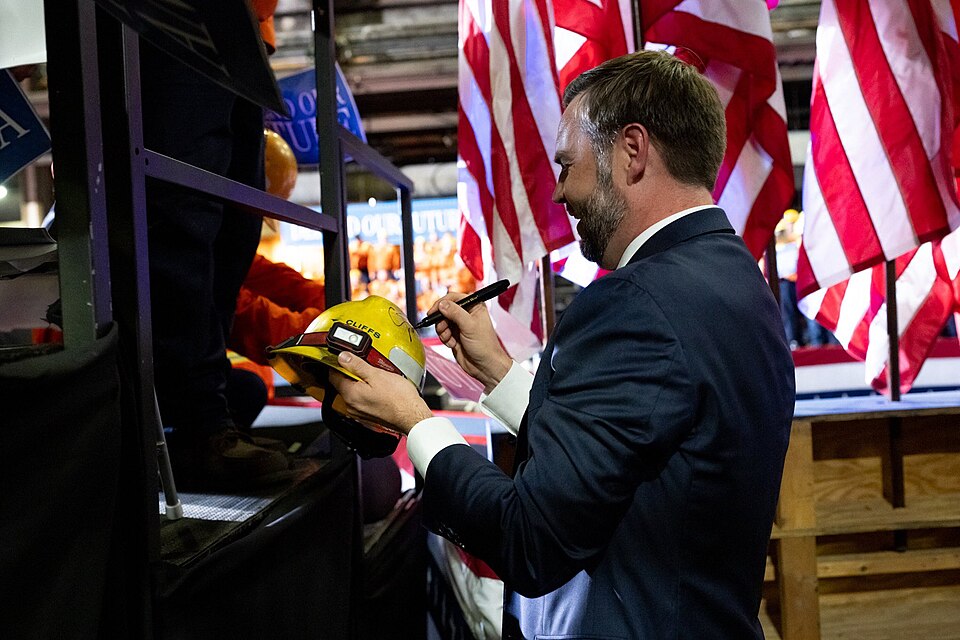
Vice President JD Vance had a lighthearted moment at the expense of two major news organizations this week as the Trump administration’s increasingly public battle with the press moved into the courtroom.
During a Tuesday event focused on combating fraud in federal programs, Vance looked down at his notes and indicated that he was supposed to take questions from CNN and Politico.
There was just one problem: neither outlet appeared to have a reporter in the room.
“I have my notes here that I’m supposed to take questions from CNN and Politico,” Vance said before asking whether representatives of either organization were present.
After receiving no response, the vice president moved on.
Centers for Medicare and Medicaid Services Administrator Dr. Mehmet Oz, who was standing behind Vance, laughed at the exchange.
The brief moment came against the backdrop of a much larger confrontation between President Donald Trump and several national news organizations.
Trump Bars Three News Outlets From White House Grounds
Trump announced Friday that CNN, Politico and MS NOW would no longer be permitted on White House grounds.
The president has accused the organizations of repeatedly publishing what he considers inaccurate or unfair coverage. The three outlets dispute the administration’s justification and argue that the restrictions violate their constitutional rights.
Reuters reported that Trump announced the restrictions through Truth Social and accused the organizations of reporting what he described as “fiction and lies.”
The administration’s move went beyond criticism of individual stories. Reporters from the affected organizations were denied access to White House grounds, setting off an immediate confrontation over presidential authority and freedom of the press.
The White House’s position is that news organizations remain free to cover the president without receiving access to restricted areas inside the White House complex.
The news organizations argue that the government cannot selectively revoke access in retaliation for reporting officials dislike.
That disagreement is now being decided in federal court.
CNN, Politico And MS NOW File Lawsuit
CNN, Politico and MS NOW filed a lawsuit against the Trump administration on September 21, asking a federal judge to restore their White House access.
The organizations allege that the restrictions violate both First Amendment protections and their due-process rights.
The administration disputes that interpretation.
According to Reuters, the organizations sought an emergency court order overturning the restrictions, with a hearing scheduled for Wednesday, September 23.
The case could have implications reaching well beyond these three outlets because it raises a fundamental question about the relationship between the presidency and the journalists assigned to cover it.
Presidents have considerable authority over security and operations at the White House. At the same time, courts have previously considered constitutional limits on how administrations may revoke individual journalists’ access.
The latest lawsuit will determine how those principles apply to Trump’s broader restrictions on entire news organizations.
Trump Encounters CNN At United Nations
The White House restrictions did not prevent the affected organizations from covering Trump elsewhere.
That became clear Tuesday when CNN reporters appeared at the United Nations General Assembly in New York.
Trump noticed CNN White House correspondent Kaitlan Collins among the reporters and expressed surprise that the network was covering him.
“You should not be here covering me,” Trump told her.
CNN later emphasized that it had never announced it would stop reporting on Trump.
There was also an important distinction between the two locations: reporters covering the president at the United Nations were operating under U.N.-issued credentials rather than White House credentials.
Reuters confirmed that reporters from CNN, Politico and MS NOW were able to cover Trump’s U.N. appearance with passes issued by the United Nations.
The encounter underscored an important part of the dispute.
The administration has restricted the organizations’ physical access to White House grounds, but it has not prevented them from reporting on the president at other locations.
Administration Defends Its Decision
Trump has strongly defended the White House action.
The president argues that the restrictions are aimed at organizations he believes have repeatedly treated his administration unfairly, rather than at freedom of the press itself.
The affected organizations reject that distinction.
Their lawsuit contends that the government cannot punish news organizations because of the content or viewpoint of their reporting.
That question — whether the administration is exercising legitimate control over White House access or engaging in unconstitutional retaliation — is now at the center of the legal fight.
Secretary of State Marco Rubio has also defended the broader principle behind the administration’s position, arguing that an organization can continue reporting on the government without having a permanent presence inside the White House.
Media Fight Expands Beyond Three Outlets
The controversy has also affected other news organizations.
Following the restrictions, several major television networks temporarily suspended participation in some presidential press-pool coverage in protest.
The development demonstrates how a dispute initially involving three organizations has expanded into a broader debate within the White House press corps.
Supporters of greater presidential discretion over White House access argue that occupying space inside one of the country’s most secure government buildings is different from possessing a general constitutional right to publish news.
The organizations challenging Trump argue that once the government establishes a system of press access, it cannot distribute that access based on whether officials approve of an outlet’s reporting.
The federal courts will have to determine how those competing arguments apply in this case.
White House Expands Direct-To-Public Media Strategy
At roughly the same time as the dispute intensified, the White House launched a new 24-hour streaming channel known as Trump TV.
The online service features speeches, administration announcements, previous presidential appearances and other White House-produced content.
The launch reflects a strategy increasingly available to modern presidents: communicating directly with millions of Americans without depending entirely on traditional television networks and newspapers.
Social media, livestreaming and online video have made it possible for presidents to distribute speeches and announcements directly to the public.
Traditional news organizations still play a separate role by independently reporting on, analyzing and questioning government actions.
The tension between those two models — direct presidential communication and independent press coverage — is becoming increasingly visible in Washington.
Vance’s Remark Captures A Much Bigger Fight
Against that backdrop, Vance’s joke about CNN and Politico lasted only a few seconds.
But the laughter in the room reflected a dispute that has become anything but small.
Trump has made his dissatisfaction with several major media organizations a defining feature of his relationship with the press, while CNN, Politico and MS NOW are now asking the judiciary to place limits on the administration’s ability to restrict their White House access.
For now, the organizations continue to cover Trump outside the White House while their attorneys fight for restored access inside it.
The next major development will come from the courts, where judges will weigh the administration’s authority to control access against the constitutional protections invoked by the news organizations.
Whatever the outcome, the confrontation is likely to remain one of the most closely watched press-access disputes of Trump’s second term.