In another powerful move to rein in Washington’s out-of-control spending, President Donald Trump has officially shut down a major federal department created earlier this year.
The administration confirmed the closure of the Department of Government Efficiency (DOGE) — an initiative originally launched to target waste, bureaucracy, and soaring federal costs.
The decision marks one of the boldest steps yet in Trump’s renewed push to cut government bloat and protect taxpayers.
DOGE Officially Dissolved — “It Doesn’t Exist”
According to a new Reuters report, the Office of Personnel Management (OPM) confirmed the department’s termination this month. OPM Director Scott Kupor was blunt when asked about DOGE:
“That doesn’t exist.”
Kupor said DOGE is no longer a centralized department and now functions only as an informal idea within the administration — not a standalone federal entity.
The shutdown comes eight months ahead of schedule, signaling the administration’s intention to streamline and reorganize government operations more aggressively.
Trump Launched DOGE to Fight Bureaucracy and Spending
President Trump created DOGE on Day One of his return to the Oval Office earlier this year, tasking Elon Musk with a direct mission: cut needless federal spending and bring accountability back to Washington.
Musk described the project as an urgent effort to push back against what he called the “tyranny of the bureaucracy.”
During a Fox News interview with Sean Hannity, Musk warned Americans:
“If the deficit is not brought under control, America will go bankrupt.”
The department originally aimed to cut $1 to $2 trillion in government waste every year.
DOGE Delivered Results — $150 Billion in Cuts Before Shutdown
While the trillion-dollar target was ambitious, DOGE still delivered substantial savings. By the time Musk departed the administration in late May, the department had cut an estimated $150 billion in federal spending.
For taxpayers — especially older Americans concerned about inflation and the national debt — these cuts represented a key victory in Trump’s wider effort to restore fiscal responsibility.
Backlash Against Musk — Attacks, Vandalism, and Market Turbulence
Musk’s involvement came at a cost. As he pushed deeper into the fight against federal waste, he became a political target. Multiple Tesla vehicles were attacked, critics went after him online, and media pressure intensified.
Tesla’s stock also took a hit early in the year, falling from $379 to $225 by mid-March.
But the company has since rebounded, trading around $391 today — even higher than its January level.
Trump Praised Musk’s Patriotism Before His Departure
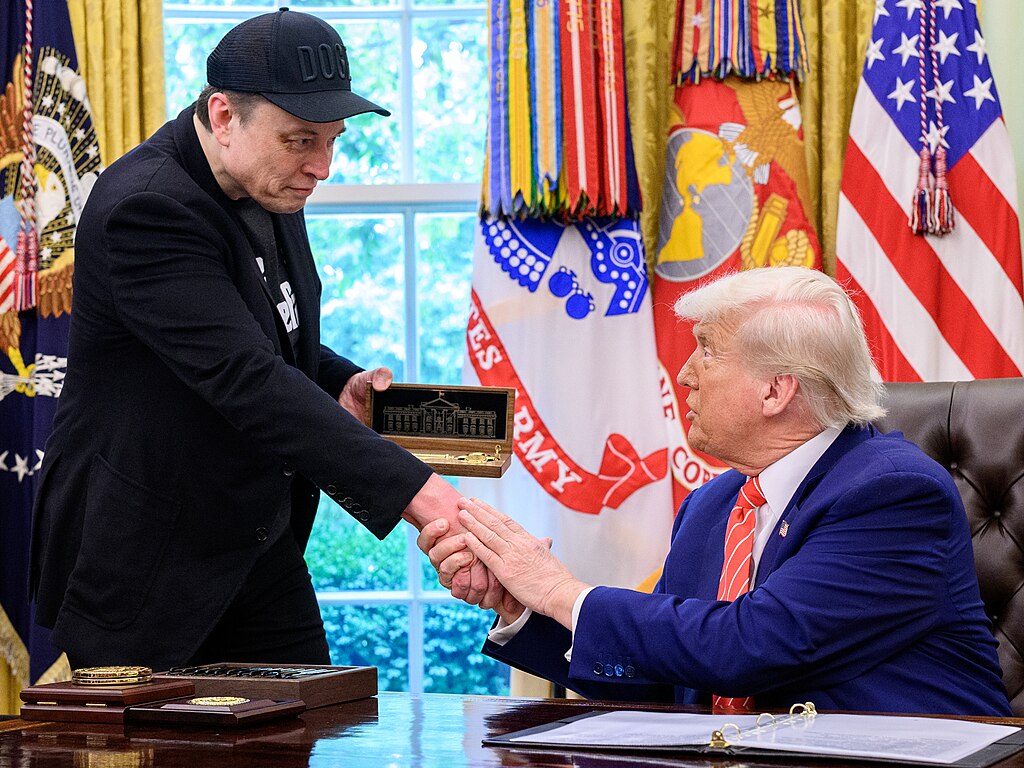
Despite the tension and political attacks, Musk left the White House on positive terms. President Trump personally thanked him for his service and presented him with a gold key to the White House, calling him an “incredible patriot.”
Trump added:
“There’s nobody like him.”
The praise reflected Musk’s outsized impact on government efficiency and spending reform.
A Temporary Rift — Then a Public Reconciliation
Their relationship briefly cooled after Musk suggested Trump withheld Epstein-related documents. But the two ultimately reconnected.
They were seen speaking at Charlie Kirk’s memorial service in September, and Musk later joined Trump at a high-profile White House event honoring Saudi Crown Prince Mohammed bin Salman.
The reunion signaled that the partnership — and their influence on American economic policy — remains strong.
DOGE Ends Early — But the Push to Cut Waste Continues
The department’s early termination — originally set for July 4, 2026 — doesn’t mean the mission is over. Instead, Trump officials say the effort to cut waste, shrink bureaucracy, and protect taxpayer dollars is simply moving into a new phase.
For many conservative voters, especially older Americans frustrated with Washington’s spending addiction, DOGE’s shutdown underscores a simple truth:
President Trump is still willing to confront federal waste head-on — even if it means closing down a department created under his own watch.