The United States military is preparing for what could become a major national security turning point in the Middle East.
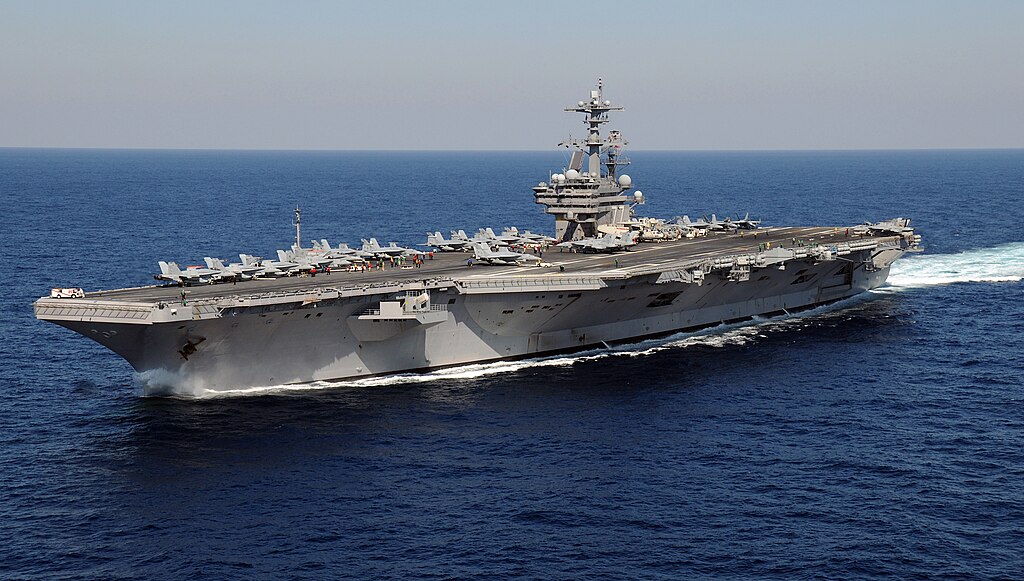
Senior defense officials, speaking to The Wall Street Journal, said the Pentagon has directed a second aircraft carrier strike group to get ready for a potential deployment to the Middle East as tensions with Iran intensify.
While President Donald Trump has not yet given the final authorization, sources say the order could be issued within hours if the situation escalates.
For Americans watching global instability grow once again, the message is clear: the United States is positioning itself from a place of strength.
Second Carrier Strike Group on Standby
The additional carrier group would likely deploy from the East Coast. One vessel is reportedly being prepared for departure within two weeks.
USS George H.W. Bush, currently conducting training exercises off Virginia’s coast, is believed to be the leading candidate.
The nuclear-powered aircraft carrier is equipped with advanced F-35 stealth fighter jets, capable of precision operations against fortified targets. Military analysts say such aircraft would be essential in any potential strike scenario involving Iran’s hardened military infrastructure.
If deployed, it would reinforce the existing presence of USS Abraham Lincoln, already stationed in the region.
Two U.S. aircraft carriers operating simultaneously in the Middle East would represent a powerful strategic deterrent — something not seen since earlier U.S. military operations in 2025.
For many Americans who remember decades of instability in the region, this kind of forward positioning signals preparedness rather than hesitation.
President Trump’s Firm Stance on Iran
President Trump has consistently warned Iran’s leadership that continued nuclear development and violent crackdowns on protesters would not go unanswered.
Over the past month, he has referenced a “massive flotilla” and a “big armada” prepared to defend U.S. interests and regional allies.
On Wednesday, Trump met at the White House with Israeli Prime Minister Benjamin Netanyahu to discuss intelligence findings and the broader security picture in the Middle East.
Following the meeting, Trump emphasized that diplomacy remains the preferred path — but only if negotiations are serious.
The president wrote on Truth Social that no final agreement was reached, but he made clear that he wants talks with Iran to continue in hopes that a deal can ultimately be finalized.
He also reminded observers that previous refusals to negotiate carried consequences, referencing prior military actions that significantly impacted Iran’s strategic position.
Intelligence Signals Growing Concern
Reports from Israeli outlet i24News indicate that Netanyahu presented intelligence materials highlighting Iran’s ballistic missile stockpiles and military capabilities.
These developments come amid ongoing concerns about regional security, energy markets, and global stability — all issues that directly affect American families, retirement portfolios, and long-term economic confidence.
For investors and retirees alike, Middle East stability plays a significant role in oil prices, defense spending, and overall market conditions.
What Happens Next?
If President Trump authorizes the deployment, it would mark a major escalation in U.S. military posture.
However, administration officials stress that the objective remains deterrence — projecting strength to prevent conflict rather than invite it.
Historically, forward deployment of U.S. naval power has often served as leverage in negotiations rather than a precursor to sustained war.
For Americans who prioritize strong borders, national security, and peace through strength, the coming hours could prove pivotal.
One thing is certain: Washington is preparing for every possible outcome.
And the world is watching.
Why This Matters for Americans 50+
- Energy prices and retirement accounts are sensitive to Middle East instability
- National security policy directly impacts defense spending and federal budgets
- Global conflict risk influences markets and economic confidence
As this story develops, it could shape not only foreign policy — but also economic stability at home.
Stay tuned.