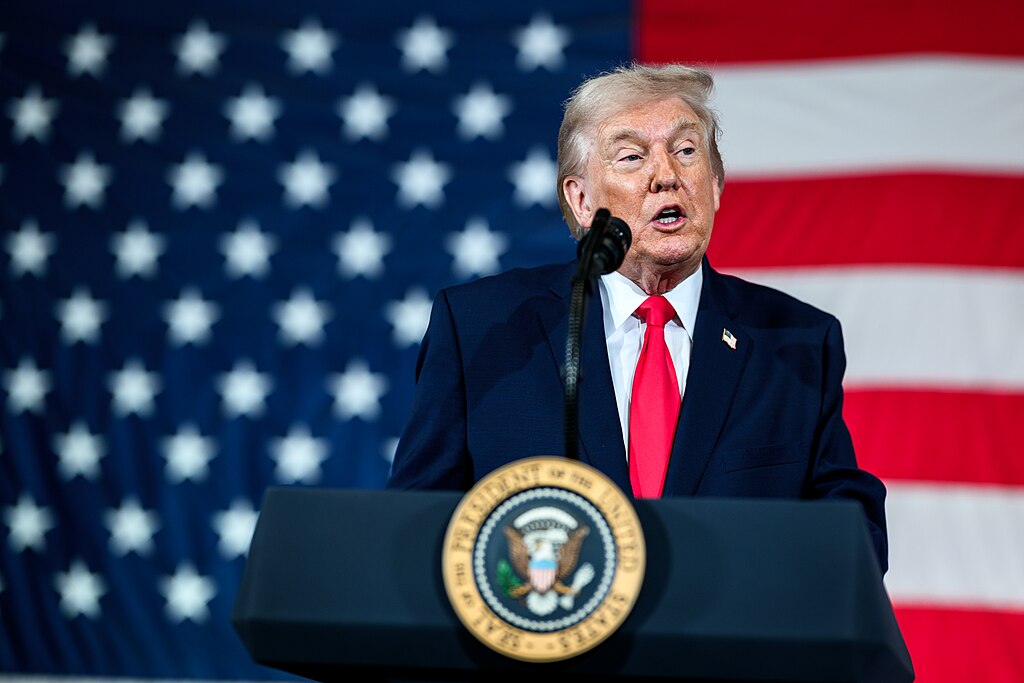
Trump upped the ante.
President Donald Trump announced plans to raise newly imposed global tariffs to 15% following a major decision from the Supreme Court of the United States that limited his earlier trade actions.
The Court ruled 6–3 that the administration exceeded its authority under the International Emergency Economic Powers Act of 1977 (IEEPA) when applying sweeping import taxes intended to address trade imbalances and fentanyl trafficking concerns.
Rather than step back, the president signaled a recalibration.
A New Legal Path: Section 122 of the Trade Act
In response to the ruling, President Trump said his administration would pivot to Section 122 of the Trade Act of 1974 — a provision allowing temporary tariffs of up to 15% for 150 days to address “large and serious” trade deficits.
This authority provides a faster, though temporary, mechanism for implementing tariffs while longer-term trade investigations are conducted.
The administration has framed the move as part of its broader effort to strengthen domestic manufacturing, reduce reliance on foreign supply chains, and confront persistent trade deficits that have impacted American industry for decades.
For many voters — particularly those who remember the industrial strength of the 1970s and 1980s — the tariff strategy represents an attempt to restore economic leverage in global trade negotiations.
Debate Over Legal Interpretation
Some trade policy experts have questioned whether Section 122 was originally intended for today’s floating exchange rate system.
Andrew Hale of Advancing American Freedom, an organization affiliated with former Vice President Mike Pence, argued that the statute references conditions tied to an older fixed-rate system abandoned in the 1970s.
Supporters of the president counter that the United States continues to face significant trade deficits and unfair trade practices — conditions they believe justify aggressive use of available legal authorities.
The legal discussion is likely to continue as new tariff measures are implemented.
Section 301: A Proven Trade Enforcement Tool
In addition to Section 122, the administration is moving forward with actions under Section 301 of the Trade Act of 1974.
Section 301 allows the United States to investigate and respond to unfair foreign trade practices that harm American businesses. The same authority was used during President Trump’s first term to impose tariffs on Chinese exports — actions that survived extensive legal scrutiny.
U.S. Trade Representative Jamieson Greer emphasized that additional Section 301 investigations are underway and described the mechanism as legally durable.
The goal, according to administration officials, is continuity — ensuring that trade enforcement remains consistent even as legal strategies evolve.
Why This Matters for American Workers
Trade policy may sound technical, but its effects are tangible.
Tariffs influence:
- Manufacturing competitiveness
- Supply chain security
- Consumer pricing
- Domestic job growth
- National economic independence
For older Americans who witnessed factory closures, outsourcing waves, and shifting global alliances, these debates are not abstract. They are tied directly to economic security and national strength.
Supporters argue that stronger tariff enforcement can help rebalance trade relationships and encourage companies to invest domestically.
Critics warn of potential retaliation or higher consumer costs.
The Bigger Economic Picture
The renewed tariff strategy underscores a central theme of the administration’s economic policy: prioritizing American production and challenging long-standing trade deficits.
With new investigations underway and temporary tariffs poised to take effect, markets, global trading partners, and policymakers will be watching closely.
What is clear is that the administration intends to continue pursuing trade enforcement tools it believes are legally sound and economically necessary.