They aren’t giving President Trump and inch.
President Donald Trump’s plan to dramatically renovate the historic Eisenhower Executive Office Building has run into a legal challenge, putting one of Washington’s most recognizable government landmarks at the center of a fight over preservation, presidential authority and federal law.
The controversy centers on Trump’s proposal to paint the exterior of the Eisenhower Executive Office Building, or EEOB, white.
The Trump administration says the project would beautify and preserve a building that officials argue has suffered from decades of neglect. Historic preservation advocates, however, warn that painting the structure’s granite exterior could permanently change its appearance and potentially damage the landmark.
The disagreement has now moved into federal court.
Trump Wants to Beautify Historic White House Complex
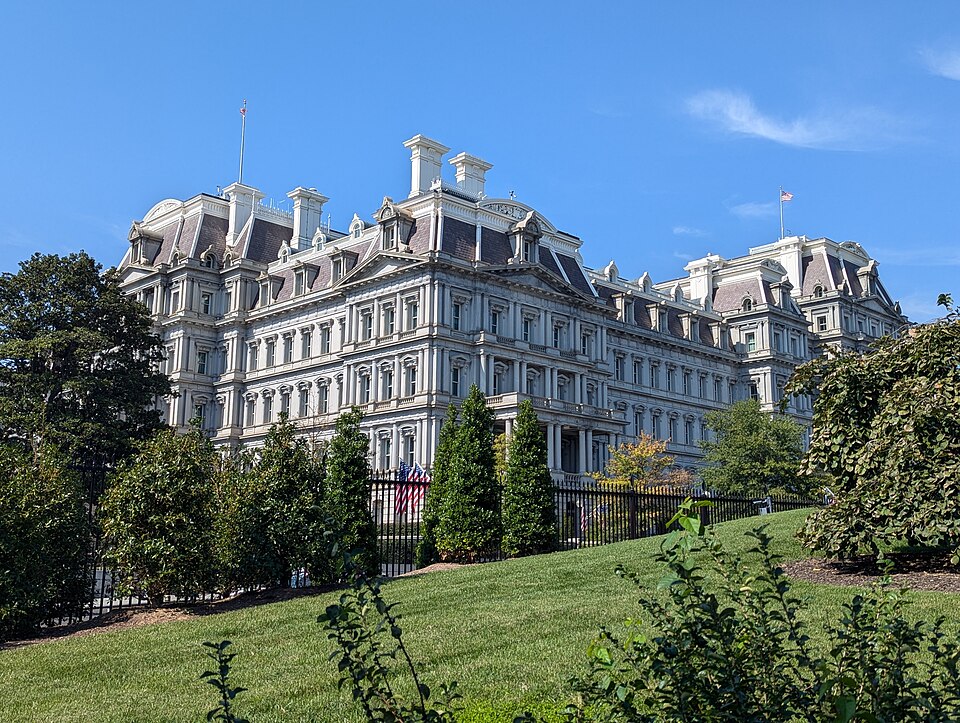
Located beside the White House, the Eisenhower Executive Office Building is one of the most distinctive government buildings in Washington, D.C.
Approximately 1,500 employees connected to the executive offices of the president and vice president work inside the massive structure.
Trump’s proposed renovation comes during America’s 250th anniversary year and is part of his administration’s broader effort to improve prominent federal properties around the nation’s capital.
White House spokesperson Davis Ingle defended the president’s approach in comments to Newsweek, describing the renovations as overdue and saying the administration wants to preserve the White House complex for future generations.
The White House also says the EEOB project will undergo the appropriate review process, including consideration involving the National Capital Planning Commission and the U.S. Commission of Fine Arts.
But two preservation organizations are challenging how the project is being handled.
Preservation Groups File Lawsuit
Cultural Heritage Partners and the DC Preservation League have filed a lawsuit seeking emergency relief over the proposed renovation.
The groups want the court to ensure that the project complies with federal preservation and environmental requirements, including the National Historic Preservation Act and National Environmental Policy Act.
Their challenge could turn what initially appeared to be an architectural dispute into a larger legal battle over the limits of presidential power involving historic federal property.
Greg Werkheiser, an attorney and founding partner of Cultural Heritage Partners, argued that presidents are temporary caretakers of America’s historic landmarks rather than their owners.
His organization maintains that significant and potentially permanent alterations should go through the public review procedures established under federal law.
The Trump administration sees the building’s condition differently.
Why Trump Wants the EEOB Painted White
The most dramatic part of Trump’s proposal is his desire to transform the building’s exterior by painting it white.
Cultural Heritage Partners says Trump announced the idea in November 2025 as part of an effort to beautify the property.
The change would substantially alter the appearance of a building that has stood beside the White House for well over a century.
Completed in 1888, the EEOB is known for its elaborate French Second Empire architecture. Granite walls, a slate roof and extensive cast-iron detailing give the structure an appearance that contrasts sharply with the White House.
Administration officials argue the building needs significant attention.
According to materials prepared by the White House Office of Administration for a Commission of Fine Arts review, the EEOB has received relatively limited exterior maintenance during its long history.
Officials cited grime, soot, staining, cracks and abrasions affecting the granite façade.
The administration also argued that the EEOB’s current exterior does not visually align with surrounding architecture or provide enough symbolic continuity with the neighboring White House.
Painting the building, according to the administration’s argument, could provide a more consistent method for maintaining its exterior in the future.
Preservationists say that solution could come at too high a price.
Historic Preservation Advocates Warn of Permanent Damage
The National Trust for Historic Preservation has raised concerns about making such a significant change to the landmark.
The organization notes that the building’s exterior has remained unpainted since its completion in 1888.
The EEOB is also part of the Lafayette Square National Historic Landmark District, further increasing the historical significance of its existing appearance.
Preservation advocates say the granite exterior, slate roofing and decorative cast-iron features aren’t simply cosmetic details. They argue those materials are essential parts of the building’s architectural character.
Covering the granite with bright white paint, critics contend, could obscure an appearance that has survived for more than a century.
There are also concerns about what painting could do to the structure itself.
Preservationists have warned that applying a coating to historic stone could potentially trap moisture within the masonry and contribute to deterioration.
That has led opponents to argue that restoration should focus on cleaning and repairing the historic materials rather than covering them.
Bigger Question Over Presidential Authority
The lawsuit could ultimately determine much more than what color the Eisenhower Executive Office Building will be.
Cultural Heritage Partners argues that the administration’s legal position could have consequences for future presidents and historic federal properties.
The group is concerned that placing projects directly under White House authority could potentially allow an administration to avoid preservation and environmental procedures that would normally apply when federal agencies oversee similar work.
That interpretation is disputed, and the White House says it intends to follow the necessary review procedures.
Still, the disagreement creates an important question for the courts: How far does presidential authority extend when a president wants to alter historically significant property within the White House complex?
Werkheiser argues that Congress established preservation laws specifically to ensure major decisions involving national landmarks receive appropriate scrutiny.
The outcome could therefore establish an important precedent extending far beyond this particular renovation.
Trump’s Renovation Plan Faces Major Hurdle
For Trump, the controversy comes as his administration pushes to improve the appearance of Washington during the nation’s 250th anniversary celebration.
Supporters of the president’s approach may view the project as a long-overdue attempt to clean up and maintain an aging federal landmark.
The administration’s case rests partly on the argument that the EEOB has accumulated visible deterioration and that its appearance lacks cohesion with the neighboring White House.
Preservation advocates aren’t opposed to maintaining the building. Their objection centers on how that restoration should be performed.
They believe preserving the original granite exterior and other historic materials is more important than making the building visually match its surroundings.
That distinction has transformed a renovation proposal into a broader fight involving history, architecture, federal law and presidential power.
For now, Trump’s vision for a newly transformed Eisenhower Executive Office Building faces significant legal and preservation hurdles.
And as the dispute continues, the ultimate question isn’t merely whether the historic building should be painted white. It’s also about who gets to decide how much a president can change an American landmark that has stood beside the White House since the 19th century.