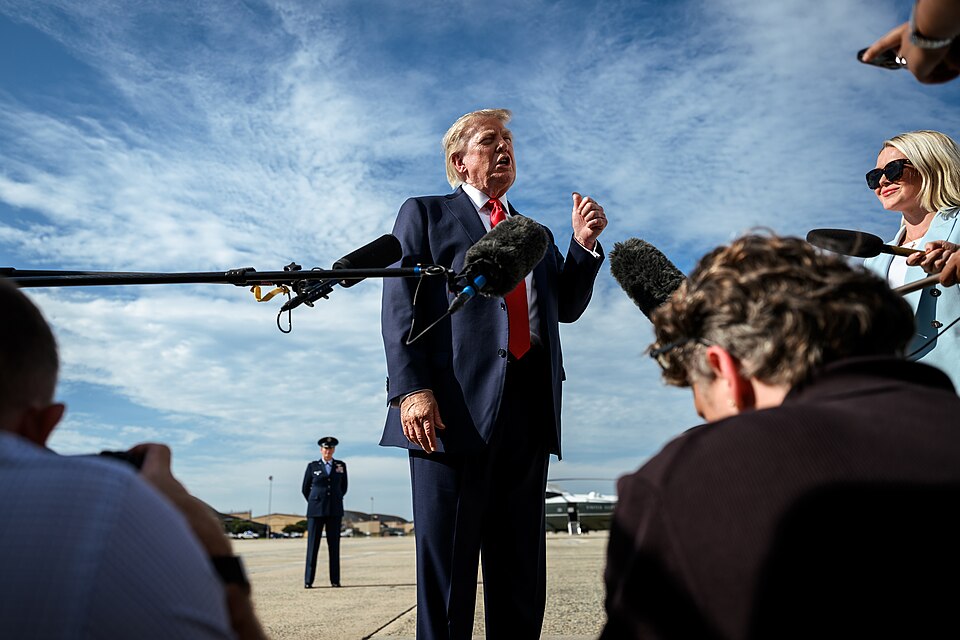
President Donald Trump just added another intriguing name to the growing conversation about who could eventually succeed him — and his latest comments are likely to get the attention of Vice President JD Vance supporters.
Trump offered unusually warm praise for Texas Sen. Ted Cruz on Thursday after being asked about Cruz potentially launching another presidential campaign in 2028.
But has Trump suddenly turned against Vance?
Not so fast.
Trump has not withdrawn his support for his vice president, nor has he endorsed Cruz for president. Still, his willingness to praise another potential Republican contender shows that the battle over the future of the GOP may be far from settled.
Trump Praises Ted Cruz
While answering questions from reporters in the Oval Office, Trump was asked directly about Cruz and the possibility that the Texas Republican could seek the White House again.
Trump had plenty of good things to say.
“I would say that he’s very talented. He’s a very good friend of mine,” Trump said.
The president went on to suggest that Cruz could be a formidable contender before again describing the senator as talented.
For Republicans who remember the 2016 presidential election, hearing Trump describe Cruz as a “very good friend” is remarkable.
The two men were once bitter political rivals.
Trump and Cruz Were Once Bitter Rivals
Cruz emerged as one of Trump’s toughest competitors during the 2016 Republican presidential primary.
Their campaign battle became intensely personal as Trump, Cruz and a crowded field of Republicans fought for the nomination.
Trump eventually prevailed, captured the Republican nomination and defeated Democrat Hillary Clinton in the general election.
In the years that followed, however, the relationship between Trump and Cruz changed considerably.
Cruz became an important conservative voice in the Senate and frequently supported Trump on major political battles.
Now, a decade after their heated primary fight, Trump is publicly praising Cruz as the Texas senator considers whether to make another run for president.
That raises an obvious question: Could Cruz challenge Vance for control of the Republican Party after Trump?
Ted Cruz Admits He Wants to Be President
Cruz isn’t exactly hiding his ambitions.
During an interview with Texas Lt. Gov. Dan Patrick this week, Cruz acknowledged that his desire to become president is hardly a secret.
Asked whether he would run again, Cruz stopped short of making an announcement and said that “time will tell.”
That leaves the door wide open.
Cruz already knows what a national presidential campaign requires. He built a powerful conservative following during the 2016 Republican primary and remained one of Trump’s final major challengers before Trump secured the nomination.
A 2028 campaign would be different.
Instead of running against Trump, Cruz could find himself running against Trump’s vice president.
Cruz Says Republicans Haven’t Chosen Vance
Perhaps even more significant were Cruz’s comments about JD Vance.
Despite growing speculation that Vance could become Trump’s political successor, Cruz pushed back against the suggestion that Republicans have already decided who should lead the party in 2028.
“There is going to be a full discussion about who we are and what we believe,” Cruz said during an interview this week.
Then came the line likely to fuel even more 2028 speculation:
“I’ll certainly be part of the discussion.”
That doesn’t amount to an official presidential announcement.
But it certainly doesn’t sound like Cruz intends to stand on the sidelines while Republicans choose their next leader.
Is JD Vance Still Trump’s Favorite?
There is an important distinction that shouldn’t get lost in the political speculation.
Trump has not dumped JD Vance.
In fact, the president has previously described his vice president as the “most likely” successor to his political movement.
“I think most likely, in all fairness, he’s the vice president,” Trump said earlier this month while discussing the Republican Party’s future.
That’s a major advantage for Vance.
Serving as vice president gives him national visibility, a direct connection to the Trump administration and an opportunity to build relationships with Republican voters well before the 2028 campaign begins.
Vance has also developed a strong following among many America First and MAGA conservatives.
But Trump praising Cruz demonstrates why Republicans shouldn’t assume the nomination has already been decided.
Marco Rubio Is Also in the Conversation
Cruz and Vance aren’t the only Republicans whose names have surfaced in conversations about the party’s future.
Secretary of State Marco Rubio has also received praise from Trump.
Rubio, like Cruz, competed against Trump during the 2016 Republican presidential primary before eventually becoming one of the most prominent figures in Trump’s administration.
Trump has even floated the possibility that Vance and Rubio could “get together” in some form in the future.
Exactly what that would mean remains unclear, and Trump has repeatedly cautioned that it is still too early to settle the 2028 question.
That’s understandable.
Political circumstances can change dramatically in two years, much less between now and the next presidential election.
The Battle for Trump’s MAGA Movement
The larger issue isn’t simply whether Cruz, Vance or Rubio wants to become president.
Republicans will eventually face a much bigger question: Who can keep Trump’s political coalition together?
Trump transformed the Republican Party by emphasizing border security, tougher trade policies, economic populism, energy independence and an America First approach to foreign policy.
Any Republican hoping to succeed him will have to persuade those voters that he can preserve the policies they supported under Trump while also offering his own vision for the country’s future.
That could create an interesting ideological battle.
Vance has become closely associated with the newer populist wing of the Republican Party.
Cruz built much of his political career around traditional constitutional conservatism, limited government and free-market principles.
Rubio has undergone his own political evolution while becoming a major figure in Trump’s administration.
Those differences could eventually give Republican voters a genuine choice about the direction of the party.
A Republican Primary Could Get Crowded
History also suggests that presumed presidential frontrunners don’t always win.
Candidates can look unbeatable years before an election only to stumble once voters actually begin paying attention.
Trump himself proved that in 2016.
Few establishment political observers expected him to defeat a Republican field filled with governors, senators and experienced politicians. Yet Republican voters rejected the conventional wisdom and handed Trump the nomination.
That history makes declaring Vance — or anyone else — the guaranteed 2028 nominee especially premature.
Cruz appears to understand that.
His latest comments suggest he wants Republican voters, rather than political insiders, to decide who should carry the party forward.
Trump Isn’t Endorsing Anyone Yet
For all the speculation surrounding Trump’s remarks, one fact remains important: Trump has not formally endorsed Ted Cruz for president in 2028.
His comments amounted to praise, not an endorsement.
Likewise, Trump’s previous compliments toward Vance do not necessarily mean the 2028 Republican nomination has been settled years in advance.
Trump appears willing to keep several potential successors in the conversation.
That may ultimately benefit him politically.
Rather than creating a lame-duck atmosphere where Republicans immediately shift their loyalty toward a presumed successor, an unsettled 2028 field keeps Trump at the center of the Republican Party.
Potential candidates still have a powerful incentive to seek his support and remain close to his political movement.
Could Cruz Really Challenge Vance?
Cruz would bring several advantages to a presidential campaign.
He has national name recognition, a loyal conservative following, extensive fundraising experience and firsthand knowledge of running for president.
He also represents Texas, one of the largest and most influential Republican states in the country.
Vance, however, would have something Cruz didn’t possess in 2016: the ability to run as Trump’s sitting vice president and potentially argue that he represents continuity with the Trump administration.
That could be enormously valuable in a Republican primary.
Much will depend on what happens between now and 2028.
The economy, immigration, foreign policy, Trump’s popularity and the results of upcoming elections could all influence what Republican voters want in their next presidential nominee.
The Bottom Line
No, Donald Trump hasn’t “dumped” JD Vance.
But his enthusiastic praise for Ted Cruz is another sign that Republicans shouldn’t assume the 2028 presidential race is already over before it begins.
Vance remains exceptionally well positioned to inherit Trump’s MAGA coalition. Cruz, however, is openly signaling that he intends to participate in the debate over the Republican Party’s future.
Marco Rubio remains another name to watch.
And Trump?
For now, the president appears perfectly comfortable keeping everyone guessing.
The eventual contest to succeed Trump could become one of the most consequential Republican primaries in decades — a battle not only over who gets the nomination, but over what the Republican Party and the MAGA movement will look like in the years ahead.