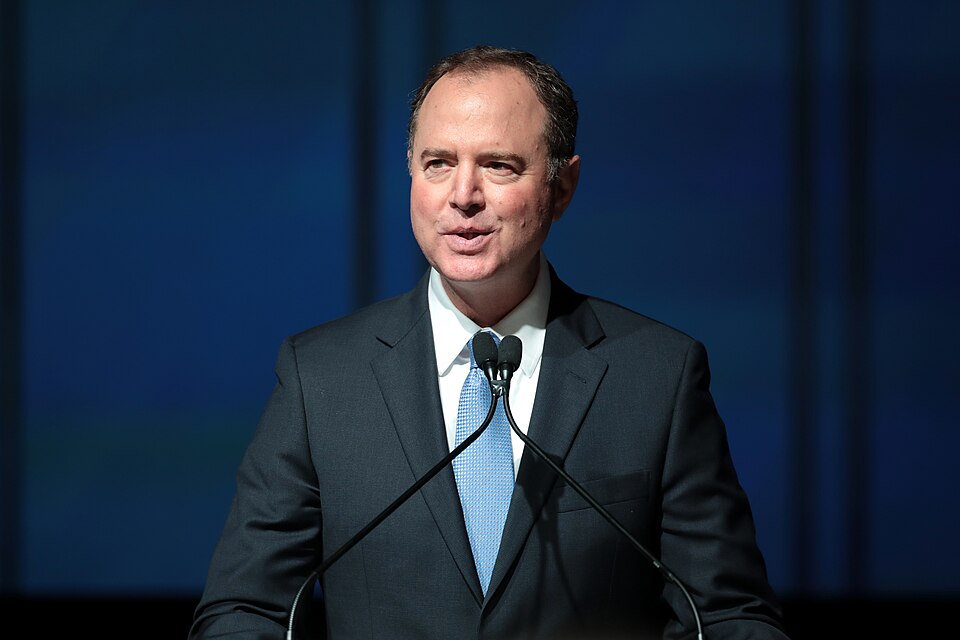
Whoa! This was shocking to see.
Sen. Adam Schiff has spent years battling President Donald Trump, but the California Democrat is now publicly siding with his longtime political rival on an issue hitting close to home: the loss of American film and television jobs to foreign countries.
In a striking moment of bipartisan agreement, Schiff said he is in “strong agreement” with Trump’s proposal for a federal tax incentive designed to encourage movie and television production in the United States.
The unlikely alliance comes as concerns grow over Hollywood productions—and the thousands of American jobs connected to them—moving to Canada, the United Kingdom and other overseas locations offering lucrative financial incentives.
For Trump, the answer is straightforward: give companies a stronger financial reason to produce their movies and television programs in America.
And this time, Schiff agrees.
Trump Wants Hollywood Jobs Back in America
Trump called on Congress to take action after meeting with actor Jon Voight, whom the president previously selected as one of his Special Ambassadors to Hollywood.
The president urged Republicans and Democrats to put their differences aside and develop legislation aimed at revitalizing America’s entertainment industry.
“I am going to suggest that Republicans and Democrats get together, and immediately craft Legislation to save the Movie, Television, and Entertainment Business in America,” Trump wrote on Truth Social.
Trump specifically called for Congress to establish a federal production incentive that would encourage studios to keep more entertainment jobs inside the United States.
“Congress should approve, immediately, a Federal Production Incentive to create Entertainment Jobs in America,” Trump wrote.
It fits squarely within Trump’s broader economic message of encouraging companies to invest, manufacture and employ workers in the United States rather than sending jobs overseas.
Trump Warns About Hollywood’s Decline
Trump didn’t mince words about the current state of the entertainment industry.
“Hollywood is a Complete and Total Disaster!” the president declared.
Trump argued that productions have increasingly moved to Canada and other countries because companies can receive more attractive financial incentives elsewhere.
The issue matters well beyond wealthy actors, directors and studio executives.
A major film or television production can employ hundreds—or even thousands—of people.
Camera operators, electricians, carpenters, truck drivers, set builders, costume designers, makeup artists, caterers, security personnel and countless other workers depend on the entertainment industry for their livelihoods.
Local hotels, restaurants, equipment companies and small businesses can also benefit when a major production comes to town.
When those productions leave America, much of that spending can leave with them.
Schiff Delivers a Surprising Response
Considering the history between Trump and Schiff, the California senator’s response was difficult to ignore.
Rather than attacking Trump’s proposal, Schiff enthusiastically endorsed the central idea.
“I am in strong agreement with the President,” Schiff wrote on X.
Schiff then called on Congress to quickly approve a federal film tax incentive designed to recover entertainment jobs that have moved outside the country.
“Let’s work together – Republicans and Democrats – to get this done, and bring the movie magic back to America,” Schiff said.
Those words represent a remarkable departure from the political warfare that has defined the Trump-Schiff relationship.
Trump and Schiff Have Been Bitter Political Rivals
There is little chance anyone will mistake Schiff for a Trump political ally.
Schiff became nationally known as one of Trump’s most aggressive Democratic critics during the president’s first term.
As a member of the House of Representatives, Schiff played a major role in the first impeachment proceedings against Trump in 2019.
Their political feud continued for years afterward.
Trump has repeatedly criticized Schiff, while Schiff has remained an outspoken opponent of Trump and many of his policies.
That history makes the senator’s declaration of “strong agreement” particularly notable.
It doesn’t mean their long-running political feud has disappeared.
But on the question of protecting American entertainment jobs, the two rivals suddenly find themselves standing on surprisingly similar ground.
Schiff Was Already Pushing a Tax Credit
There is another important part of the story.
Schiff didn’t suddenly embrace the idea simply because Trump proposed it.
The California Democrat has been advocating for a federal film production incentive since last year and has circulated a proposal that would reportedly provide a 15% tax credit for qualifying U.S. labor costs.
Schiff also held a Senate hearing on the subject in March.
Trump and Schiff therefore approached the issue from very different political directions but reached a similar conclusion: the federal government should consider using tax policy to make American film and television production more competitive.
Voight has reportedly advocated for an even larger 20% federal production credit.
The final details would ultimately be up to Congress.
Why Are American Productions Moving Overseas?
Money is a major factor.
Foreign governments have spent years developing incentives intended to attract Hollywood productions.
Canada and the United Kingdom are among the international destinations that have benefited from the competition for film and television spending.
American states have responded with incentive programs of their own, creating an increasingly competitive marketplace for major productions.
Studios consider labor expenses, tax benefits, construction costs, available facilities and numerous other factors when deciding where to film.
Supporters of a nationwide incentive argue that individual states shouldn’t have to compete against entire foreign countries without help from Washington.
A federal tax credit could potentially change that equation.
The Debate Isn’t Just About Hollywood Celebrities
The word “Hollywood” may bring movie stars and multimillion-dollar contracts to mind, but entertainment production supports a much broader workforce.
Consider everything required to make a major movie or television series.
Sets must be constructed. Equipment has to be transported. Workers need meals. Costumes must be produced. Locations need security. Actors and production employees require lodging.
That activity generates business for companies that may have little direct connection to Hollywood.
Supporters of Trump’s proposal therefore argue that encouraging domestic production could protect American workers while generating economic activity in communities where filming occurs.
For Americans concerned about jobs moving overseas, that argument may sound familiar.
But Would a Federal Hollywood Tax Credit Be Worth It?
There is another side to the debate.
Critics of film production incentives have long questioned whether taxpayers should provide financial benefits to profitable entertainment corporations.
Congress would have to determine how much a federal incentive would cost, which productions would qualify and whether the economic benefits would justify the lost federal tax revenue.
Lawmakers could also consider requirements designed to ensure that incentives actually result in American employment.
Those details matter.
A program intended to protect American workers would need safeguards to make sure taxpayers receive meaningful economic benefits in return.
Trump Previously Considered a Much Tougher Approach
Tax incentives aren’t the only tool Trump has considered.
The president previously threatened a 100% tariff on movies produced overseas as he sought ways to discourage studios from shifting production outside the United States.
Hollywood studios and entertainment unions have instead advocated for production incentives resembling programs already offered by foreign governments and numerous U.S. states.
Trump’s latest proposal indicates that tax incentives could become a central part of his strategy for rebuilding domestic entertainment production.
That approach could also have a better chance of attracting Democratic support.
Schiff’s response is evidence of that possibility.
Could Trump Actually Get a Bipartisan Deal?
In today’s deeply divided Washington, Republicans and Democrats agreeing on major economic legislation can be difficult.
But entertainment production creates an unusual political dynamic.
California Democrats have an obvious reason to protect an industry that remains enormously important to their state’s economy.
Republicans focused on bringing jobs and investment back to America may find the domestic-production argument appealing as well.
That could create an opening for legislation capable of attracting votes from both parties.
The details—particularly the size and cost of the tax credit—could still produce significant disagreements.
But Trump has already accomplished something unusual.
He has Adam Schiff publicly agreeing with him.
An Unexpected Alliance Over American Jobs
Nobody should expect Trump and Schiff to suddenly become political partners.
Their disagreements run far too deep for that.
But their surprising agreement demonstrates that even Washington’s fiercest political rivals can occasionally find common ground when American jobs are involved.
Trump wants Congress to make producing movies and television shows in the United States more financially attractive.
Schiff wants Congress to do essentially the same thing.
Now the question is whether lawmakers will turn that unexpected agreement into legislation.
For American entertainment workers who have watched productions and jobs migrate overseas, the answer could have consequences reaching far beyond Hollywood.