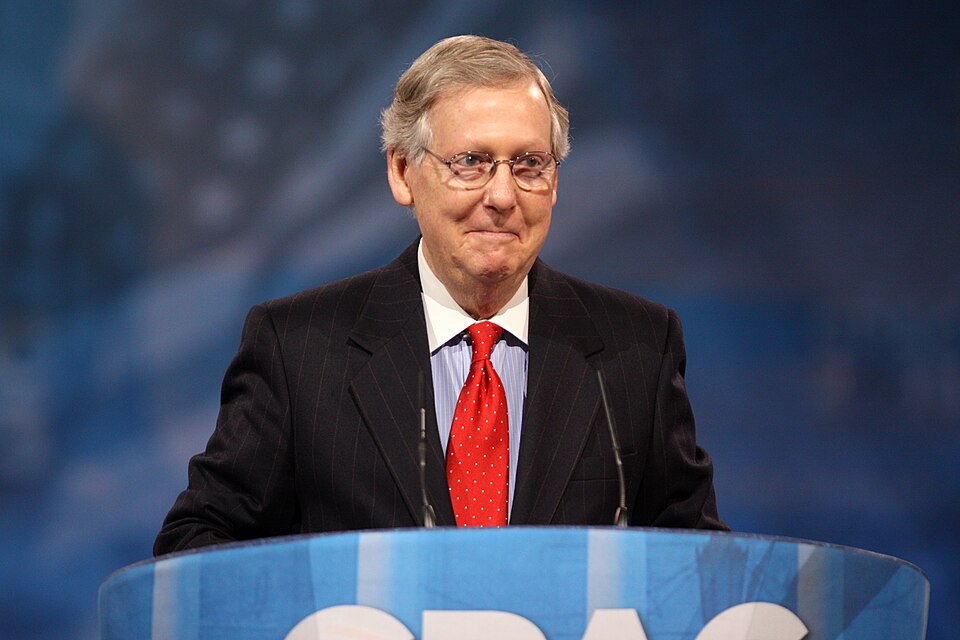
Here’s what McConnell and some Republicans are urging Trump to do.
Sen. Mitch McConnell and three other Republican senators are demanding answers from the Trump administration over more than $15 billion in stalled U.S. security assistance and weapons sales involving Taiwan.
McConnell of Kentucky joined Sens. John Cornyn, Lisa Murkowski and Thom Tillis in a letter Wednesday to Secretary of State Marco Rubio and Defense Secretary Pete Hegseth.
The senators are pressing the administration to explain why congressionally approved Taiwan security funds remain unobligated and why a multibillion-dollar weapons package has been held up.
The dispute comes at a particularly sensitive time, with President Donald Trump preparing to host Chinese President Xi Jinping in Washington amid renewed tensions over Taiwan, trade and U.S.-China relations.
More Than $15 Billion At The Center Of Dispute
The Republican senators identified three major areas of concern.
First, they said the State Department has not moved forward with $300 million in foreign military financing Congress approved for Taiwan.
Second, the Defense Department has not obligated another $1 billion through the Taiwan Security Cooperation Initiative.
The lawmakers are also questioning the administration’s decision to delay approval of a proposed $14 billion package of foreign military sales to Taiwan.
Combined, the funding and proposed military sales total more than $15 billion.
The senators warned that continued delays could raise questions among U.S. partners about Washington’s security commitments throughout the Indo-Pacific.
McConnell And Republicans Press Trump Administration
The letter puts several prominent Republicans at odds with the administration on a major foreign-policy issue.
McConnell, who chairs the Senate Appropriations Defense Subcommittee, has long advocated a strong U.S. defense posture in Asia and continued security support for Taiwan.
The senators said they are concerned about Trump’s earlier description of Taiwan-related arms sales as a negotiating tool in his dealings with Xi and the Chinese government.
Trump said after his May meeting with Xi that a pending Taiwan weapons package was being held in abeyance and described it as a “very good negotiating chip.”
That statement has become increasingly important as Xi prepares for another round of talks with Trump.
China Expected To Raise Taiwan During Washington Visit
Taiwan is expected to be one of the most closely watched subjects during the Trump-Xi meetings.
China claims Taiwan as part of its territory and strongly opposes American weapons sales to the democratically governed island.
Taiwan rejects Beijing’s sovereignty claims.
The United States does not maintain formal diplomatic relations with Taiwan, but American law provides a framework for supplying Taiwan with defensive arms and maintaining the capacity to resist coercion that could threaten its security.
China has repeatedly called on Washington to reduce or end arms sales to Taiwan.
Xi is expected to raise those concerns directly with Trump during his Washington visit.
Senators Question Whether Taiwan Is Being Used In Negotiations
McConnell and the other senators expressed concern that Taiwan’s security could become tied to broader negotiations between Washington and Beijing.
They argued that delaying important defensive capabilities while conducting diplomatic talks could create uncertainty over America’s commitments in Asia.
The senators also noted that Rubio and Hegseth have previously spoken strongly about the importance of confronting security challenges posed by China.
Rubio, before joining the administration, supported congressional efforts aimed at strengthening U.S.-Taiwan security cooperation.
Hegseth has also publicly warned about China’s growing military capabilities and emphasized the importance of protecting American allies and partners.
The senators are now asking the two administration officials to explain how those positions square with the current funding delays.
Republicans Compare Situation To Biden-Era Ukraine Decision
The lawmakers also drew a comparison to a foreign-policy dispute from the Biden administration.
They referenced the Biden administration’s decision to temporarily withhold some military assistance involving Ukraine ahead of President Joe Biden’s 2021 summit with Russian President Vladimir Putin.
The senators used the comparison to make a broader argument about the potential consequences of delaying security assistance while major diplomatic negotiations are underway.
Their concern is that repeated delays could create uncertainty among countries that depend on Washington for security cooperation.
Trump Has Also Approved Major Taiwan Arms Sales
The current dispute does not mean the Trump administration has stopped all military support for Taiwan.
In December, the administration approved an approximately $11 billion arms package for Taiwan, which Reuters reported was the largest such package ever approved.
A separate package worth roughly $14 billion, however, has remained on hold for months.
That delayed package is now receiving renewed attention from lawmakers, defense companies and officials in Taiwan.
The United States has also recently reaffirmed the importance of peace and stability across the Taiwan Strait during meetings with major Asian allies.
Why Taiwan Matters To Washington
Taiwan has become one of the most important points of tension between the United States and China.
Beijing has expanded military activity around the island in recent years while continuing to insist that Taiwan eventually come under Chinese control.
Washington, meanwhile, has maintained extensive economic and unofficial political relations with Taiwan while supplying the island with defensive military equipment.
Taiwan also plays an important role in the global technology economy because of its semiconductor industry.
As competition between Washington and Beijing has intensified, Taiwan’s security has increasingly become part of the larger debate over America’s role in the Indo-Pacific.
McConnell Wants Answers From Rubio And Hegseth
The senators specifically asked Rubio to explain why the $300 million in foreign military financing remains unobligated.
They also want Hegseth to account for the separate $1 billion Taiwan Security Cooperation Initiative funding.
The larger $14 billion arms package remains another major point of contention.
For McConnell and the other Republican senators, the dispute centers on whether funding already approved by Congress and weapons intended to strengthen Taiwan’s defenses should continue moving forward while Trump negotiates with Xi.
For the administration, the issue comes at a delicate moment as Washington attempts to balance military deterrence, economic negotiations and diplomatic relations with Beijing.
With more than $15 billion at issue and the Chinese president arriving for high-level talks, the administration’s next move on Taiwan is likely to receive close attention from Congress, U.S. allies and Beijing.