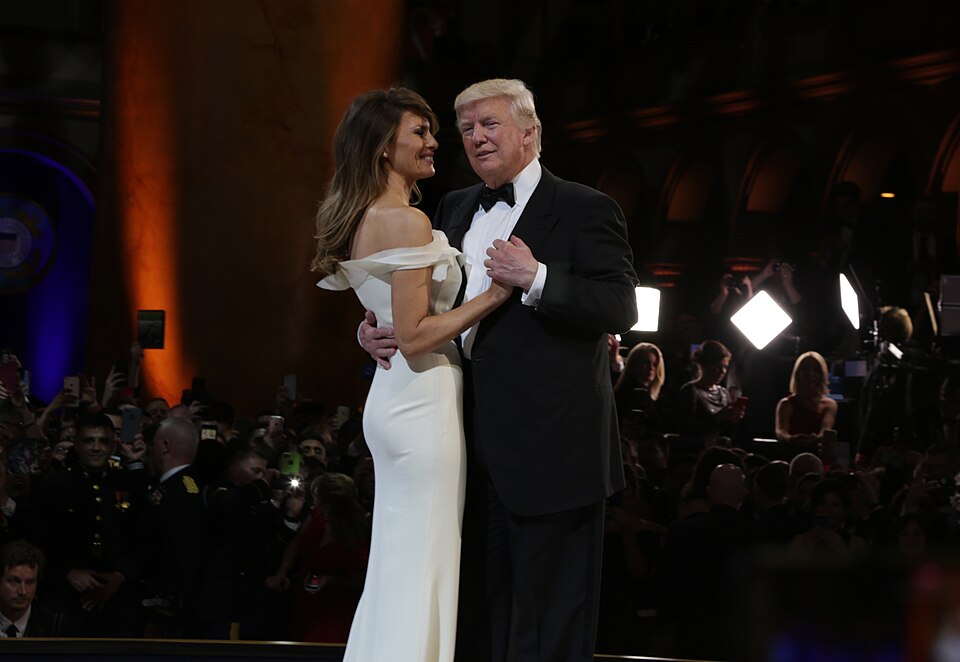
President Donald Trump is facing fresh media criticism after making a brief joke about First Lady Melania Trump during a White House ceremony.
What was supposed to be a major announcement about women’s healthcare quickly became a controversy over a few words exchanged between the president and his wife.
The incident occurred Monday, October 19, as Trump and Melania appeared together in the White House Rose Garden to announce a new federal initiative focused on improving women’s health research and treatment.
The event was intended to recognize Melania’s involvement in developing the initiative, which aims to address medical conditions that have historically received insufficient research attention.
Instead, one media outlet focused on an unscripted moment between the couple, raising questions about whether Trump’s remark was disrespectful.
The controversy has revived a familiar debate over how the national media covers the president, particularly when his comments involve humor, personal relationships, or spontaneous interactions.
Trump’s Joke About Melania Draws Media Backlash
The exchange happened while Trump was signing an executive order establishing new federal efforts to advance women’s healthcare.
After signing the document, the president handed a pen to Melania and invited her to add her signature.
As she prepared to sign, Trump remarked, “I don’t know if her signature means anything.”
People attending the ceremony laughed, and Melania responded, “Yours is the most important.”
Trump subsequently complimented his wife’s signature, and the ceremony continued.
However, The Daily Beast published an article describing the exchange as a public humiliation of the first lady.
The report presented Trump’s comment as an example of him belittling Melania during an event recognizing her work.
While critics interpreted the joke as dismissive, the exchange itself does not establish mistreatment or abuse within the couple’s marriage.
The distinction matters because an awkward public comment and an allegation of marital abuse are fundamentally different things.
Why Trump’s Comment May Have Been About Presidential Authority
There is another important detail behind the exchange.
Although Melania helped promote the women’s health initiative, she does not possess the same executive authority as the president.
Under the American system of government, the president has constitutional and statutory responsibilities that the first lady does not share.
When Trump signs an executive order, his signature formally authorizes the presidential directive. Melania’s signature at the ceremony served a symbolic purpose.
That distinction provides context for Trump’s remark about whether her signature carried any official meaning.
It does not prove what Trump intended, and some observers may still find the comment inappropriate.
Nevertheless, understanding the difference between presidential authority and a ceremonial signature helps readers evaluate the exchange more fairly.
Melania’s immediate response also suggested that she recognized the distinction between their official roles.
The broader question is whether a brief joke at a public event warrants the negative interpretation it received.
Melania Trump’s Women’s Health Initiative Takes Center Stage
The controversy unfolded during an announcement that could have meaningful implications for healthcare research across the country.
President Trump signed an executive order creating a new Women’s Health Division within the National Institutes of Health, alongside a White House Women’s Health Task Force.
The administration says the initiative will place greater emphasis on conditions that disproportionately affect women while improving how medical research translates into treatment.
Among the areas identified for additional attention are:
- Heart disease and cardiovascular conditions.
- Alzheimer’s disease and other neurological disorders.
- Osteoporosis and age-related bone health.
- Menopause and related health concerns.
- Cancer and autoimmune diseases.
- Reproductive and maternal healthcare.
The task force will be led by White House Chief of Staff Susie Wiles and Health and Human Services Secretary Robert F. Kennedy Jr.
The administration also intends to encourage greater participation by women in clinical research and improve coordination between federal health agencies.
For women facing chronic medical conditions, these research priorities could eventually lead to improvements in diagnosis and treatment.
However, the executive order does not specify a new funding amount, and its ultimate effectiveness will depend on implementation and measurable results.
Why the Announcement Matters for Older Americans
Although the media controversy centers on a joke, the healthcare announcement concerns issues affecting millions of American families.
Many women face increasing risks of certain medical conditions as they age, including cardiovascular disease, osteoporosis, and cognitive decline.
Heart disease remains a particularly serious concern because symptoms, risk factors, and treatment responses can differ between men and women.
Bone health is another important issue, especially for postmenopausal women facing an increased risk of osteoporosis and fractures.
Research involving Alzheimer’s disease and other conditions affecting older adults may also benefit from greater attention to biological differences.
The new federal initiative is intended to address research gaps and improve the development of treatments for conditions affecting women throughout their lives.
That does not mean immediate changes to Medicare coverage, Social Security benefits, or out-of-pocket healthcare costs.
For Americans approaching retirement or already enrolled in Medicare, the announcement is primarily about the future direction of medical research rather than an immediate change to their benefits.
Whether those research priorities eventually translate into better patient outcomes remains to be seen.
Melania Receives Recognition for Her Role
Despite the controversy surrounding the president’s joke, Melania played a significant role in bringing the healthcare initiative forward.
The first lady advocated for the proposal and helped organize discussions about research priorities and medical needs.
During the Rose Garden ceremony, Trump credited Melania with helping develop the initiative.
Her involvement reflects an expanding policy role during the president’s second term.
Previously, Melania has concentrated on children’s welfare, foster care, education, and initiatives involving technology.
The women’s health announcement represents another effort to use her public position to advance policy goals.
Although first ladies do not hold elected office, they have historically helped bring national attention to important social and healthcare issues.
Melania’s work on this initiative follows that tradition.
The policy announcement also invites scrutiny beyond the ceremony itself. Critics have questioned how the new initiative will interact with previous federal women’s health programs and broader decisions affecting medical research funding.
The Trump administration revoked a Biden-era women’s health research initiative as part of the new order, making implementation and continuity important issues to monitor.
Trump’s Sense of Humor Once Again Becomes a Political Story
President Trump has long been known for his unscripted speaking style.
Whether addressing supporters, answering reporters, or participating in official ceremonies, he regularly delivers spontaneous comments that become national news.
His remarks frequently produce dramatically different interpretations.
Supporters may view his humor as an expression of his personality, while critics may consider the same remarks unnecessary or disrespectful.
The exchange with Melania illustrates how quickly those differences can turn a brief moment into a political controversy.
The public record establishes what Trump said, how Melania responded, and how the ceremony proceeded.
It does not establish the president’s private intentions or the condition of his marriage.
That distinction is especially important when media commentary moves beyond the words spoken into conclusions about personal relationships.
Readers can decide whether the joke was appropriate without treating a subjective interpretation as a proven fact.
Was the Media Reaction Justified?
The controversy also raises questions about editorial priorities.
Trump and Melania appeared together to announce a federal initiative dealing with serious healthcare concerns.
The event included the creation of a new NIH division and a White House task force, both of which could influence future medical research priorities.
Yet a few seconds of joking between the president and first lady became a separate national headline.
Criticism of a president’s public behavior is a legitimate part of political journalism.
At the same time, reporting should distinguish between a verified event, an interpretation of that event, and allegations involving someone’s private life.
In this case, Trump’s remark was documented, and the criticism surrounding it is real.
However, describing the exchange as evidence of marital abuse would go beyond what the public interaction demonstrates.
The available facts support a discussion about presidential humor and public respect, not a finding of abuse.
What Happens Next?
The administration’s women’s health initiative will now face the more substantial test of implementation.
Federal officials must determine how the new NIH division will operate, how the task force will coordinate research priorities, and what resources will support its objectives.
Researchers and healthcare advocates will also be watching whether the initiative generates measurable progress in diagnosis, prevention, and treatment.
For now, the Rose Garden exchange remains a matter of public interpretation.
Some Americans may believe Trump should have avoided joking about Melania’s signature during an event highlighting her accomplishments.
Others may see the incident as an ordinary moment of humor between a husband and wife that received disproportionate media attention.
Ultimately, the larger issue may be whether the administration’s new women’s health initiative delivers meaningful results for American women.
The president’s joke lasted only seconds. The healthcare policies announced during the same ceremony could have consequences for years to come.