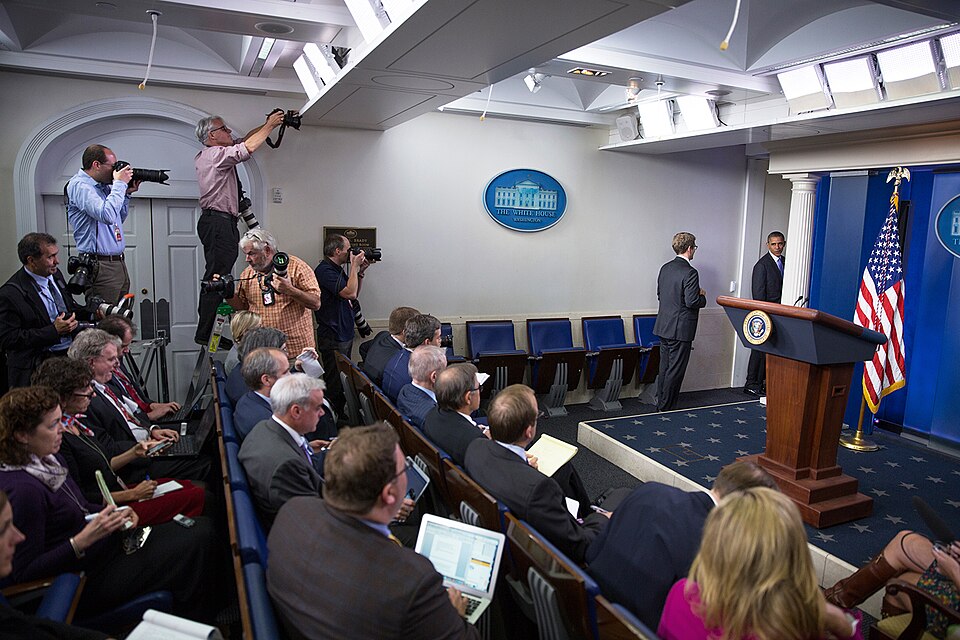
President Donald Trump has delivered another warning to the White House press corps, raising the possibility of a major change that could disrupt a decades-old Washington tradition.
The president suggested Saturday that reporters covering his administration could be moved from their longtime workspace inside the White House.
And while Trump dismissed reports about turning the historic press briefing room into a swimming pool, he made it clear that relocating journalists remains a possibility.
The latest development comes as tensions continue to grow between the Trump administration and several of the nation’s largest news organizations.
Trump Sends White House Reporters a Message
On October 24, Trump responded to reports suggesting he wanted to eliminate the James S. Brady Press Briefing Room and restore a swimming pool beneath the facility.
The president quickly rejected the swimming pool story.
But he left the door open to a different change that could have significant consequences for journalists assigned to cover the White House.
“I may move the Fake News to a less obnoxious location,” Trump wrote on Truth Social.
He also insisted that restoring the old swimming pool was never part of his plans.
Trump described that suggestion as something he had never seriously considered.
His comments appeared to settle the swimming pool controversy while keeping alive the possibility of moving reporters away from their familiar surroundings.
Historic White House Press Room Could Face Changes
The controversy centers on a room that has played an important role in presidential communications for generations.
The James S. Brady Press Briefing Room sits above a swimming pool originally installed during President Franklin D. Roosevelt’s administration.
Roosevelt used swimming as part of his physical therapy following the illness that left him paralyzed.
During Richard Nixon’s presidency, the pool was covered to provide additional space for journalists working inside the White House.
The area eventually became the briefing room Americans recognize today.
For decades, television viewers have watched presidential press secretaries stand behind its familiar podium and answer questions about administration policies.
Now, the future location of those briefings is being discussed once again.
According to reporting from CBS News and The New York Times, Trump has considered moving the press corps to another building within the White House complex.
The Eisenhower Executive Office Building, located near the West Wing, has previously been discussed as a possible alternative.
However, no final relocation decision has been announced.
White House Pushes Back Against Media Criticism
The potential changes are unfolding against a backdrop of disagreements between the administration and the national news media.
Trump has repeatedly criticized major news organizations, accusing them of unfair reporting and distorted coverage of his presidency.
White House Communications Director Steven Cheung has also defended the administration’s position.
Responding to earlier reports about possible changes to press facilities, Cheung accused some media organizations of relying on inaccurate information.
He indicated that the administration was considering its options and would announce any decision when appropriate.
The dispute goes beyond where reporters sit during daily briefings.
It also raises questions about who controls access to the president and how journalists should interact with an administration they cover.
White House officials maintain authority over many access arrangements, while journalists and press freedom advocates argue that restrictions must respect constitutional protections.
Trump and the National Media Remain at Odds
The latest discussion follows a series of confrontations involving the White House and prominent news organizations.
In September, the administration temporarily restricted White House access for journalists representing CNN, MS NOW, and Politico.
A federal judge subsequently ruled that the restrictions were likely unconstitutional and ordered access restored.
The administration has continued to challenge that decision.
The situation reflects a broader disagreement over the boundaries of presidential authority and the rights of journalists covering government officials.
Supporters of the administration’s approach argue that presidents should have flexibility in managing White House operations.
Critics contend that relocating the press corps could reduce journalists’ proximity to officials and make independent coverage more difficult.
Whether a change of location would actually affect access would depend on the details of any proposal.
A Major Change Could Be Coming to Washington
Moving the White House press corps would represent more than simply assigning reporters to different offices.
Journalists have maintained dedicated workspace inside the White House for more than a century, making their presence an established part of presidential operations.
The arrangement allows reporters to observe developments, attend briefings, and question officials about government decisions.
A relocation could alter those longstanding routines.
However, Trump has not explained exactly where reporters might be moved or when any change could take effect.
For now, the president has ruled out bringing back Roosevelt’s swimming pool while continuing to entertain the possibility of moving the journalists who currently occupy the space above it.
That distinction is important because the two proposals have sometimes been discussed together.
The swimming pool restoration is off the table, according to Trump.
The press corps relocation remains an open question.
Trump Leaves Reporters Facing Uncertainty
Trump’s latest remarks underscore the continuing friction between his administration and the Washington press establishment.
The president has made no secret of his dissatisfaction with coverage from several major media outlets.
Now, those disagreements could potentially result in a physical change to how journalists operate inside the White House.
Whether the administration follows through remains to be seen.
But one thing is certain: Trump has publicly raised the possibility of relocating the reporters who cover him, even as he rejects claims that he wants their briefing room turned back into a swimming pool.
For Washington’s press corps, the biggest question is no longer whether Roosevelt’s old swimming pool will return. It’s whether the reporters themselves will be allowed to remain where they are.