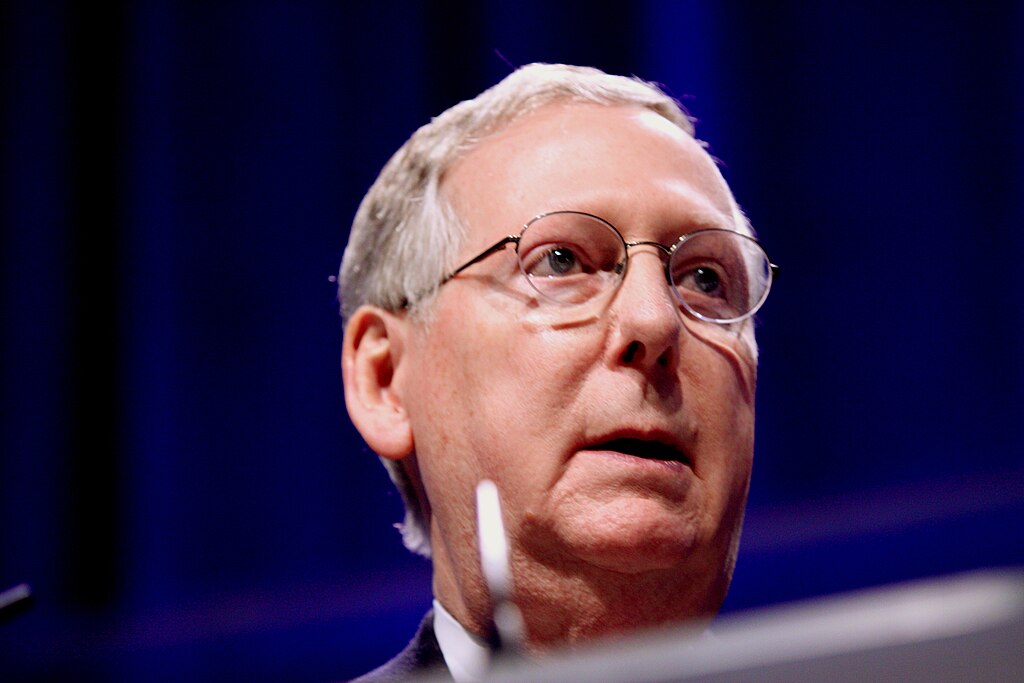
Supreme Court tariff ruling sparks clash between Mitch McConnell and President Trump over constitutional authority and economic policy
A major Supreme Court decision has reignited debate inside the Republican Party — and this time, it’s putting Senate veteran Mitch McConnell directly at odds with President Donald Trump.
In a 6–3 ruling, the Supreme Court struck down several tariffs imposed by the Trump administration under the International Emergency Economic Powers Act (IEEPA). The Court determined that the law did not give the executive branch broad authority to impose sweeping tariffs without congressional approval.
The decision marks a significant moment in the ongoing debate over presidential power, trade policy, and the Constitution.
McConnell: Congress Holds the Power on Trade
Following the ruling, Sen. Mitch McConnell emphasized what he described as a long-standing constitutional principle: Congress controls taxation and trade policy — not the White House.
“Today, the Supreme Court reaffirmed authority that has rested with Congress for centuries,” McConnell said in a public statement.
The Kentucky Republican has consistently warned against expanding executive power in trade matters. In October, he joined three other Republicans in backing a Senate resolution calling for the administration to repeal certain tariffs. That vote reflected growing concern from businesses and consumers facing rising costs.
Why Tariffs Matter to American Families
For many Americans — especially those nearing retirement or living on fixed incomes — trade policy isn’t just political theory. It affects everyday prices.
When tariffs are imposed, import costs often rise. Those increases can eventually reach:
- Grocery store shelves
- Auto dealerships
- Farm supply chains
- Consumer goods and home improvement materials
McConnell argued that broad trade battles — particularly with allied nations — often create unintended consequences.
“The American people already know that when Washington throws up artificial barriers, building and buying here at home become more expensive,” he said.
In Kentucky, industries like auto manufacturing, agriculture, and bourbon exports depend heavily on stable international markets. Tariff retaliation can directly impact those sectors.
A Constitutional Debate Inside the GOP
At the heart of this dispute is not just economics — but constitutional authority.
Under Article I of the U.S. Constitution, Congress is granted power over taxation and regulation of commerce. McConnell stressed that this authority cannot be bypassed simply for policy convenience.
“Congress’ role in trade policy… is not an inconvenience to avoid,” he stated. “If the executive would like to enact trade policies that impact American producers and consumers, its path forward is crystal clear: convince their representatives.”
This perspective reflects a long-running conservative debate about limited government and separation of powers.
Trump Pushes Back
President Trump responded strongly to the ruling, criticizing the conservative justices who joined the majority opinion. Speaking from the White House, he suggested his administration has alternative legal mechanisms to pursue tariffs if necessary.
However, he appeared less enthusiastic about working through Congress to advance new trade measures.
Supporters argue that tough trade action protects American jobs and manufacturing. Critics warn that bypassing Congress risks expanding executive authority beyond constitutional limits.
What This Means Going Forward
The Supreme Court’s decision does not eliminate the tariff debate. Instead, it shifts the focus back to Capitol Hill.
For American voters — particularly those concerned about:
- Inflation
- Retirement savings
- Manufacturing jobs
- Agricultural exports
- Small business stability
The key question now becomes: Should trade policy be driven by executive action or by congressional consensus?
This ruling ensures that, at least for now, Congress will have a larger role in answering that question.
The Bottom Line
The clash between McConnell and Trump highlights an important reality inside today’s Republican Party: there is strong agreement on protecting American interests — but debate over how to do it constitutionally.
As trade tensions continue to shape global markets, voters will be watching closely to see whether future policy emerges through executive action or through Congress.
Either way, the economic impact will be felt far beyond Washington.