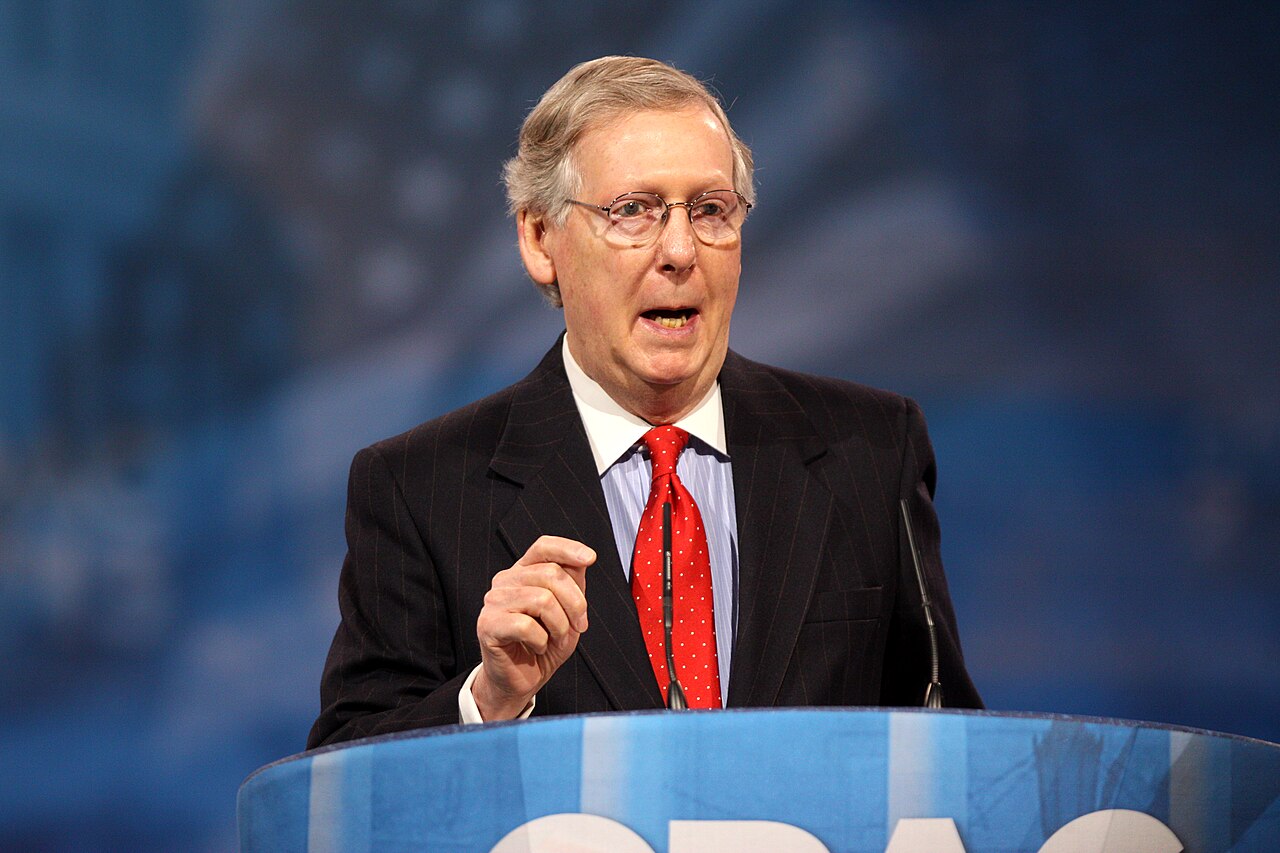
McConnell would do this.
A growing divide inside the Republican Party is taking center stage, as Senate Republican leader Mitch McConnell breaks with President Donald Trump and sides with Democrats on one of the biggest foreign policy issues facing the country today—NATO.
The disagreement highlights a larger battle between traditional Washington leadership and the rising America First movement that continues to reshape the GOP.
McConnell Aligns With Democrats on NATO
Senator Mitch McConnell (R-KY) joined Democrat Senator Chris Coons (D-DE) in defending the North Atlantic Treaty Organization (NATO), calling it a critical pillar of U.S. national security.
In a joint statement, the two lawmakers described NATO as:
“The most successful military alliance in history.”
They also emphasized that the alliance has supported American security interests for more than seven decades.
But for many conservative voters, this position raises serious questions about whether longtime Washington leaders are ignoring the changing realities of global politics.
Trump Challenges NATO’s Role
President Donald Trump has taken a very different stance, openly questioning whether NATO still benefits the United States.
In a recent interview, Trump suggested that withdrawing from NATO is now a real possibility—not just political rhetoric.
Trump has repeatedly argued that:
- The U.S. carries too much of the financial burden
- Many NATO countries fail to meet defense commitments
- America is often left to handle global threats alone
He has also criticized NATO allies for not supporting recent U.S. military efforts involving Iran, describing their response as weak and ineffective.
For supporters of Trump’s America First agenda, these concerns reflect a long-standing frustration: Why should American taxpayers continue to shoulder the cost of defending wealthy foreign nations?
Establishment vs. America First
McConnell’s position underscores a clear divide within the Republican Party.
On one side:
- Establishment Republicans who support traditional alliances and global engagement
On the other:
- America First conservatives who prioritize U.S. sovereignty, reduced foreign involvement, and stronger accountability from allies
McConnell and Coons argued that unity within NATO is essential, stating:
“Americans are safer when NATO is strong and united.”
Meanwhile, Democrat Senator Mark Warner also defended NATO, calling it the “cornerstone” of U.S. national security and warning against withdrawal.
Why This Debate Matters to Americans
This isn’t just a political disagreement in Washington—it directly impacts:
- U.S. military spending
- Foreign policy direction
- Taxpayer dollars
- America’s role on the world stage
For older Americans in particular, many of whom remember the Cold War and decades of global conflict, the question is increasingly relevant:
Is NATO still protecting America—or is America protecting NATO?
What Happens Next?
As President Trump continues to push for a reevaluation of long-standing alliances, clashes like this one with Mitch McConnell are likely to become more frequent.
The outcome could redefine:
- The future of the Republican Party
- U.S. foreign policy for decades
- America’s commitment to global alliances
One thing is certain: This debate is far from over—and voters will ultimately decide which vision leads the country forward.