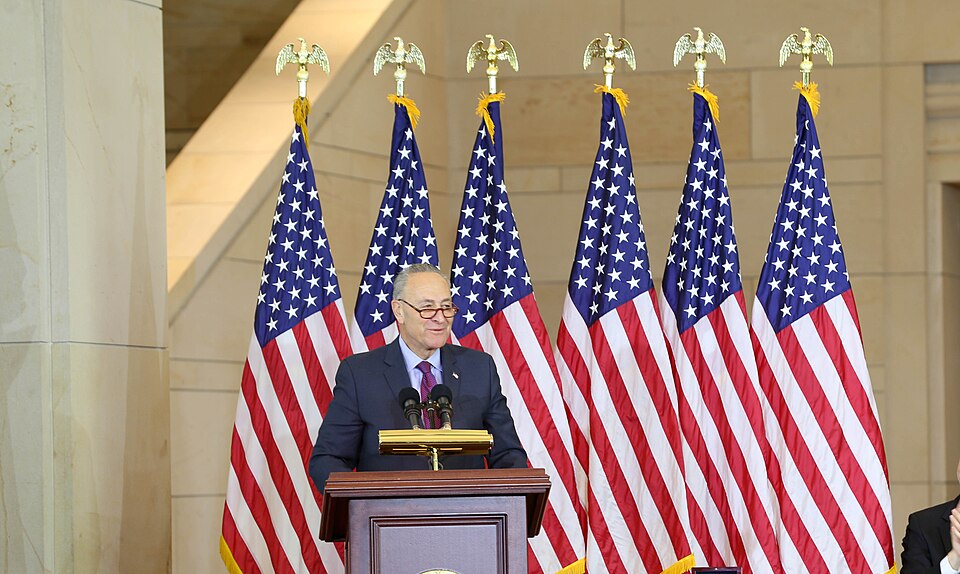
Schumer is piling onto a problem that Trump had nothing to do with.
President Donald Trump is facing another political confrontation in Washington after Senate Democratic Leader Chuck Schumer launched a sharp attack over a growing national security controversy involving one of America’s most powerful technology companies.
Schumer is demanding answers from the Trump administration following reports that Nvidia CEO Jensen Huang had a personal relationship with a woman suspected of having ties to Chinese intelligence.
The controversy has raised questions about foreign espionage, America’s advanced computer chip industry, and whether sensitive technology could have been exposed to China.
Trump, however, has defended Huang, setting up another dispute between the White House and Democratic leaders.
Schumer Goes After Trump Over Nvidia Controversy
Speaking on the Senate floor Tuesday, Schumer accused Trump of failing to take the allegations seriously enough.
The New York Democrat cited reports suggesting the president had previously been briefed about intelligence concerns involving Huang and a Chinese businesswoman.
According to those reports, American intelligence officials suspected that the woman, identified as Alice Huang, may have provided information to the Chinese government.
Schumer argued that the administration should have responded more aggressively to the potential security threat.
He also demanded that Congress receive a full explanation of what federal officials knew about the situation and how the administration handled the intelligence.
The senator’s comments added another political dimension to a controversy already attracting considerable attention from federal investigators and congressional lawmakers.
However, the allegations remain under investigation, and there has been no public determination that Trump knowingly allowed classified information to be compromised.
Trump Defends Nvidia CEO As Investigation Continues
Despite the controversy, Trump has publicly expressed confidence in Nvidia’s chief executive.
During remarks Monday, Trump said he had personally spoken with Huang about the allegations.
According to the president, Huang insisted that he did not know the woman was suspected of having connections to Chinese intelligence.
Trump indicated that he believed the executive’s explanation.
The president also acknowledged that the FBI was examining the matter, signaling that federal authorities were taking the allegations seriously.
Meanwhile, Nvidia’s independent directors have launched an investigation into the circumstances surrounding the controversy.
The company has maintained that it has no reason to believe sensitive corporate information or American national security secrets were compromised.
Those statements have not ended the political debate, particularly as lawmakers seek additional information about the company’s security practices.
China Espionage Concerns Raise Serious Questions
The controversy has attracted attention because Nvidia occupies a critical position in America’s technology industry.
The company produces advanced semiconductors used to power artificial intelligence systems, sophisticated computing networks, and other technologies with significant economic and national security implications.
Those products are increasingly important in the technological competition between the United States and China.
For years, American officials have warned that Beijing is attempting to acquire advanced technology that could strengthen its military and intelligence capabilities.
Washington has consequently imposed restrictions on certain high-performance computer chips that American companies can export to China.
The latest allegations have renewed concerns about whether those protections are strong enough.
Investigators and lawmakers are now examining whether the reported relationship involving Nvidia’s CEO created opportunities for foreign intelligence gathering.
The investigation has not publicly established that Huang knowingly assisted a foreign intelligence operation.
Republicans Also Demand Answers From Nvidia
Although Schumer has directed much of his criticism toward Trump, the national security concerns are not limited to Democrats.
Several prominent House Republicans have also demanded additional information from Nvidia.
House Foreign Affairs Committee Chairman Brian Mast, House Intelligence Committee Chairman Rick Crawford, and House China Committee Chairman John Moolenaar requested a closed-door briefing with Huang.
The Republican lawmakers want to examine Nvidia’s security procedures and determine whether the company took adequate precautions against potential foreign espionage.
Their request demonstrates that concerns about China’s access to advanced American technology extend across party lines.
Republicans have emphasized the importance of protecting American innovation and preventing foreign adversaries from obtaining strategically valuable technology.
Democrats have similarly pushed for stronger oversight of semiconductor exports.
While the two parties disagree over Trump’s handling of the controversy, protecting sensitive American technology remains a shared congressional concern.
Schumer Pushes For Tougher Restrictions On China
Schumer is also using the controversy to advocate additional restrictions on advanced computer chip exports.
The Democratic leader has urged Congress to advance legislation intended to limit China’s access to sophisticated American artificial intelligence technology.
Among the proposals are measures that would strengthen oversight of semiconductor exports, improve tracking of advanced chips, and increase accountability for companies operating internationally.
Schumer has additionally questioned Nvidia’s influence in Washington, pointing to the company’s reported $25 million contribution toward Trump’s White House ballroom project.
The senator suggested that lawmakers should examine whether the technology company’s relationship with the administration influenced decisions about export restrictions.
However, political criticism and financial contributions alone do not establish improper influence or illegal activity.
Any determination of wrongdoing would require additional evidence.
The broader debate could have substantial consequences for American technology businesses, which must navigate international competition while complying with national security restrictions.
What Happens Next For Trump And Nvidia?
The controversy now presents several challenges for the White House, Congress, and the technology industry.
Federal investigators are examining the suspected intelligence connections, while Nvidia’s independent investigation will review the company’s handling of the situation.
Congressional Republicans are seeking direct answers from Huang, and Schumer is pushing the administration to provide additional intelligence briefings.
The findings could influence future decisions about technology exports, corporate security requirements, and federal oversight of major American companies.
For Trump, the situation represents another political confrontation with Democratic leaders who are questioning his administration’s national security decisions.
For Congress, the more significant question is whether existing safeguards are sufficient to prevent foreign intelligence operations from threatening America’s technological advantages.
As the investigation continues, lawmakers from both parties will be watching closely for evidence about what occurred and whether sensitive information was compromised.
The central issue now is whether Washington can protect America’s advanced technology from foreign threats while ensuring that political accusations do not get ahead of the facts.