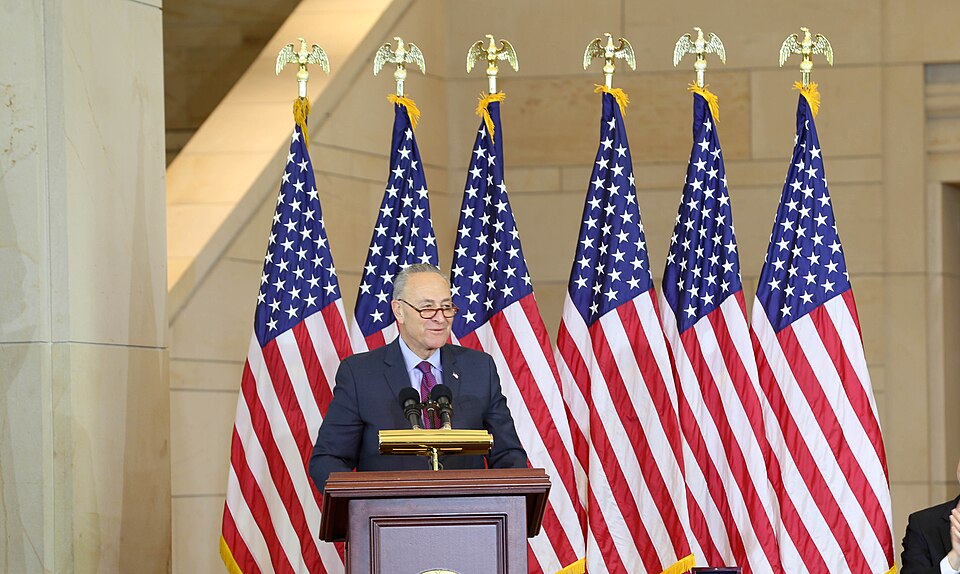
Schumer won’t get far trying to make President Trump angrier.
Senate Democratic Leader Chuck Schumer is taking aim at President Donald Trump after a federal judge delivered a significant legal setback to the White House, temporarily blocking millions of dollars in taxpayer-funded television advertisements promoting the president’s administration.
The ruling has sparked another confrontation between Trump and congressional Democrats, with Schumer celebrating the decision and demanding an investigation into how federal funds were used.
The controversy comes at a particularly sensitive time for Washington, with the November midterm elections approaching and both political parties fighting over government spending, executive authority, and accountability.
While Democrats are portraying the ruling as a victory, the Trump administration has defended its advertising campaign and argued that government-funded public messaging is not unusual.
Federal Judge Delivers Setback to Trump Administration
On Sunday, October 11, U.S. District Judge Jennifer Rochon issued a temporary restraining order directing the Trump administration to stop airing certain government-funded advertisements featuring President Trump.
The advertisements had been running on television since late September and were financed through approximately $20 million allocated to the Department of Homeland Security.
The commercials promoted Trump and his administration’s priorities, drawing criticism from opponents who argued that taxpayer dollars were being used for political purposes.
The lawsuit was brought by a coalition that included government watchdog organization Common Cause and other plaintiffs.
They maintained that the administration had crossed an important legal boundary by spending federal money on advertisements resembling political campaign messages.
Judge Rochon determined that the plaintiffs were likely to succeed on their legal claims and ordered the administration to cancel any remaining scheduled advertisements covered by the order.
The restriction lasts two weeks unless subsequently modified by the court.
The ruling is temporary and does not represent a final determination that President Trump or his administration violated federal law.
Schumer Celebrates Ruling and Takes Aim at Trump
Schumer wasted little time responding to the court’s decision.
The New York Democrat issued a statement welcoming the ruling while suggesting that additional scrutiny of the Trump administration could be coming.
“Taxpayer dollars are not Trump’s personal propaganda fund,” Schumer declared.
He also warned that stopping the advertisements was only the beginning of his efforts to examine the controversial spending.
Schumer demanded an accounting of the advertising campaign, including details about who authorized the expenditures, how much money was used, and whether federal officials should be held responsible.
The Democratic leader has also requested that relevant government records be preserved for further examination.
His response underscores the longstanding political rivalry between Schumer and Trump, who have repeatedly clashed over federal spending, immigration enforcement, congressional priorities, and presidential authority.
Schumer’s remarks make clear that Democrats intend to keep the controversy alive even after the court’s temporary order.
Trump Defends Government Advertising Campaign
Despite the legal challenge, Trump has defended the advertisements as a legitimate way to promote the United States and communicate his administration’s accomplishments.
The White House has argued that previous administrations have also used government resources to inform the public about federal policies and initiatives.
However, critics maintain that the disputed advertisements went beyond ordinary public information campaigns by prominently featuring political messaging associated with Trump.
Some commercials reportedly included material similar to advertisements used during Trump’s previous presidential campaign.
The controversy eventually prompted Trump to indicate that future advertisements could be financed through his political fundraising operation rather than federal funds.
That would represent an important distinction because political organizations and government agencies operate under different rules governing advertising expenditures.
Nevertheless, the question of what happens to the taxpayer money already spent remains unresolved.
According to the Associated Press, approximately $12 million in federal funds had already been spent on the advertisements as of earlier reporting, and the administration had not committed to reimbursing the government.
Even Republicans Raise Questions About Taxpayer Spending
Although Democrats have been the most vocal critics of the advertising campaign, concerns about the use of government funds have not been limited to one political party.
Senate Majority Leader John Thune, a Republican from South Dakota, previously expressed opposition to financing the advertisements with taxpayer money.
His criticism highlighted a distinction between supporting the president’s policy agenda and agreeing with the methods used to promote it.
The controversy also raises questions about where federal agencies should draw the line between informing Americans about government programs and advocating for political leaders.
Federal administrations routinely advertise public health initiatives, military recruitment, emergency preparedness, and other government services.
But laws governing federal appropriations restrict certain forms of unauthorized publicity and propaganda.
Determining whether the Trump administration’s advertisements violated those restrictions is now part of the legal dispute.
The distinction matters because the outcome could influence how future administrations communicate their policies using public money.
Why This Court Battle Matters for American Taxpayers
The dispute involves more than television commercials and political disagreements.
At its center is the question of who controls federal spending and how taxpayer money may legally be used.
Congress authorizes federal spending for designated government purposes, while executive agencies are responsible for carrying out programs within applicable legal requirements.
When disagreements arise over how those funds are being used, courts may be asked to determine whether the executive branch has exceeded its authority.
In this case, the plaintiffs argue that the advertising campaign improperly used government resources to advance political messaging ahead of the midterm elections.
The administration maintains that the commercials were a permissible form of public communication.
The court will ultimately need to address those competing arguments through further proceedings.
For Americans concerned about federal spending, the larger issue is whether government agencies are following the rules established for public funds, regardless of which political party controls Washington.
Midterm Elections Add Another Layer to the Controversy
The timing of the court ruling has also attracted attention.
The November 3 midterm elections are approaching, with Republicans seeking to maintain their congressional majorities and Democrats hoping to regain political ground.
The advertisements began airing during the final stretch of the campaign season, when political messaging can influence voter awareness and public debate.
That timing became a central concern for the plaintiffs, who argued that the commercials effectively promoted Trump’s political agenda using federal resources.
Trump and his supporters, meanwhile, maintain that the administration has a legitimate interest in communicating its achievements and priorities.
The dispute gives Democrats another issue to raise in the closing weeks of the election campaign.
It also presents Republicans with questions about government spending at a time when fiscal responsibility remains an important part of the party’s policy agenda.
Whether the controversy ultimately affects voters is uncertain, but it has already resulted in substantial legal and political attention.
What Happens Next for Trump and Schumer?
The legal fight is far from finished.
Judge Rochon’s temporary restraining order blocks further activity covered by the ruling while the court considers the underlying challenge.
A hearing is scheduled for October 13 to address the next phase of the proceedings.
The administration could continue defending the legality of its actions, while the plaintiffs may seek longer-lasting restrictions.
Separate litigation over the advertisements has also been filed by the Democratic National Committee, creating another potential legal challenge for the White House.
Schumer has made clear that he wants the controversy investigated beyond the immediate decision to stop the commercials.
For Trump, the court ruling represents an unwelcome setback as his administration continues defending its priorities and spending decisions.
However, the president remains free to promote his administration’s policies through lawful means, including appropriately financed political advertising.
For now, Schumer is celebrating a courtroom victory against his longtime political rival, but the larger questions surrounding federal spending, presidential authority, and government advertising remain unsettled.
The coming court proceedings could determine whether the dispute results in further restrictions or becomes another chapter in the continuing political battles between President Trump and congressional Democrats.