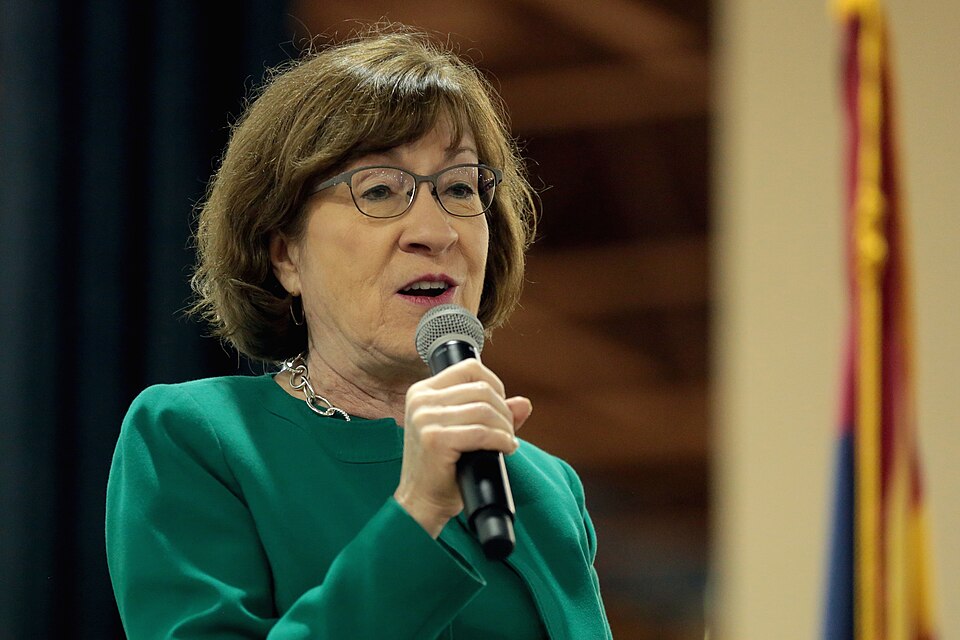
Sen. Susan Collins is breaking with President Donald Trump on two major issues as the Maine Republican fights to keep her seat in one of the most closely watched Senate races of the 2026 midterm elections.
Collins has come out against Trump’s new 50% tariffs on certain Canadian goods while also opposing proposed changes affecting mail-in voting.
The disagreement puts the longtime Republican at odds with the Trump administration at a critical moment for the GOP, which is fighting to maintain its narrow Senate majority.
Collins Opposes Trump’s New Canada Tariffs
One of the biggest disagreements centers on Trump’s trade policy toward Canada.
Collins said she believes imposing additional tariffs on America’s northern neighbor is the wrong move, particularly for Maine.
“I still think imposing new tariffs on Canada is a mistake,” Collins said.
Maine shares a long border with Canada, and businesses on both sides depend heavily on cross-border commerce. Industries including agriculture, forestry and seafood could be affected by escalating trade tensions.
The Trump administration has defended tougher trade policies as a way to protect American workers and businesses from unfair foreign competition.
Vice President JD Vance made that argument during his Monday appearance in Maine, accusing Canada of taking advantage of American producers and calling for greater fairness in trade.
But Collins isn’t convinced that higher tariffs are the answer.
Her opposition is notable because Trump has made tariffs and tougher international trade negotiations central parts of his economic agenda.
Collins Breaks With Trump on Mail-In Voting
The Maine senator is also opposing proposed U.S. Postal Service rules connected to Trump’s efforts to tighten requirements surrounding mail-in ballots.
The proposal could restrict the handling of absentee ballots in states that do not provide certain voter-roll information to federal authorities.
Trump and his allies have argued that stronger safeguards are necessary to increase confidence in America’s elections.
Collins, however, is concerned about how additional restrictions could affect Maine residents — particularly older voters who rely on absentee ballots.
“Mail-in ballots are very important to the people of Maine,” Collins said. “I do not support restrictions that make it more difficult for seniors to cast votes on Election Day via the mail.”
Her opposition comes as election security and mail-in voting once again emerge as major political issues ahead of the November midterms.
Collins Supports Some Election Security Measures
Despite opposing the proposed mail-ballot restrictions, Collins has supported other Republican election-integrity proposals.
She supports the House version of the SAVE America Act, which would require documentary proof of U.S. citizenship to register to vote and photo identification in federal elections.
But Collins joined three other Republicans and Senate Democrats in voting against advancing the Senate version of the legislation, dealing another setback to a proposal strongly supported by Trump.
The competing positions illustrate Collins’ longstanding effort to portray herself as an independent Republican rather than a guaranteed vote for either party.
Collins Skips Vance’s Maine Appearance
The political tension received additional attention Monday when Collins did not appear with Vice President JD Vance during his visit to Maine.
Vance spoke at Compotech, a defense technology manufacturer in Brewer.
Collins said her absence was caused by a scheduling conflict.
“I am already scheduled on Monday, so I will not be able to join the vice president,” she told reporters ahead of the event.
It marked the second time this year that Vance traveled to Maine without Collins appearing alongside him.
During Vance’s May visit to Bangor, Collins remained in Washington while the Senate was in session.
The senator has an extraordinary attendance record, having cast more than 10,000 consecutive Senate roll-call votes during her decades in Washington.
Collins also noted that she recently appeared with Energy Secretary Chris Wright when he visited a federally funded battery-storage project in Lincoln, Maine.
Vance Still Backs Collins
Despite Collins’ disagreements with the White House, Vance made clear Monday that Republicans still want her to win.
The vice president called Collins his “dear friend” and praised her willingness to fight for Maine even when that creates disagreements within the Republican Party.
Vance has previously acknowledged that Collins can frustrate fellow Republicans because of her independent streak.
“Sometimes I get frustrated with Susan Collins,” Vance said during an earlier Maine appearance.
But Vance has argued that Collins’ political independence makes her a good fit for a state where Republicans must compete for independent and Democratic voters.
That distinction could prove extremely important in November.
Collins Has Broken With Trump Before
This is hardly the first time Collins has opposed Trump.
She was one of the Republican senators who voted to convict Trump during his second impeachment trial in 2021 following the Jan. 6 Capitol riot.
Collins has also criticized parts of the Trump administration’s aggressive immigration enforcement and deportation agenda.
Those positions have occasionally angered conservatives who believe Republican senators should do more to support Trump’s agenda.
At the same time, Collins represents a politically difficult state for Republicans.
Maine backed then-Vice President Kamala Harris in the 2024 presidential election, making Collins the only Republican senator seeking re-election this year in a state Harris carried.
That gives Collins a political incentive to demonstrate independence from Trump while still maintaining enough support among Republican voters to keep the GOP coalition together.
Democrats Try to Tie Collins to Trump
Democrats are pursuing the opposite strategy.
Former Maine Senate President Troy Jackson, Collins’ Democratic challenger, has repeatedly attempted to connect her to Trump and the Republican administration.
Jackson has criticized Collins over immigration enforcement and her previous support for federal funding involving Immigration and Customs Enforcement.
Ahead of Vance’s latest visit, Jackson also attacked the relationship between Collins and the vice president.
The strategy highlights the unusual position Collins finds herself in.
Some conservatives criticize her for opposing Trump, while Democrats argue that she has supported the Republican agenda too often.
Collins must convince voters that she remains independent enough for Maine without losing the Republican base she needs to win another term.
Maine Senate Race Could Decide Control of Washington
The stakes go well beyond Collins’ political future.
Her race is among a small number of contests that could determine whether Republicans maintain control of the Senate.
Losing the chamber would make it significantly harder for Trump to advance legislation and secure confirmation of administration officials and federal judges during the remainder of his presidency.
Maine’s 2nd Congressional District is also shaping up as an important battleground.
Former Republican Gov. Paul LePage joined Vance at Monday’s event and is running for the House seat being vacated by Democratic Rep. Jared Golden.
Republicans view the rural district as a major pickup opportunity in their battle for control of Congress.
For Trump and the GOP, that means Maine could have an outsized influence on the balance of power in Washington.
And for Collins, the challenge is becoming increasingly clear: convince Maine voters that she is willing to stand up to her own party while persuading Republicans that keeping her in the Senate is essential to protecting Trump’s agenda.