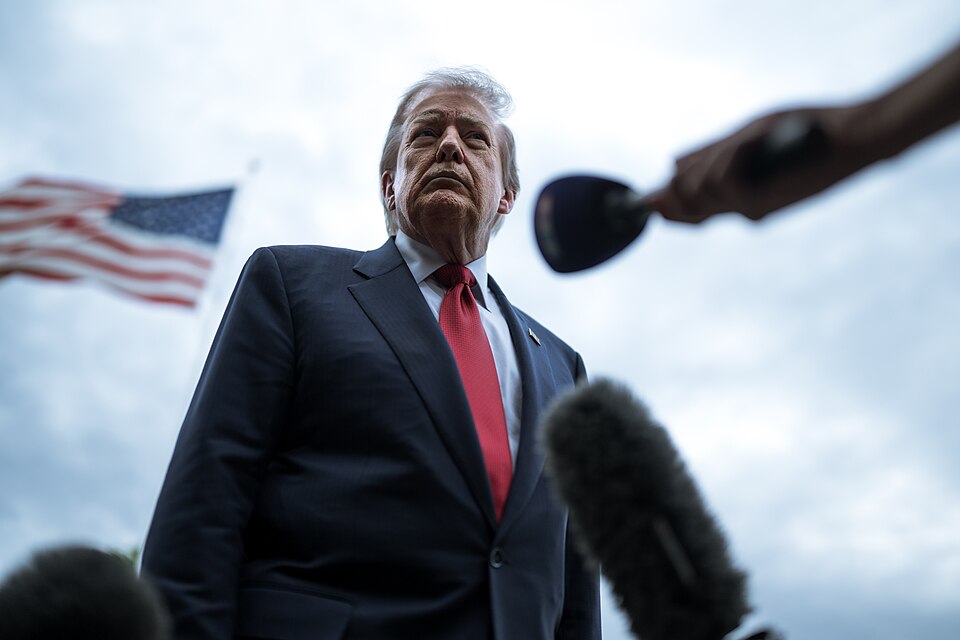
President Donald Trump is offering a surprisingly friendly assessment of one of Washington’s most prominent Democrats as Republicans face a high-stakes battle for control of Congress in the 2026 midterm elections.
Trump said he believes he could potentially work with House Minority Leader Hakeem Jeffries if Democrats capture the House of Representatives in November and Jeffries becomes the next speaker.
The comments are notable considering the long-running political feud between the two men.
During an interview with Punchbowl News, Trump was asked directly whether he could conduct business with Jeffries under a Democratic-controlled House.
Trump responded that he would “probably” get along with the New York Democrat “very well.”
The president went even further, describing Jeffries as a “nice guy” while recalling a previous White House meeting between the two political rivals.
Trump said the meeting went well, suggesting that despite their heated public disagreements, the relationship behind closed doors may be considerably less hostile.
That does not mean Trump is endorsing Jeffries for speaker. The president remains firmly aligned with Republicans as the GOP fights to maintain control of the House.
But Trump’s remarks provide a revealing glimpse at how he could approach Washington if voters hand Democrats control of one chamber of Congress.
Trump And Jeffries Have A History Of Political Combat
Anyone who has followed Washington politics knows Trump and Jeffries have hardly been political allies.
The two men have repeatedly traded personal and political attacks.
Trump has previously criticized Jeffries in unusually harsh terms, while Jeffries has responded with attacks of his own. At one point, the Democratic leader accused Trump of having what he called “Jeffries derangement syndrome,” borrowing from the phrase commonly used by Trump supporters to describe intense opposition to the president.
When Punchbowl News brought up Jeffries’ previous attacks, Trump appeared relatively unconcerned.
The president suggested Jeffries has been tough on him because Trump has been equally tough on the Democratic leader.
That response could indicate Trump views at least some of their public conflict as part of the political battle rather than an obstacle that would make future negotiations impossible.
For voters, the more important question is what a Jeffries-led House would mean for the Trump administration.
Democrats Are Fighting To Take Back The House
Control of the House of Representatives is shaping up to be one of the biggest political battles of the 2026 midterm elections.
Republicans want to maintain their congressional majority and continue advancing Trump’s second-term agenda. Democrats see November as an opportunity to regain power in Washington and place a major check on the White House.
Recent national polling has given Democrats some encouraging numbers.
A CNN poll released last week found Democrats holding an 8-point advantage over Republicans on the generic congressional ballot.
The Decision Desk HQ polling average has also shown Democrats ahead nationally, with an advantage of slightly more than 6 percentage points.
Those figures could create concern for Republicans, but generic congressional polling does not determine who controls the House.
Americans do not vote on one nationwide congressional ballot. Instead, hundreds of individual House races will determine which party holds the majority.
That means competitive districts in battleground areas could ultimately decide whether Republicans keep control or Jeffries gets an opportunity to become speaker.
What’s At Stake For Trump?
The consequences could extend far beyond which party controls the speaker’s gavel.
Congress plays an enormous role in determining the direction of federal policy, including government spending, taxes, immigration, energy, defense and economic legislation.
A Republican-controlled Congress would generally provide Trump with a clearer path for pursuing his administration’s priorities.
A Democratic House could make that considerably more difficult.
Democratic control would give Jeffries and his party significant influence over which bills advance through the House. Democrats would also gain control of powerful committees, giving them greater authority to conduct investigations and challenge administration policies.
That could produce two very different political realities for the second half of Trump’s term.
With Republicans in control, the White House could focus on working with GOP lawmakers to advance legislation on issues important to conservative voters.
With Democrats in charge of the House, Trump could instead find himself negotiating with Jeffries over government funding, federal spending and other legislation while simultaneously battling Democratic opposition to his broader agenda.
That possibility makes Trump’s latest comments particularly significant.
Economy And Immigration Could Shape November
For many Americans, however, the midterm elections will likely come down to issues much closer to home.
The economy, cost of living, taxes, immigration, border security, energy prices, public safety and national security remain major concerns for voters.
Republicans are expected to argue that maintaining GOP control of Congress is necessary to give Trump the votes needed to continue implementing his agenda.
Democrats will make the opposite argument, asking voters to give them control of the House as a counterweight to the administration.
Older Americans could have an especially important voice in that decision.
Voters age 50 and older traditionally make up a significant portion of the electorate, and issues involving inflation, retirement security, Medicare, Social Security, taxes and household expenses can play an important role in determining how they vote.
Republicans therefore have considerable incentive to keep the election focused on pocketbook issues and the direction of the country.
Could Trump Really Work With Speaker Jeffries?
Washington has seen divided government many times before.
Presidents routinely find themselves negotiating with congressional leaders from the opposing party, even after bitter election campaigns and years of political attacks.
Trump’s latest remarks suggest he believes he could do the same with Jeffries.
Personal cooperation, however, would not eliminate their major political differences.
The Trump administration and House Democrats remain divided on numerous questions involving immigration, federal spending, taxes, regulation and the proper role of government.
Even if Trump and Jeffries maintained a workable personal relationship, negotiations between a Republican White House and Democratic House could still become contentious.
There would also be enormous pressure from both parties’ voters to avoid giving too much ground to the opposition.
Republicans Face A High-Stakes Midterm Battle
Trump’s comments therefore carry an interesting message.
The president is not backing Jeffries for speaker. Instead, he appears to be acknowledging the political reality that he may have to deal with the Democratic leader if Republicans lose control of the House.
Whether that happens will be decided by voters in November.
For Republicans, maintaining control of Congress could determine how much of Trump’s agenda can realistically move through Washington during the remainder of his term.
For Democrats, winning the House would provide an opportunity to block Republican legislation, pursue their own priorities and dramatically increase congressional scrutiny of the administration.
National polling currently suggests Democrats have momentum on the generic ballot, but individual congressional races will ultimately determine the outcome.
That leaves Republicans with months to make their case on the economy, immigration, taxes, national security and the direction of the country.
And despite years of political warfare between Trump and Jeffries, the president is already signaling that if voters produce divided government, he believes he can sit across the negotiating table from one of his fiercest Democratic opponents and make a deal.
For conservative voters, the bigger question may not be whether Trump can work with Jeffries.
It may be whether Republicans can win enough races in November to make sure he never has to.